Quranic Answer
The Holy Quran, in its profound wisdom, frequently highlights the boundless mercy of Allah and the indispensable path to forgiveness through sincere repentance. While the Quran does not provide a direct, tangible sign that allows an individual to know with absolute certainty that a specific sin has been forgiven, it meticulously guides believers on the precise manner of seeking forgiveness and instills an unwavering hope in Allah's infinite mercy. The fundamental principle underpinning this spiritual journey is what the Quran refers to as “Tawbah Nasuhah” – sincere, complete, and unwavering repentance. This concept is not merely about verbal regret but encompasses a holistic internal and external transformation. Allah, in His ultimate benevolence and compassion, repeatedly extends an invitation to His servants to return to Him, promising comprehensive forgiveness for all sins to those who genuinely repent. This divine promise in itself serves as an immense source of solace and forms the cornerstone of a believer's hope. A prime example of this divine assurance is found in Surah Az-Zumar (39:53), where Allah proclaims: “Say, 'O My servants who have transgressed against themselves [by sinning], do not despair of the mercy of Allah. Indeed, Allah forgives all sins. Indeed, it is He who is the Forgiving, the Merciful.'” This verse stands as a powerful testament to Allah's readiness to forgive, irrespective of the gravity or multiplicity of sins, provided that a sincere turning back to Him takes place. The very act of seeking forgiveness with a truthful heart is a profound act of worship and obedience, and Allah, being the Most Just and Most Merciful, will undoubtedly respond to such earnest supplications. So, the pertinent question arises: how does one ascertain if their repentance has been accepted and their sin consequently forgiven? The Quran, rather than offering a direct, miraculous manifestation or a simplistic checklist, directs believers towards the qualities inherent in true repentance and the discernible spiritual transformations that ensue. When an individual engages in genuine repentance, they experience a deep and pervasive regret for their past transgression. This regret transcends superficial sorrow; it is a profound, heart-wrenching remorse born from an acute awareness of having displeased their Omnipotent Creator. Concurrent with this profound regret is the development of a firm resolve and an unyielding commitment never to revert to that particular sin. This resolute internal determination is a critical indicator of the sincerity of one's repentance. As elucidated in Surah At-Tahrim (66:8), “O you who have believed, repent to Allah with sincere repentance. Perhaps your Lord will remove from you your misdeeds and admit you into Gardens beneath which rivers flow...” The use of the word “perhaps” here should not be misconstrued as an indication of divine uncertainty; rather, it underscores the servant's necessary humility and absolute dependence on Allah's sublime will, while simultaneously affirming the very high probability of divine acceptance for a sincere endeavor. The very capacity to embark upon such sincere repentance is, in itself, a monumental grace from Allah, guiding the servant back onto the path of righteousness and proximity to Him. Furthermore, a compelling sign of accepted repentance frequently manifests itself in a person's subsequent conduct and their internal spiritual state. Following a period of genuine repentance, an individual often experiences a profound sense of inner peace, tranquility, and a feeling of spiritual lightness, akin to being relieved of an oppressive burden. This profound peace is a spiritual recompense bestowed by Allah upon those whose hearts have been cleansed and purified through their sincere turning back to Him. This inner serenity is not merely a transient psychological relief but a deeply rooted spiritual state of contentment that emanates from the profound realization of having earnestly sought forgiveness from the All-For-giving. Moreover, the individual typically develops a far stronger aversion to the very sin they repented from, coupled with a significantly greater inclination towards performing virtuous deeds. Their commitment to adhering to Allah's divine commands solidifies, and they become notably more diligent in their acts of worship. For instance, they might find themselves meticulously punctual in their daily prayers, remarkably more generous in their charitable giving, or exceedingly more mindful of their speech and actions, striving to embody prophetic virtues. This heightened piety, coupled with a tangible and positive shift in behavior – moving from a state of disobedience towards one of devoted obedience – serves as a powerful indication that the repentance has genuinely taken root and has been embraced by divine mercy. The Quran also emphatically clarifies that if a sin involved infringing upon the rights of other human beings (e.g., acts of theft, defamation, or any form of injustice), mere repentance directed solely towards Allah is insufficient for complete absolution. The individual is morally and spiritually obligated to exert earnest effort to make amends with the wronged party, to fully restore their usurped rights, or to earnestly seek their sincere forgiveness. This aspect is critically important for the completeness of repentance, as consistently highlighted by the overarching principles of justice and equity interwoven throughout the entire Quranic narrative. Only after conscientiously fulfilling the rights of others, in conjunction with a sincere and heartfelt turning to Allah, can one harbor the legitimate hope for comprehensive divine forgiveness. Allah is the Embodiment of Justice and Mercy, and He never overlooks the legitimate rights of His creation. Consequently, the active rectification of wrongs perpetrated against others constitutes a pivotal component of sincere repentance and serves as an undeniable sign of one's profound commitment to genuine righteousness. Ultimately, the “knowledge” of forgiveness is not predicated upon receiving an audible divine pronouncement or a spectacular, tangible sign from the heavens. Rather, it is intrinsically linked to the conscientious fulfillment of the conditions of sincere repentance with an unwavering conviction, fostering a deep-seated faith in Allah's unequivocal promise, and attentively observing the positive spiritual and behavioral transformations within one's own being. The palpable feeling of enhanced faith, the newfound ease in performing virtuous deeds, a resolute aversion to past transgressions, and an overall sense of profound spiritual upliftment are often divine endowments from Allah, powerfully indicating that one's sincere turning back has been accepted. It is a perpetual spiritual odyssey of self-refinement and an unceasing quest for Allah's profound pleasure, where each sincere act of repentance gracefully opens a new gateway to divine mercy. The believer is perpetually encouraged to sustain an unwavering hope and absolute trust in Allah's infinite compassion, recognizing that He is “At-Tawwab” (The Acceptor of Repentance) and “Al-Ghafoor” (The Oft-Forgiving). Therefore, the comprehensive answer to “how to know” fundamentally resides in the absolute sincerity of one's repentance, the subsequent and observable positive transformation in character and conduct, and the unwavering faith in Allah's sacred promise to mercifully forgive those who earnestly and truthfully seek His pardon. This continuous spiritual endeavor and persistent growth are the ultimate and most profound signs of a heart that has truly and wholeheartedly turned back to its Lord.
Related Verses
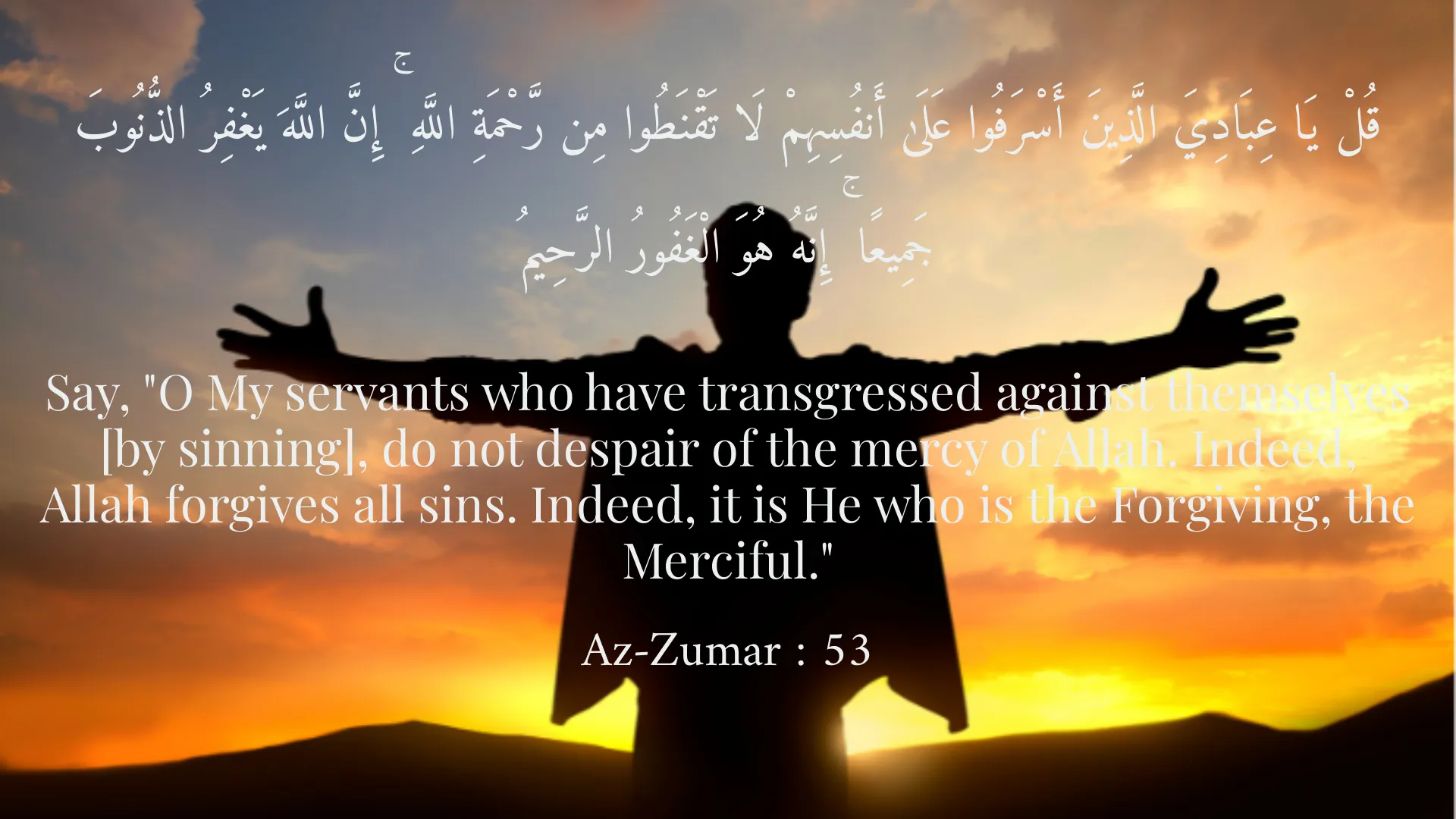
قُلْ يَا عِبَادِيَ الَّذِينَ أَسْرَفُوا عَلَىٰ أَنفُسِهِمْ لَا تَقْنَطُوا مِن رَّحْمَةِ اللَّهِ ۚ إِنَّ اللَّهَ يَغْفِرُ الذُّنُوبَ جَمِيعًا ۚ إِنَّهُ هُوَ الْغَفُورُ الرَّحِيمُ
Say, "O My servants who have transgressed against themselves [by sinning], do not despair of the mercy of Allah. Indeed, Allah forgives all sins. Indeed, it is He who is the Forgiving, the Merciful."
Az-Zumar : 53
يَا أَيُّهَا الَّذِينَ آمَنُوا تُوبُوا إِلَى اللَّهِ تَوْبَةً نَّصُوحًا عَسَىٰ رَبُّكُمْ أَن يُكَفِّرَ عَنكُمْ سَيِّئَاتِكُمْ وَيُدْخِلَكُمْ جَنَّاتٍ تَجْرِي مِن تَحْتِهَا الْأَنْهَارُ يَوْمَ لَا يُخْزِي اللَّهُ النَّبِيَّ وَالَّذِينَ آمَنُوا مَعَهُ ۖ نُورُهُمْ يَسْعَىٰ بَيْنَ أَيْدِيهِمْ وَبِأَيْمَانِهِمْ يَقُولُونَ رَبَّنَا أَتْمِمْ لَنَا نُورَنَا وَاغْفِرْ لَنَا ۖ إِنَّكَ عَلَىٰ كُلِّ شَيْءٍ قَدِيرٌ
O you who have believed, repent to Allah with sincere repentance. Perhaps your Lord will remove from you your misdeeds and admit you into Gardens beneath which rivers flow [on] the Day when Allah will not disgrace the Prophet and those who believed with him. Their light will proceed before them and on their right; they will say, "Our Lord, perfect for us our light and forgive us. Indeed, You are over all things competent."
At-Tahrim : 8
وَمَن يَعْمَلْ سُوءًا أَوْ يَظْلِمْ نَفْسَهُ ثُمَّ يَسْتَغْفِرِ اللَّهَ يَجِدِ اللَّهَ غَفُورًا رَّحِيمًا
And whoever does a wrong or wrongs himself but then seeks forgiveness of Allah will find Allah Forgiving and Merciful.
An-Nisa : 110
Short Story
One of the eloquent tales of Sa'di, the sweet-tongued, goes like this: There was a man who had spent his life in error and heedlessness, and his heart was heavy with the burden of sins. He would regret his past deeds at night and live with a heavy heart by day. One day, he approached a wise and sagacious elder, and with a heart full of remorse, he asked: "O wise one, how can I know that my sins have been forgiven and my heart has been purified? No matter how much I pray and seek forgiveness, I still feel anxious." The elder, with a warm and friendly smile, replied: "My dear friend, the signs of forgiveness emerge from within you. When your repentance is sincere, and your regret springs from the depths of your soul, not only your tongue but your entire being will abandon sin. Then you will find your heart at peace, as if a heavy burden has been lifted from your shoulders. You will notice that your desire for good deeds becomes stronger, and you will feel an aversion to anything that carries the scent of sin. This inner peace, this inclination towards purity and goodness, and this turning away from evil, are themselves the best signs that the door of Divine Mercy has been opened for you, and Allah has looked upon your repentance with favor. Place your trust in His generosity, for He is the Most Forgiving, the Most Merciful." From that day forward, the man began a new life with a calm heart and firm resolve, and every day he found himself on the path of purity and goodness. This newfound state of well-being assured him that his repentance had been accepted.