Quranic Answer
Envy, known as 'Hasad' in Islamic texts, is one of the most destructive diseases of the heart and soul, capable of robbing a person of inner peace and distancing them from closeness to God. While the Holy Quran does not provide a direct 'step-by-step guide' for purifying oneself from envy, its profound teachings, deep concepts, and ethical principles offer a comprehensive path to cleanse the heart from this vice and achieve divine tranquility and contentment. To purify one's inner self from envy, one must address its roots by strengthening faith, practicing gratitude, and changing one's perspective to achieve complete healing. One of the most crucial ways to combat envy is to seek refuge in Allah. Surah Al-Falaq (113) explicitly teaches us to seek refuge with Allah from the evil of the 'envier.' Verse 5 of this Surah states: "And from the evil of the envier when he envies." This seeking of refuge is not merely a verbal recitation; it must be done with one's entire being and with firm conviction in Allah's absolute power to protect an individual from external harms and internal afflictions, including the evil of envy itself and its effects. When a person seeks refuge in God, they are, in essence, admitting their weakness and helplessness against this destructive emotion and seeking aid from the infinite power of the Divine to overcome it. A correct understanding of the concept of 'Rizq' (sustenance) and Divine wisdom in distributing blessings is another key to freeing oneself from envy. The Quran teaches us that all blessings and provisions come from Allah, and it is He, in His wisdom, who distributes them among His servants. Verse 32 of Surah An-Nisa states: "And do not wish for that by which Allah has made some of you exceed others. For men is a share of what they have earned, and for women is a share of what they have earned. And ask Allah of His bounty. Indeed, Allah is ever, of all things, Knowing." This verse clearly indicates that we should not wish for what others possess or harbor envy; rather, we should ask Allah for His bounty for ourselves. When a person reaches this deep conviction that every blessing bestowed upon another is according to Divine wisdom and decree, and that there is no injustice in it, their heart is purified from the desire for others' possessions, and they become content and grateful for what they have. Consistent gratitude (Shukr) is one of the most potent antidotes to envy. The Quran emphasizes the importance of gratitude in numerous verses. Surah Ibrahim, verse 7, says: "If you are grateful, I will surely increase you [in favor]; but if you deny, indeed, My punishment is severe." When an individual focuses on their own possessions, however small, and is thankful to Allah for them, their perspective shifts from deficiencies and what they lack to the abundance and blessings they possess. This change in perspective provides an opportunity for growth and flourishing, filling the place of envy with contentment and peace. Gratitude opens a door to increased divine blessings and cleanses the heart from the impurities of envy. Focusing on self-improvement and competing in good deeds (Musara'ah fil Khayrat) instead of comparing oneself to others is another Quranic approach. The Quran encourages believers to hasten towards good deeds and righteous actions, not in acquiring worldly wealth or status. This positive competition compels individuals to look inward and strive to improve their spiritual and moral condition, leaving no room for envy of others' possessions. When a person sets their goal as gaining Allah's pleasure and elevating their own soul, worldly comparisons become insignificant, and envy, which often stems from misguided comparisons, dissipates. Frequent supplication (Du'a) to Allah for the purification of the heart plays a vital role. The Quran teaches us that true believers are those who pray for themselves and for their believing brethren, asking Allah not to place any malice or envy in their hearts towards other believers. Verse 10 of Surah Al-Hashr states: "And those who came after them say, 'Our Lord, forgive us and our brothers who preceded us in faith and put not in our hearts [any] resentment toward those who have believed. Our Lord, indeed You are Kind and Merciful.'" This supplication demonstrates the importance of having a pure heart free from any rancor or malice, including envy, towards other believers. Persistent supplication of this kind gradually cleanses the heart from the stains of envy. Finally, the constant reminder of the transient nature of this world and the impermanence of its blessings significantly helps reduce envy. The Quran repeatedly emphasizes that the life of this world is but play and amusement, and the true abode is the Hereafter. When a person realizes that what others possess is temporary and perishable, and that the real measure of success is gaining Allah's pleasure and the blessings of the Hereafter, envy for others' worldly possessions fades. This afterlife-centric view guides one towards contentment and satisfaction, freeing them from the internal suffering and torment caused by envy. Remember that purifying the heart from envy is a continuous spiritual journey that requires self-awareness, contemplation, and reliance on Allah. By adhering to these Quranic principles, one can achieve profound peace and possess a heart full of love and goodness for oneself and for others.
Related Verses
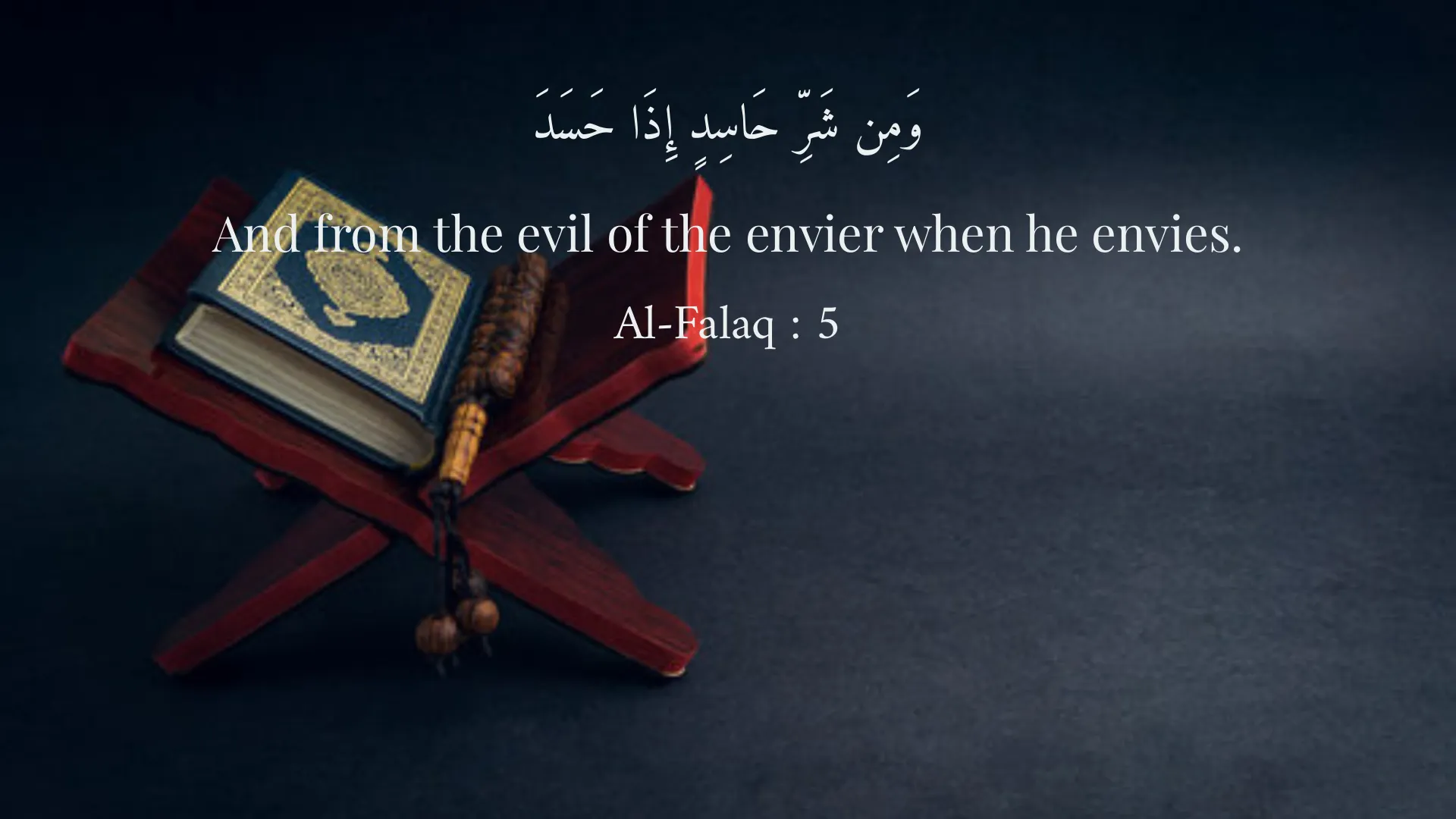
وَمِن شَرِّ حَاسِدٍ إِذَا حَسَدَ
And from the evil of the envier when he envies.
Al-Falaq : 5
وَلَا تَتَمَنَّوْا مَا فَضَّلَ اللَّهُ بِهِ بَعْضَكُمْ عَلَىٰ بَعْضٍ ۚ لِّلرِّجَالِ نَصِيبٌ مِّمَّا اكْتَسَبُوا ۖ وَلِلنِّسَاءِ نَصِيبٌ مِّمَّا اكْتَسَبْنَ ۚ وَاسْأَلُوا اللَّهَ مِن فَضْلِهِ ۗ إِنَّ اللَّهَ كَانَ بِكُلِّ شَيْءٍ عَلِيمًا
And do not wish for that by which Allah has made some of you exceed others. For men is a share of what they have earned, and for women is a share of what they have earned. And ask Allah of His bounty. Indeed, Allah is ever, of all things, Knowing.
An-Nisa : 32
وَالَّذِينَ جَاءُوا مِن بَعْدِهِمْ يَقُولُونَ رَبَّنَا اغْفِرْ لَنَا وَلِإِخْوَانِنَا الَّذِينَ سَبَقُونَا بِالْإِيمَانِ وَلَا تَجْعَلْ فِي قُلُوبِنَا غِلًّا لِّلَّذِينَ آمَنُوا رَبَّنَا إِنَّكَ رَءُوفٌ رَّحِيمٌ
And those who came after them say, 'Our Lord, forgive us and our brothers who preceded us in faith and put not in our hearts [any] resentment toward those who have believed. Our Lord, indeed You are Kind and Merciful.'
Al-Hashr : 10
Short Story
In Saadi's Gulistan, it is narrated that a pious man lived with a tranquil heart, free from worldly attachments. One day, a king asked him, "How is it that I, with all this wealth and power, am constantly preoccupied, while you, with your poverty, are so at peace?" The pious man replied, "O King, you are constantly worried about losing what you have, and more importantly, you suffer from what others possess and you do not. But I do not cast my eyes upon worldly possessions; what I have suffices me, and I do not envy what I lack. Truly, peace belongs to the one whose heart is pure from avarice and envy, and who is content with their own sustenance." This tale teaches us that envy only ignites fire within the envier, robbing them of peace, while contentment and submission to divine decree enlighten and soothe the heart.