Quranic Answer
The Holy Quran, as the divine guide for humanity, addresses the concept of forgiveness with unparalleled breadth and depth, presenting it not only as a sublime attribute of Allah but also as an invaluable and vital characteristic for believers. Indeed, within the Quranic value system, forgiveness forms a crucial pillar that strengthens one's relationship with the Almighty and reinforces the foundations of peace and harmonious coexistence within society. The Quran teaches us that forgiveness is a power and an ability inherent in God, and He continuously invites His servants towards this profound virtue. This concept holds such paramount importance in the Quran that various Arabic terms like "Ghufran," "'Afw," "Safh," and "Maghfira" are used to explain its diverse dimensions, each carrying subtle nuances of pardoning, overlooking, and wiping away sins. One of the most prominent manifestations of the power of forgiveness in the Quran is its embodiment in the essence of Allah Almighty. God describes Himself as "Al-Ghaffar" (The All-Forgiving), "Al-Ghafur" (The Oft-Forgiving), "Ar-Rahim" (The Most Merciful), and "At-Tawwab" (The Acceptor of Repentance). These divine attributes signify that Allah's mercy and forgiveness are boundless, and no sin—however grave—is too great to be pardoned if sincere repentance and a genuine turning back to Him are made. The Quran repeatedly calls believers to seek forgiveness (Istighfar) and repentance (Tawbah), keeping these doors perpetually open for His servants. For instance, in Surah Az-Zumar, verse 53, Allah says: "Say, 'O My servants who have transgressed against themselves [by committing sins]! Do not despair of the mercy of Allah. Indeed, Allah forgives all sins. Indeed, it is He who is the Forgiving, the Merciful.'" This verse not only opens a door of hope for sinners but also assures them that returning to Allah will always be met with His open arms. The power of divine forgiveness is so vast that even those who have committed major errors throughout their lives can be forgiven and granted mercy, provided they show genuine remorse and a firm resolve to reform. This divine pardon offers individuals a fresh start, a renewed path to a pure life, liberating them from despair and hopelessness and instilling confidence that a path to betterment always exists. Beyond divine forgiveness, the Quran strongly emphasizes the virtue of mutual forgiveness among human beings. This teaching is not merely a moral recommendation but a practical strategy for establishing a healthy and dynamic society. The Quran implores believers to be patient, tolerant, and forgiving in their interactions with one another, even when they have been wronged or oppressed. Surah An-Nur, verse 22, provides a striking example in this regard. Following the incident of "Ifk" (the slander against the Prophet's wife), those who had sworn not to provide for their needy relatives who were involved in the false accusation are addressed: "And let them pardon and overlook. Would you not like that Allah should forgive you? And Allah is Forgiving and Merciful." This verse clearly links the forgiveness of people towards each other with the expectation of forgiveness from Allah. If we wish Allah to overlook our shortcomings and sins, we must also be willing to overlook the faults of others. This reciprocal nature of forgiveness is a cornerstone of Islamic ethics, fostering a community built on compassion rather than retribution, thereby strengthening social bonds and promoting harmony. Forgiveness, from a Quranic perspective, is not a sign of weakness but rather an embodiment of strength, resolve, and steadfastness. Surah Ash-Shura, verse 43, states: "But whoever is patient and forgives, indeed, that is of the matters [requiring] determination." This verse reminds us that waiving one's right, especially in situations where retaliation is possible, requires strong will and a disciplined soul. This act signifies an individual's mastery over anger and grudges, which are considered among the greatest moral challenges. A person capable of forgiveness is liberated from the spiritual chains of revenge, achieving inner peace. This demonstrates true courage, as it is often harder to forgive than to retaliate, requiring immense self-control and a higher spiritual vision that prioritizes long-term peace over immediate gratification of anger. In practical and social terms, the power of forgiveness in the Quran is presented as a mechanism for conflict resolution and relationship restoration. Grudges and revenge lead to an endless cycle of hostility and harm, whereas forgiveness can break this cycle and pave the way for reconciliation and healing. The Quran, in numerous instances, recommends pardon and leniency in financial, familial, and social matters. This teaching not only prevents larger conflicts but also enhances trust and solidarity within the community. Prophet Muhammad (peace be upon him) himself was a prime example of this power of forgiveness; the conquest of Mecca and the general pardon granted to the Quraish disbelievers stand as a brilliant illustration of the power of forgiveness at the peak of capability, which led countless hearts to embrace Islam and showcased its transformative impact on individuals and society. Therefore, the Quran teaches us that forgiveness is not merely a spiritual value but a practical necessity that transforms individual and social life. This forgiveness is first bestowed upon us by Allah, and then we are asked to cultivate this divine attribute within ourselves and apply it in our interactions with others. By forgiving others, we are, in essence, doing ourselves a favor, as we lift the heavy burden of resentment, hatred, and sorrow from our shoulders, opening the path for spiritual tranquility and moral growth. This divine doctrine liberates humans from the captivity of the past and its bitterness, presenting bright horizons of hope and reconciliation. The Quran asks us to be forgiving so that we, in turn, may benefit from the boundless ocean of divine forgiveness and ultimately attain a worthy station with our Lord. This is the essence of Quranic teachings on the power of forgiveness—a power that manifests in the Lordship and is also required from believers to embody, so that a world full of mercy and peace may be established and a community built on love and concord can flourish.
Related Verses
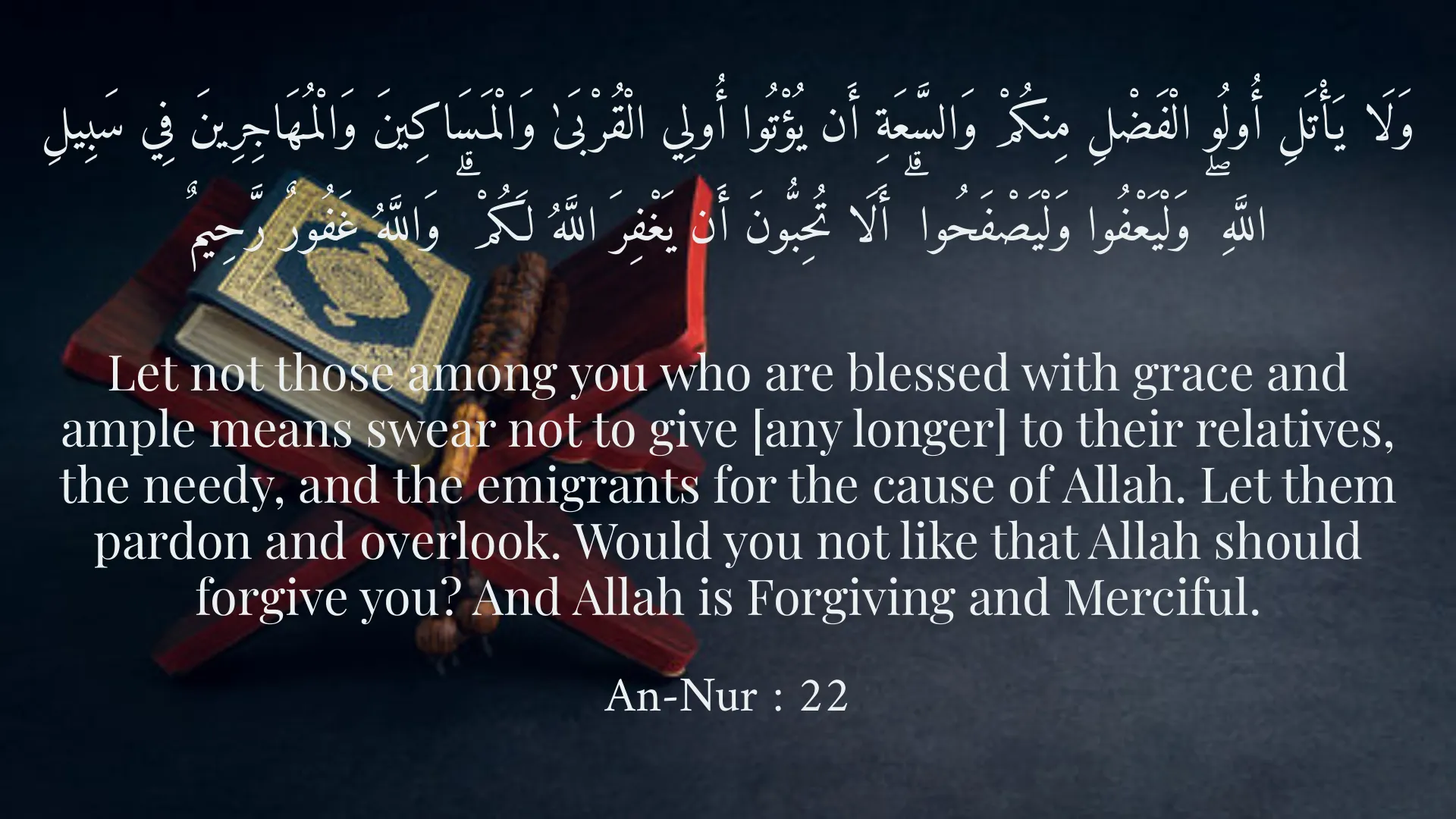
وَلَا يَأْتَلِ أُولُو الْفَضْلِ مِنكُمْ وَالسَّعَةِ أَن يُؤْتُوا أُولِي الْقُرْبَىٰ وَالْمَسَاكِينَ وَالْمُهَاجِرِينَ فِي سَبِيلِ اللَّهِ ۖ وَلْيَعْفُوا وَلْيَصْفَحُوا ۗ أَلَا تُحِبُّونَ أَن يَغْفِرَ اللَّهُ لَكُمْ ۗ وَاللَّهُ غَفُورٌ رَّحِيمٌ
Let not those among you who are blessed with grace and ample means swear not to give [any longer] to their relatives, the needy, and the emigrants for the cause of Allah. Let them pardon and overlook. Would you not like that Allah should forgive you? And Allah is Forgiving and Merciful.
An-Nur : 22
الَّذِينَ يُنفِقُونَ فِي السَّرَّاءِ وَالضَّرَّاءِ وَالْكَاظِمِينَ الْغَيْظَ وَالْعَافِينَ عَنِ النَّاسِ ۗ وَاللَّهُ يُحِبُّ الْمُحْسِنِينَ
Who spend [in the cause of Allah] during ease and hardship and who restrain anger and who pardon the people - and Allah loves the doers of good.
Al-Imran : 134
وَلَمَن صَبَرَ وَغَفَرَ إِنَّ ذَٰلِكَ لَمِنْ عَزْمِ الْأُمُورِ
But whoever is patient and forgives, indeed, that is of the matters [requiring] determination.
Ash-Shura : 43
Short Story
It is narrated that in ancient times, two merchants lived in a city. One of them, named Mansour, suffered great harm from the other, named Sadiq, due to an old grudge. Mansour's companions urged him to exact revenge from Sadiq and punish him by any means possible for his actions. However, Mansour, whose heart yearned for true understanding, paused for a moment and pondered whether causing Sadiq further distress and getting entangled in the endless cycle of revenge would yield anything but bitterness and turmoil. He recalled the teachings of the wise and the word of truth that says: 'Forgiveness is when one has the power to avenge.' So, with a confident heart and a liberated spirit, instead of shouting at Sadiq or dragging him to court, he forgave him and let go of his right. His companions, astonished, asked: 'Why did you do this, after all the injustice you suffered?' Mansour replied with a calm smile: 'His harm diminished my worldly possessions, but forgiving him bestowed upon my heart the treasure of peace and tranquility, freeing me from the heavy burden of resentment. Do not think that forgiveness is weakness; it is, in fact, one of the greatest acts of courage and the fount of inner peace.' And so it was that Mansour, through his forgiveness, not only found peace for his own heart but Sadiq also repented of his deeds and embarked on a path of reform, and their long-standing friendship was rekindled. This indeed showed that sometimes, forgiveness sows the seeds of friendship and goodness, where hatred and revenge bring only destruction.