Quranic Answer
In today's complex and information-saturated world, the human mind is inherently prone to errors and biases that can profoundly influence our judgments, decisions, and even our perception of reality. These cognitive biases are unconscious patterns of thought that often lead us toward incorrect or unfair conclusions. However, within the rich teachings of the Holy Quran, profound and fundamental solutions are presented for identifying, confronting, and mitigating the effects of these biases. The Quran not only teaches us how we should think but also helps us to purify our hearts and minds, moving towards a clearer and more just insight. These solutions are evident in various domains of thought, judgment, and social interactions. One of the most crucial principles the Quran puts forth to combat cognitive biases is its emphasis on seeking truth and avoiding conjecture or mere assumption. Many biases, such as confirmation bias (the tendency to seek out and interpret information in a way that confirms one's existing beliefs), stem from an unwillingness to confront truth or an over-reliance on baseless assumptions. The Holy Quran explicitly instructs us to avoid following that of which we have no sure knowledge. In Surah Al-Isra, verse 36, Allah states: “And do not pursue that of which you have no knowledge. Indeed, the hearing, the sight, and the heart – all of those will be questioned.” This verse is a clear invitation to critical inquiry, thoughtful consideration, and a rejection of reliance on rumors or unverified information. Furthermore, in Surah Al-Hujurat, verse 6, the Quran stresses the necessity of verifying news: “O you who have believed, if there comes to you a disobedient one with information, investigate, lest you harm a people out of ignorance and then become regretful for what you have done.” This command to 'tabayyan' (investigate and clarify the truth) directly counters biases that lead to hasty and erroneous judgments. Another principle the Quran offers for overcoming biases is adherence to justice and fairness, even if it is against oneself or one's close relatives. Self-serving bias (the tendency to attribute successes to one's own abilities and failures to external factors) and in-group bias (favoring one's own group) are examples of such biases. The Quran, in Surah An-Nisa, verse 135, declares: “O you who have believed, be persistently maintainers of justice, witnesses for Allah, even if it be against yourselves or your parents and relatives. Whether one is rich or poor, Allah is more worthy of both. So follow not [personal] inclination, lest you deviate. And if you distort [your testimony] or turn away, then indeed Allah is ever, with what you do, Acquainted.” This verse forms the cornerstone of a just and impartial mindset, teaching individuals not to sacrifice truth and justice for personal or collective interests, nor to yield to personal desires. This approach actively combats biases rooted in personal or group inclinations. Encouraging reflection, deliberation, and insight (Tadabbur and Tafakkur) is yet another Quranic strategy. The Quran repeatedly invites humanity to ponder over divine signs, the creation of the heavens and the earth, and within themselves. This call for deep contemplation counters biases like hasty generalization and reliance on superficial information (availability heuristic). A mindful and insightful mind is less likely to fall into the trap of inaccurate generalizations or over-reliance on the first readily available information. In Surah Az-Zumar, verse 18, the Holy Quran states: “Those who listen to the Word and follow the best of it – those are the ones Allah has guided, and those are the people of understanding.” This verse teaches us to listen to all sayings with an open mind, weigh them, and choose the best and most correct among them. This approach is a powerful antidote to confirmation bias and anchoring bias, where an individual gives undue weight to the first piece of information received. Avoiding arrogance and pride, and cultivating humility and self-criticism, are also among the Quranic teachings that help combat biases. Overconfidence bias, which causes individuals to overestimate their abilities and pay less attention to their mistakes, contradicts the spirit of humility and acceptance of fallibility that the Quran encourages. A believer learns to always seek refuge in Allah and ask for His guidance, for true knowledge and wisdom belong to Him. This humility protects them from arrogance and pride, which are the source of many cognitive biases. Furthermore, the Quran promotes intellectual honesty and critical thinking by repeatedly urging its readers to observe, reflect, and seek knowledge. It challenges blind imitation (taqlid) and encourages independent reasoning (ijtihad within its framework) where appropriate. For example, the Quran criticizes those who simply follow the ways of their forefathers without reflection (e.g., Surah Al-Baqarah, 2:170). This direct challenge to traditional authority, when not based on truth, is a powerful guard against biases like the bandwagon effect or appeal to tradition, where beliefs are accepted merely because they are widely held or have been practiced for a long time. The Quran champions a faith based on conviction and understanding, not on inherited dogma alone. In essence, the Holy Quran, by providing a comprehensive intellectual framework built upon truth-seeking, justice, deep contemplation, avoiding whims, and humility, assists humanity in breaking free from the snares of cognitive biases. This divine book not only teaches the right way of life but also, by nurturing moral and spiritual virtues, prepares the mind and soul for more accurate understanding and fairer judgment. By adhering to these principles, believers can attain a clearer insight that guides them on the path of truth and righteousness, protecting them from intellectual and practical pitfalls. This Quranic approach is not merely a therapeutic method for mental errors but a holistic way of life that leads individuals toward intellectual and moral perfection, fostering a mind that is robust, unbiased, and aligned with divine wisdom.
Related Verses
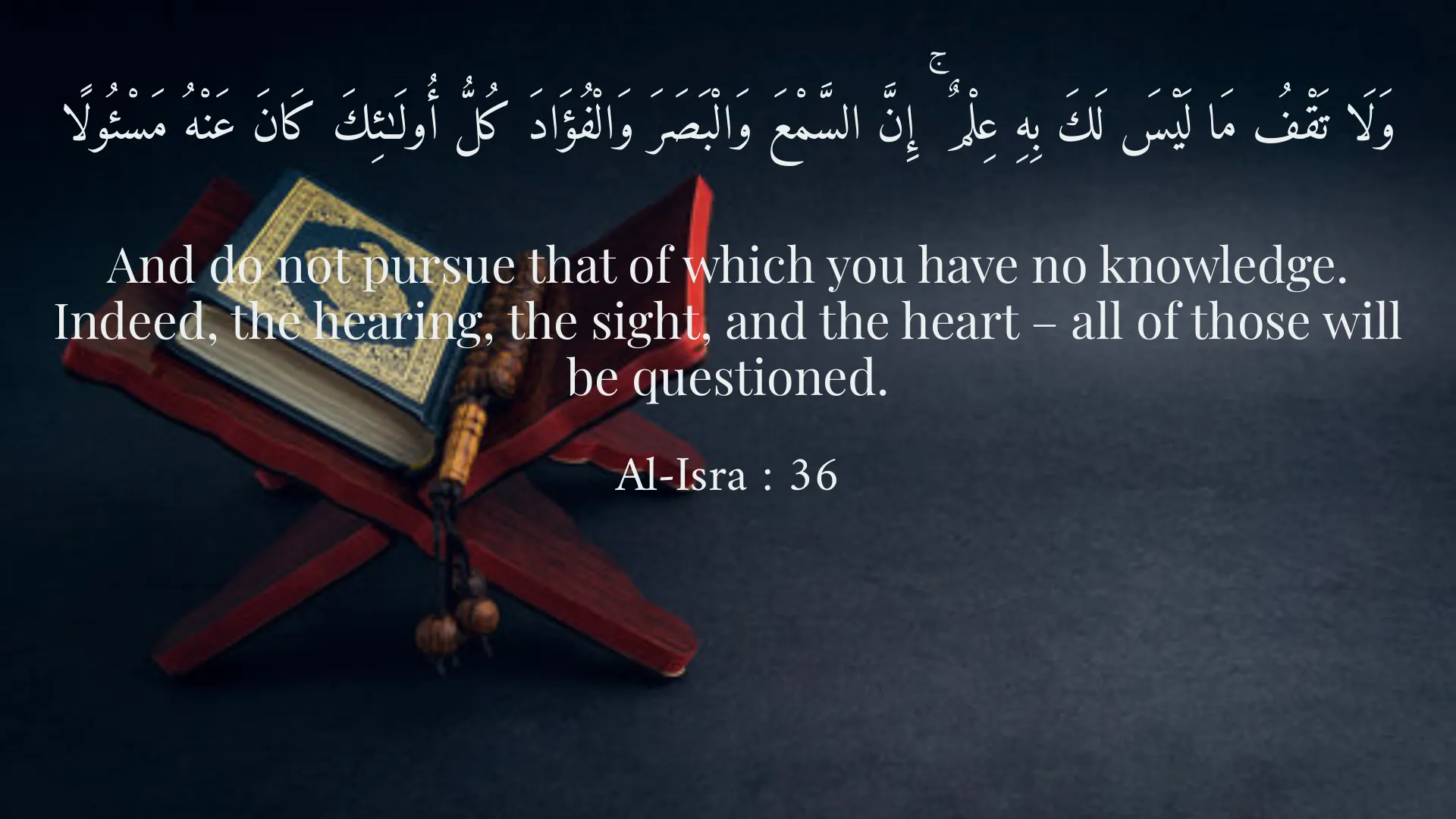
وَلَا تَقْفُ مَا لَيْسَ لَكَ بِهِ عِلْمٌ ۚ إِنَّ السَّمْعَ وَالْبَصَرَ وَالْفُؤَادَ كُلُّ أُولَٰئِكَ كَانَ عَنْهُ مَسْئُولًا
And do not pursue that of which you have no knowledge. Indeed, the hearing, the sight, and the heart – all of those will be questioned.
Al-Isra : 36
يَا أَيُّهَا الَّذِينَ آمَنُوا كُونُوا قَوَّامِينَ بِالْقِسْطِ شُهَدَاءَ لِلَّهِ وَلَوْ عَلَىٰ أَنفُسِكُمْ أَوِ الْوَالِدَيْنِ وَالْأَقْرَبِينَ ۚ إِن يَكُنْ غَنِيًّا أَوْ فَقِيرًا فَاللَّهُ أَوْلَىٰ بِهِمَا ۖ فَلَا تَتَّبِعُوا الْهَوَىٰ أَن تَعْدِلُوا ۚ وَإِن تَلْوُوا أَوْ تُعْرِضُوا فَإِنَّ اللَّهَ كَانَ بِمَا تَعْمَلُونَ خَبِيرًا
O you who have believed, be persistently maintainers of justice, witnesses for Allah, even if it be against yourselves or your parents and relatives. Whether one is rich or poor, Allah is more worthy of both. So follow not [personal] inclination, lest you deviate. And if you distort [your testimony] or turn away, then indeed Allah is ever, with what you do, Acquainted.
An-Nisa : 135
يَا أَيُّهَا الَّذِينَ آمَنُوا إِن جَاءَكُمْ فَاسِقٌ بِنَبَإٍ فَتَبَيَّنُوا أَن تُصِيبُوا قَوْمًا بِجَهَالَةٍ فَتُصْبِحُوا عَلَىٰ مَا فَعَلْتُمْ نَادِمِينَ
O you who have believed, if there comes to you a disobedient one with information, investigate, lest you harm a people out of ignorance and then become regretful for what you have done.
Al-Hujurat : 6
Short Story
In ancient times, there lived a merchant named Fereydoun, who was swift in trade and very quick in judging goods. However, sometimes haste and assumptions led him astray. One day, two men came to him to arbitrate over the price of an item. The first man asked Fereydoun to rule in his favor and presented arguments that seemed very convincing to Fereydoun. Fereydoun was inwardly ready to make a judgment when he suddenly recalled a piece of advice from Sa'di's Gulistan: 'Whoever does not listen to speech but hears mere talk, will suffer and sleep in disgrace.' He collected himself and thought, 'How can I judge without fully hearing the other person's side?' So he asked the second man to present his arguments as well. The second man, with patience and composure, revealed facts that made Fereydoun realize his error. He, who was close to making an unjust ruling due to the bias of first impressions, by following the principle of complete listening and avoiding hasty judgment, rendered justice. From that day on, Fereydoun never made a judgment without thorough examination and hearing all sides, and thus, his reputation for justice and insight spread throughout all cities, and he was known as a wise merchant.