Quranic Answer
The Holy Quran, with its profound wisdom, consistently and from various angles, calls humanity to deeply reflect on the reality of death. This invitation is not meant to instill fear or despair, but rather to enlighten and guide life. In the Quran's view, death is not an absolute end, but a gateway to eternity and an inseparable part of life's journey. This call to ponder mortality serves multiple crucial purposes: to awaken the heedless, to provide a correct perspective on worldly life, and to prepare individuals for their ultimate return to God. Firstly, the Quran establishes death as an inevitable and universal truth. Numerous verses explicitly state that "Every soul will taste death" (Al-Imran 3:185, An-Nisa 4:78). This constant reminder breaks through human denial and the tendency to live as if life on earth is unending. By presenting death as a certainty that awaits all, regardless of status, wealth, or power, the Quran urges individuals to confront this reality and integrate it into their understanding of existence. The aim is not to induce despair, but to create a sense of urgency and responsibility. If death is certain, then the life preceding it – which is a limited opportunity – gains immense value for spiritual growth and good deeds. The verses emphasize that no one can escape death, even in fortified towers, highlighting the limits of human power and ingenuity in the face of Divine decree. This perspective compels humans to invest in what is lasting and beneficial for the afterlife, rather than being attached to the fleeting allure of worldly possessions. Secondly, the Quran frames death within the context of life's purpose and accountability. Surah Al-Mulk (67:2) clearly states that Allah "created death and life to test you as to which of you is best in deed." This verse profoundly links death to the existential meaning of creation. It implies that life is a temporary arena for striving, a period of trial during which one's actions, intentions, and character are observed and evaluated. Death, in this sense, marks the point where this test concludes, leading to an accountability for deeds. Reflection on this connection compels believers to re-evaluate their priorities, favoring actions that will benefit them in the hereafter over transient worldly gains. This perspective strengthens the awareness of God's perpetual presence and the reality of the Day of Judgment, encouraging a life imbued with piety, justice, and compassion. By remembering death, individuals utilize life's opportunities more effectively, performing deeds that ultimately secure their well-being. Thirdly, the Quran portrays death as a transition, not an annihilation, leading to the afterlife (Akhirah). It speaks of the intermediate realm (Barzakh) and the eventual resurrection on the Day of Judgment. By depicting the afterlife in vivid detail – both the rewards of Paradise and the punishments of Hell – the Quran motivates individuals to prepare for their eternal abode. These detailed descriptions serve as powerful incentives for righteous living and deterrents from sin. When a person contemplates the eternal consequences of their temporal actions, their perspective shifts dramatically. Worldly attachments diminish, and spiritual aspirations grow. The Quran often uses the analogy of parched earth coming alive with rain to illustrate the ease with which God will resurrect humanity, thereby solidifying the belief in resurrection and ultimate accountability. This continuous reminder safeguards humans from heedlessness and excessive engrossment in worldly affairs, directing them towards perfection and divine knowledge. Furthermore, the Quran invites reflection on death by narrating stories of past nations and individuals. Many surahs recount the rise and fall of civilizations, the demise of tyrants, and the fate of those who rejected divine guidance. These historical accounts serve as powerful cautionary tales, demonstrating that worldly power, wealth, and status are temporary and ultimately crumble before the inevitability of death and divine justice. By learning from the experiences of those who came before, humanity is encouraged to avoid their mistakes and to remember that their own time on earth is finite. This historical perspective reinforces the transient nature of worldly existence and the enduring reality of the hereafter. These stories are instructive, reminding humans of their mortality and that everyone's ultimate destiny is a return to God. Finally, the Quran encourages observing the cycles of life and death in nature. It frequently points to the phenomena of growth, decay, and regeneration in the natural world – how seeds sprout from dead earth, how dry land becomes green after rain, how night gives way to day. These natural processes are presented as signs (Ayat) of God's power over life and death, and as metaphors for resurrection. By contemplating these cycles, the human mind is led to acknowledge the Creator's omnipotence and the possibility of life after death, thereby fostering a deeper faith and a more profound reflection on their own mortality and eventual return. In essence, the Quran's invitation to reflect on death is a comprehensive spiritual exercise. Its purpose is not morbid fascination, but the cultivation of a living awareness that shapes one's character, decisions, and overall life trajectory. This reflection transforms death from a feared unknown into a meaningful contemplation that imbues life with purpose, urgency, and a profound connection to the Divine. It guides individuals towards leading a purposeful life, oriented towards God and their eternal destiny, ensuring that every moment is lived with mindfulness and a sense of accountability. It serves as a constant reminder that this life is a journey, and death is merely a pivotal point on that journey, leading to the ultimate destination of eternal life.
Related Verses
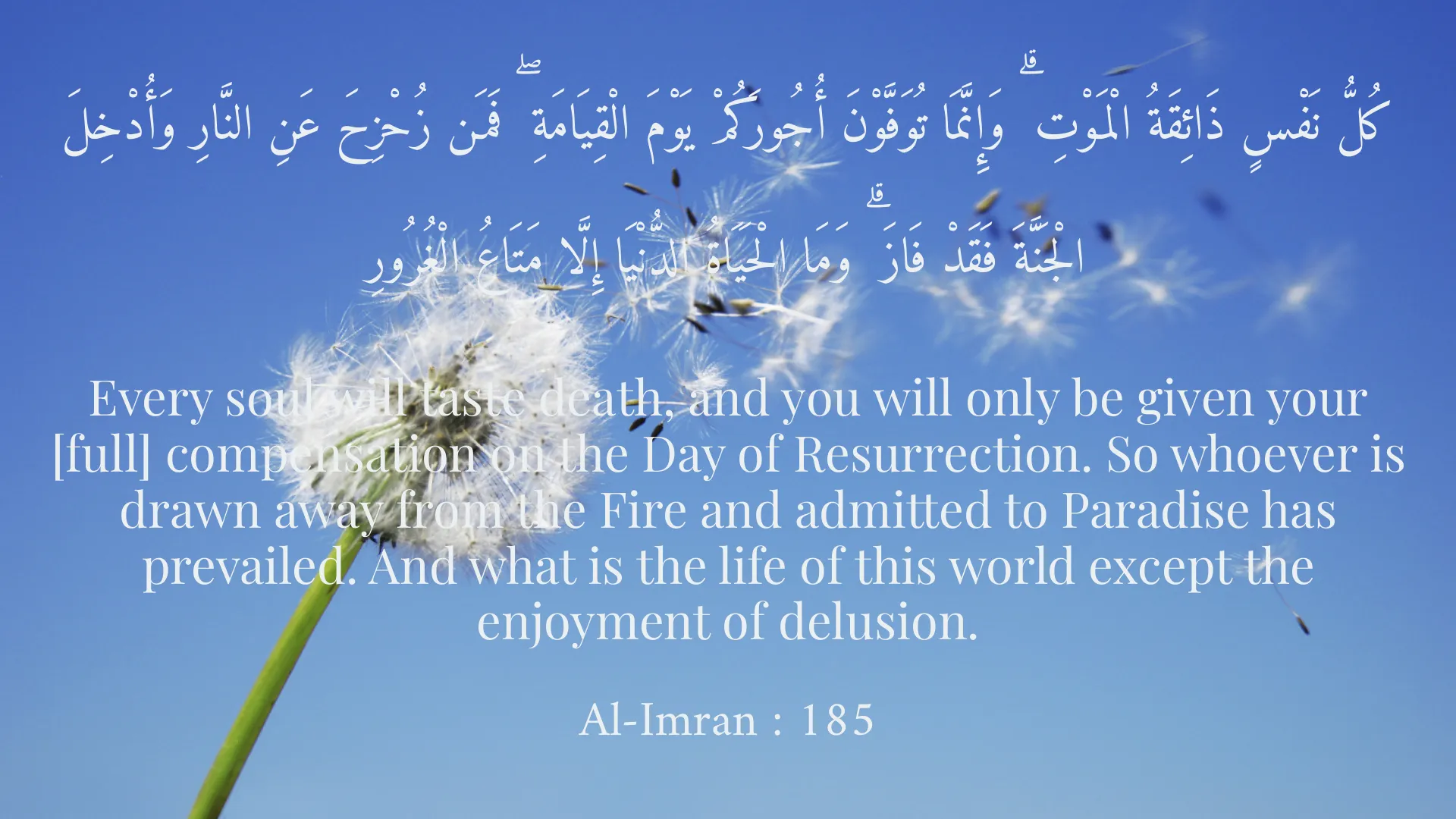
كُلُّ نَفْسٍ ذَائِقَةُ الْمَوْتِ ۗ وَإِنَّمَا تُوَفَّوْنَ أُجُورَكُمْ يَوْمَ الْقِيَامَةِ ۖ فَمَن زُحْزِحَ عَنِ النَّارِ وَأُدْخِلَ الْجَنَّةَ فَقَدْ فَازَ ۗ وَمَا الْحَيَاةُ الدُّنْيَا إِلَّا مَتَاعُ الْغُرُورِ
Every soul will taste death, and you will only be given your [full] compensation on the Day of Resurrection. So whoever is drawn away from the Fire and admitted to Paradise has prevailed. And what is the life of this world except the enjoyment of delusion.
Al-Imran : 185
الَّذِي خَلَقَ الْمَوْتَ وَالْحَيَاةَ لِيَبْلُوَكُمْ أَيُّكُمْ أَحْسَنُ عَمَلًا ۚ وَهُوَ الْعَزِيزُ الْغَفُورُ
He who created death and life to test you as to which of you is best in deed—and He is the Exalted in Might, the Forgiving—
Al-Mulk : 2
أَيْنَمَا تَكُونُوا يُدْرِككُّمُ الْمَوْتُ وَلَوْ كُنتُمْ فِي بُرُوجٍ مُّشَيَّدَةٍ ۗ وَإِن تُصِبْهُمْ حَسَنَةٌ يَقُولُوا هَٰذِهِ مِنْ عِندِ اللَّهِ ۖ وَإِن تُصِبْهُمْ سَيِّئَةٌ يَقُولُوا هَٰذِهِ مِن عِندِكَ ۚ قُلْ كُلٌّ مِّنْ عِندِ اللَّهِ ۖ فَمَالِ هَٰؤُلَاءِ الْقَوْمِ لَا يَكَادُونَ يَفْقَهُونَ حَدِيثًا
Wherever you may be, death will overtake you, even if you should be within fortified towers. But if good befalls them, they say, "This is from Allah "; and if evil befalls them, they say, "This is from you." Say, "All is from Allah." So what is [the matter] with these people that they can hardly understand any statement?
An-Nisa : 78
Short Story
It is narrated that a king, with a mighty army and countless treasures, sat upon his throne. One day, he stood boastfully atop his palace, gazing at the grandeur of his dominion, proclaiming: "Who can bring an end to all this splendor and power? It seems death has no path to us!" At that very moment, a devout dervish passed by the palace wall. With worn clothes and a dust-covered face, he murmured something that reached the king's ears. The king called down from his high perch: "O Dervish! What are you saying?" The dervish calmly replied: "O King, I have heard that you have built a house so strong and tall, as if you intend to reside in it forever. Yet every house, no matter how sturdy, one day leaves its owner behind, and every head, no matter how full of pride, shall eventually rest in dust. Is all this magnificence for the day when you shall be laid upon a bier and carried to another abode, which is neither a palace nor a treasure?" The king was initially enraged, but the dervish's words pierced his heart like an arrow. That night, sleep abandoned his eyes, and instead of contemplating the expansion of his kingdom, he reflected on his own mortality and the eternity of the hereafter. From then on, he adopted humility instead of arrogance, and instead of accumulating worldly possessions, he focused on gathering provisions for the afterlife. He understood that true greatness lies not in a crown and throne, but in good deeds and the remembrance of God, and that death is the greatest preacher for every living being.