Quranic Answer
Addressing the question of how the Quran justifies human moral responsibility is to delve into one of the most fundamental and profound aspects of the Islamic worldview. The Holy Quran, by meticulously detailing humanity's position in existence and its relationship with the Creator, comprehensively and deeply articulates the foundations of moral responsibility. This justification rests upon several interconnected pillars, each complementing the other, and collectively presenting a clear picture of how humans are accountable for their actions. 1. Free Will (Ikhtiyar): The Foundation of Moral Responsibility The most crucial pillar of moral responsibility in the Quran is the endowment of free will upon human beings. The Quran explicitly states that humans are not compelled beings, nor are they devoid of choice; rather, they possess the capacity to choose between good and evil, guidance and misguidance. It is this capacity for choice that gives rise to the meaning of responsibility. If humans lacked free will and acted like robots or programmed entities, there would be no meaning for responsibility, reward, or punishment. Allah emphasizes this truth in numerous verses, including Surah Al-Kahf, verse 29, where He says: "And say, 'The truth is from your Lord, so whoever wills - let him believe; and whoever wills - let him disbelieve.'" This verse clearly indicates that the path of choice is open to humanity. This free will represents a profound test for humans, allowing them to reveal their true nature and demonstrate whether they heed the call of their divine fitra (innate disposition) or succumb to carnal desires and satanic whispers. Humans are free to choose their path with awareness and insight, and it is this choice that determines their destiny in this world and the Hereafter. Moral responsibility originates from this freedom; for only a being capable of choice can be responsible for the consequences of its choices. If humans were not responsible, the purpose of creation and the sending of prophets and scriptures would become meaningless. This free will defines human dignity and distinguishes humans from other creations. The ability to make decisions, reflect on consequences, and choose the right or wrong path is a unique human characteristic that lays the groundwork for accountability. 2. Divine Guidance (Hidayah) and Completion of Argument (Itmam al-Hujjah): Guiding Towards Responsibility After bestowing free will upon humanity, the Quran does not abandon them; rather, to ensure that their moral responsibility is based on full awareness and complete justification, it provides necessary guidance through revelation, prophets, and scriptures. Allah states that He never punishes a people until He has sent a messenger to them to clarify the path of right and wrong: "And never would We punish until We had sent a messenger." (Surah Al-Isra, verse 15). This "completion of argument" means that humans cannot claim on the Day of Judgment that they did not know the path or were unaware of their duties. The Quran serves as a light that shows the correct path and clarifies moral standards. This guidance includes laws, values, cautionary tales, and encouragement towards good deeds while deterring evil. With this clear guidance, human responsibility to act upon it is amplified. Having received these instructions, humans are no longer ignorant and consciously choose whether to follow this light or remain in darkness. This guidance not only shows the way but also provides the criterion for evaluating actions. Therefore, the justification of human moral responsibility in the Quran is not merely based on free will, but on free will accompanied by complete awareness and divine guidance. 3. Divine Justice (Adl) and the System of Reward and Punishment (Jaza and Iqab): The Consequences of Responsibility Another pillar justifying moral responsibility is the just divine system of reward and punishment. The Quran repeatedly emphasizes that Allah wrongs no one, not even an atom's weight, and everyone will see the outcome of their deeds: "So whoever does an atom's weight of good will see it, And whoever does an atom's weight of evil will see it." (Surah Az-Zalzalah, verses 7 and 8). This precise system guarantees that no action goes unaccounted for. Moral responsibility here means accepting the consequences of one's actions. By their choices, humans sow the seeds of their deeds and will reap their fruits in the Hereafter (and sometimes even in this world). This system guides humans towards good and deters them from evil. Without divine justice, moral responsibility would be meaningless, as good and bad deeds would have no distinction. The Quran clarifies that each person carries their own burden of responsibility, and no one will bear the burden of another's sin: "And no bearer of burdens will bear the burden of another." (Surah Fatir, verse 18). This principle clarifies individual responsibility, showing that each human is directly accountable for their own actions. This system compels humans to reflect on the long-term consequences of their actions and provides them with a strong motivation to choose the right path. 4. The Divine Trust (Amanah): The Weight of Responsibility In Surah Al-Ahzab, verse 72, the Quran speaks of a "Divine Trust" that the heavens and earth and mountains refused to bear, but humanity accepted it: "Indeed, We offered the Trust to the heavens and the earth and the mountains, and they declined to bear it and feared it; but man [undertook to] bear it. Indeed, he was unjust and ignorant." Commentators have interpreted this trust in various ways, including "religious obligation," "divine vicegerency," "intellect," and "free will." Accepting this trust means accepting responsibility before God and properly utilizing divine blessings. By accepting this trust, humanity has indeed accepted the heavy burden of responsibility. This verse indicates that due to their unique characteristics, humans possessed the capacity to bear this immense responsibility, and this acceptance itself justifies their subsequent moral responsibilities. The description of humans as "unjust and ignorant" in this verse does not mean that humans are inherently oppressive and foolish, but rather refers to their potential to misuse this trust and their ignorance in truly understanding its dimensions; otherwise, how could they have carried it? This verse emphasizes the greatness and weight of human responsibility and seeks the existential basis of moral responsibility in humanity's inherent nature and its initial covenant with God. 5. Purposeful Creation and Divine Nature (Fitra): Internalizing Responsibility The Quran does not consider the creation of humanity to be futile or without purpose: "And I did not create the jinn and mankind except to worship Me." (Surah Adh-Dhariyat, verse 56). Worship here does not merely mean rituals but encompasses obedience to divine commands and living an ethical life in all its dimensions. This purposefulness gives meaning and direction to human actions and makes moral responsibility an inseparable part of their existential goal. Furthermore, humans possess a divine nature (fitra), meaning that an inclination towards truth and goodness is inherent in their being: "And inspired it [with discernment of] its wickedness and its righteousness." (Surah Ash-Shams, verse 8). This inner inspiration and the ability to distinguish good from evil are further justifications for moral responsibility. With their fitra, humans can discern right from wrong, even in the absence of external guidance. This fitra is an inner light that calls humanity towards good and warns against evil. Moral responsibility stems from the duty of humans to keep this fitra alive and not suppress it with sin and heedlessness. In summary, the Quran considers human moral responsibility not merely an external command, but a logical outcome of free will, divine guidance, divine justice, the acceptance of the divine trust, and the purposeful nature of creation. This internal and external, individual and social responsibility guides humanity towards true perfection and felicity. With this comprehensive and systematic approach, the Quran portrays humanity as an aware, free, and responsible being whose future, both in this world and the Hereafter, depends on the quality of their actions and moral choices. This thorough justification clearly demonstrates the depth and importance of ethics in Islam.
Related Verses
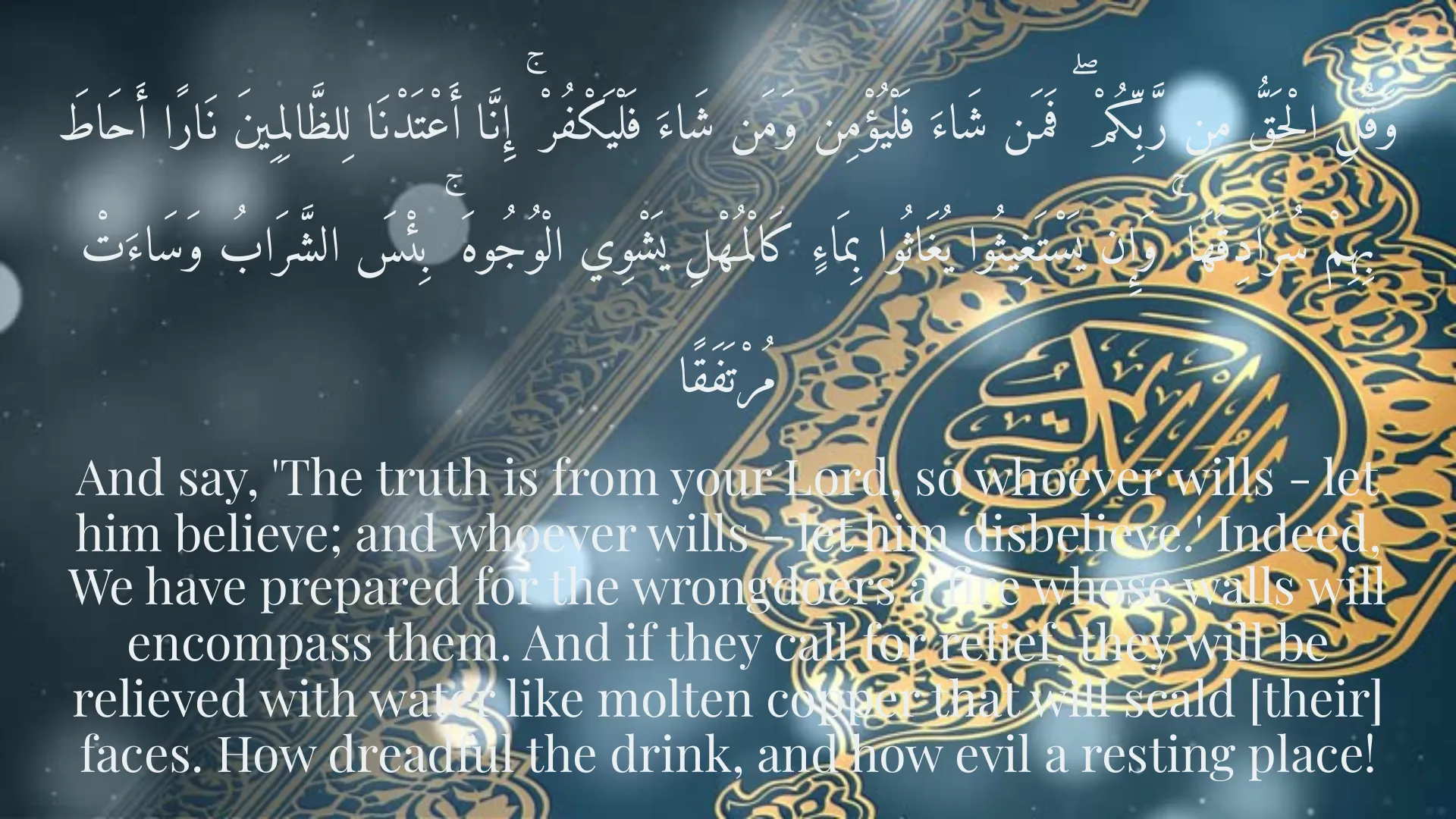
وَقُلِ الْحَقُّ مِن رَّبِّكُمْ ۖ فَمَن شَاءَ فَلْيُؤْمِن وَمَن شَاءَ فَلْيَكْفُرْ ۚ إِنَّا أَعْتَدْنَا لِلظَّالِمِينَ نَارًا أَحَاطَ بِهِمْ سُرَادِقُهَا ۚ وَإِن يَسْتَغِيثُوا يُغَاثُوا بِمَاءٍ كَالْمُهْلِ يَشْوِي الْوُجُوهَ ۚ بِئْسَ الشَّرَابُ وَسَاءَتْ مُرْتَفَقًا
And say, 'The truth is from your Lord, so whoever wills - let him believe; and whoever wills - let him disbelieve.' Indeed, We have prepared for the wrongdoers a fire whose walls will encompass them. And if they call for relief, they will be relieved with water like molten copper that will scald [their] faces. How dreadful the drink, and how evil a resting place!
Al-Kahf : 29
مَنِ اهْتَدَىٰ فَإِنَّمَا يَهْتَدِي لِنَفْسِهِ ۖ وَمَن ضَلَّ فَإِنَّمَا يَضِلُّ عَلَيْهَا ۚ وَلَا تَزِرُ وَازِرَةٌ وِزْرَ أُخْرَىٰ ۗ وَمَا كُنَّا مُعَذِّبِينَ حَتَّىٰ نَبْعَثَ رَسُولًا
Whoever is guided is only guided for [the benefit of] his soul. And whoever errs only errs against it. And no bearer of burdens will bear the burden of another. And never would We punish until We had sent a messenger.
Al-Isra : 15
إِنَّا عَرَضْنَا الْأَمَانَةَ عَلَى السَّمَاوَاتِ وَالْأَرْضِ وَالْجِبَالِ فَأَبَيْنَ أَن يَحْمِلْنَهَا وَأَشْفَقْنَ مِنْهَا وَحَمَلَهَا الْإِنسَانُ ۖ إِنَّهُ كَانَ ظَلُومًا جَهُولًا
Indeed, We offered the Trust to the heavens and the earth and the mountains, and they declined to bear it and feared it; but man [undertook to] bear it. Indeed, he was unjust and ignorant.
Al-Ahzab : 72
Short Story
Once, a powerful king, despite all his grandeur, felt no inner peace. A wise dervish came to visit him. The king asked, "How can one truly find peace amidst such great power and responsibility?" The dervish replied, "Peace is not found in the absence of responsibility, but in fulfilling it with justice and kindness, knowing that every action, great or small, is weighed in the scales of eternity. For one day, every king, like every peasant, will stand accountable." The king, struck by these words, began to rule with greater equity, understanding that his power was a trust, and his moral choices were his ultimate legacy.