Quranic Answer
The Holy Quran, as the divine book of guidance, repeatedly and emphatically highlights the importance and status of unity and solidarity within the Islamic society. This concept is not merely a moral recommendation but a divine command and one of the fundamental pillars upon which the Islamic Ummah is built. From a Quranic perspective, division and discord are destructive forces leading to weakness and decline, whereas unity and cohesion guarantee strength, progress, and salvation in this world and the hereafter. Numerous verses explicitly invite believers to hold fast to the rope of Allah and avoid disunity, considering it a great blessing from God. One of the most prominent verses in this regard is Surah Al-Imran, verse 103: "And hold firmly to the rope of Allah all together and do not become divided. And remember the favor of Allah upon you when you were enemies and He brought your hearts together, so you became by His favor brothers…" This verse clearly emphasizes collectively clinging to the "rope of Allah," which has been interpreted in various ways, including the Holy Quran itself, the religion of Islam, Prophet Muhammad (peace be upon him) and his household (Ahl al-Bayt), or any means of connection that links a person to God. The crucial point is that this rope serves as a central axis for cohesion and avoidance of dispersion. The reminder of Allah's favor in bringing hearts together after a period of enmity and conflict also demonstrates the significance of this unity in transforming the destiny of societies. The Quran considers believers as brothers to one another, as stated in Surah Al-Hujurat, verse 10: "The believers are but brothers, so make reconciliation between your brothers…" This principle of brotherhood transcends any racial, linguistic, tribal, or class distinctions, transforming the Islamic society into a single body. This spiritual brotherhood entails mutual rights and responsibilities, including love, empathy, mutual support in difficulties, safeguarding one another's honor, refraining from backbiting and slander, and striving to resolve grudges and establish peace. This spiritual bond ensures the internal strength of the community and prevents the emergence of conflicts and divisions. Furthermore, the Quran strongly prohibits division and separation, considering them factors that lead to weakness and the loss of the community's prestige and power. Surah Al-Anfal, verse 46, states: "And obey Allah and His Messenger, and do not dispute and [thus] lose courage and [then] your strength would depart; and be patient. Indeed, Allah is with the patient." This verse clearly indicates that obedience to Allah and His Messenger and avoiding disputes are essential conditions for preserving the community's strength and stability. Internal disputes and conflicts hollow out a society from within, making it vulnerable to external enemies. The Quran also warns Muslims not to become like previous nations who became divided and differed after clear proofs had come to them (Al-Imran, verse 105). The foundations of unity in the Quran are built upon several fundamental principles. The first and most important principle is Tawhid, or the Oneness of God. Belief in One God gathers all believers under a single divine banner, leading them to share common goals, values, and a single Qibla (direction of prayer). This unity in purpose and belief paves the way for unity in action and empathy. The second foundation is adherence to the Book (Quran) and the Sunnah (Prophet's tradition). The Quran and Sunnah serve as the primary sources of guidance, providing a shared authority for all Muslims and minimizing disputes. The third foundation is justice and equity. Establishing justice at all levels of society prevents the formation of dissatisfactions and social divides that are the root of many divisions. The fourth foundation is the encouragement of mutual consultation (Shura) and respect for collective decisions. Consultation and collective deliberation strengthen the spirit of participation and collective responsibility, leading to consensus, which is itself a factor in reinforcing unity. In summary, the Holy Quran regards unity not merely as an ideal but as a vital necessity for the Islamic Ummah. This unity is rooted in Tawhid, spiritual brotherhood, and adherence to divine guidance, guaranteeing the survival, strength, and flourishing of the Muslim community. Allah Almighty has commanded Muslims to hold fast to His rope, avoid division, and strive on the path of progress and excellence. This message of unity, transcending time and space, remains an essential principle for any Islamic society that desires glory and prosperity.
Related Verses
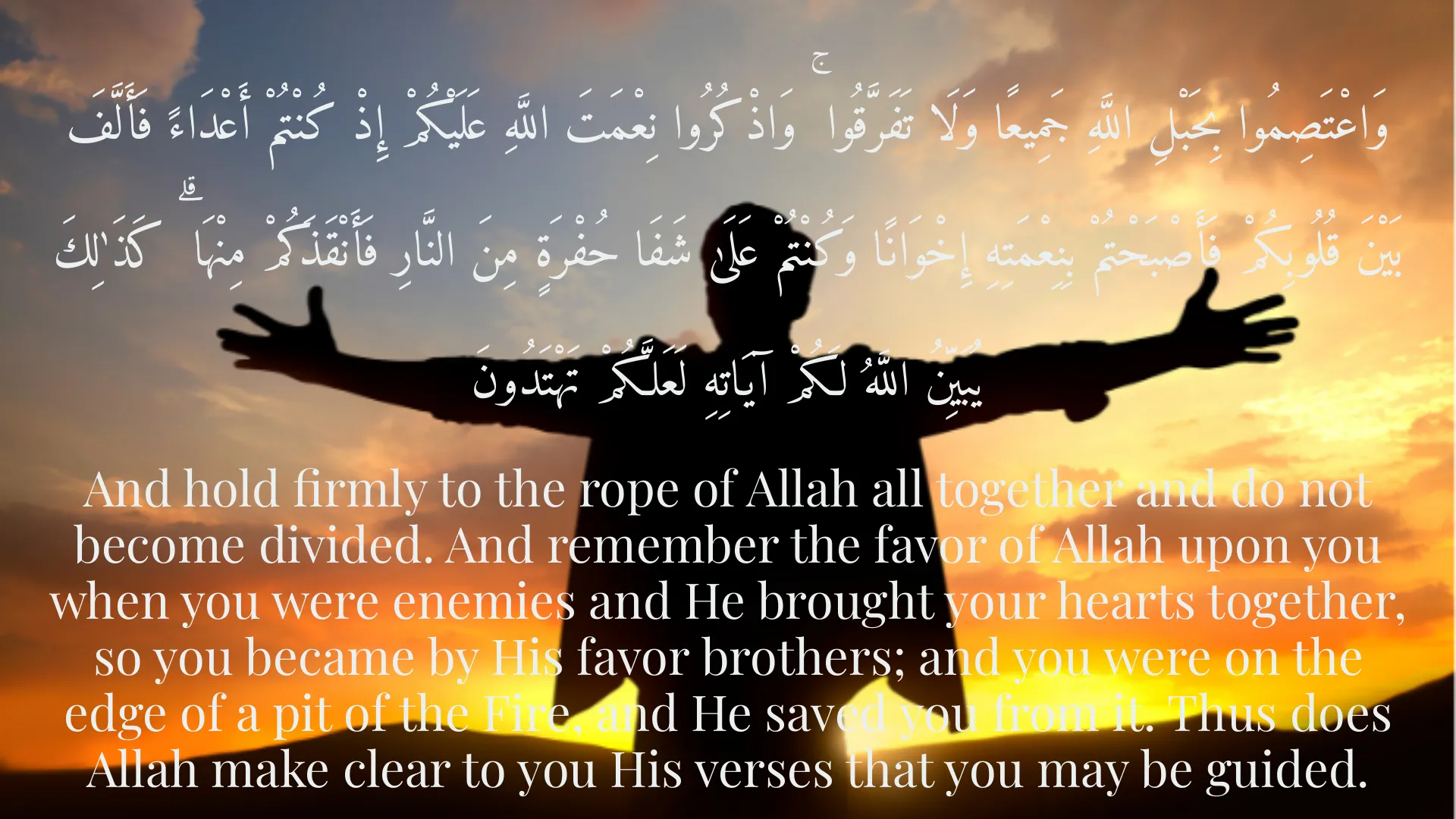
وَاعْتَصِمُوا بِحَبْلِ اللَّهِ جَمِيعًا وَلَا تَفَرَّقُوا ۚ وَاذْكُرُوا نِعْمَتَ اللَّهِ عَلَيْكُمْ إِذْ كُنْتُمْ أَعْدَاءً فَأَلَّفَ بَيْنَ قُلُوبِكُمْ فَأَصْبَحْتُمْ بِنِعْمَتِهِ إِخْوَانًا وَكُنْتُمْ عَلَىٰ شَفَا حُفْرَةٍ مِنَ النَّارِ فَأَنْقَذَكُمْ مِنْهَا ۗ كَذَٰلِكَ يُبَيِّنُ اللَّهُ لَكُمْ آيَاتِهِ لَعَلَّكُمْ تَهْتَدُونَ
And hold firmly to the rope of Allah all together and do not become divided. And remember the favor of Allah upon you when you were enemies and He brought your hearts together, so you became by His favor brothers; and you were on the edge of a pit of the Fire, and He saved you from it. Thus does Allah make clear to you His verses that you may be guided.
Al-Imran : 103
إِنَّمَا الْمُؤْمِنُونَ إِخْوَةٌ فَأَصْلِحُوا بَيْنَ أَخَوَيْكُمْ ۚ وَاتَّقُوا اللَّهَ لَعَلَّكُمْ تُرْحَمُونَ
The believers are but brothers, so make reconciliation between your brothers and fear Allah that you may receive mercy.
Al-Hujurat : 10
وَأَطِيعُوا اللَّهَ وَرَسُولَهُ وَلَا تَنَازَعُوا فَتَفْشَلُوا وَتَذْهَبَ رِيحُكُمْ ۖ وَاصْبِرُوا ۚ إِنَّ اللَّهَ مَعَ الصَّابِرِينَ
And obey Allah and His Messenger, and do not dispute and [thus] lose courage and [then] your strength would depart; and be patient. Indeed, Allah is with the patient.
Al-Anfal : 46
Short Story
One day, as Saadi Shirazi was traversing the fields of Golestan, a man approached him, lamenting the disputes and divisions among his children. Saadi, with a gentle smile, said: "O man, I have heard a tale from the ancients that may bring solace to your grief. A father on his deathbed called his sons and asked each to break a thin stick. Each broke it with ease. Then the father bound a bundle of the same sticks together and gave it to his sons, saying, 'Now, break this bundle.' None could. The father said: 'O my sons, this is your likeness. Each of you, alone, is weak and easily broken, but when you are together, no power can break you apart. Unity is like a strong thread that never breaks.' The sons learned their lesson, and from then on, their lives were filled with harmony and blessings.