Quranic Answer
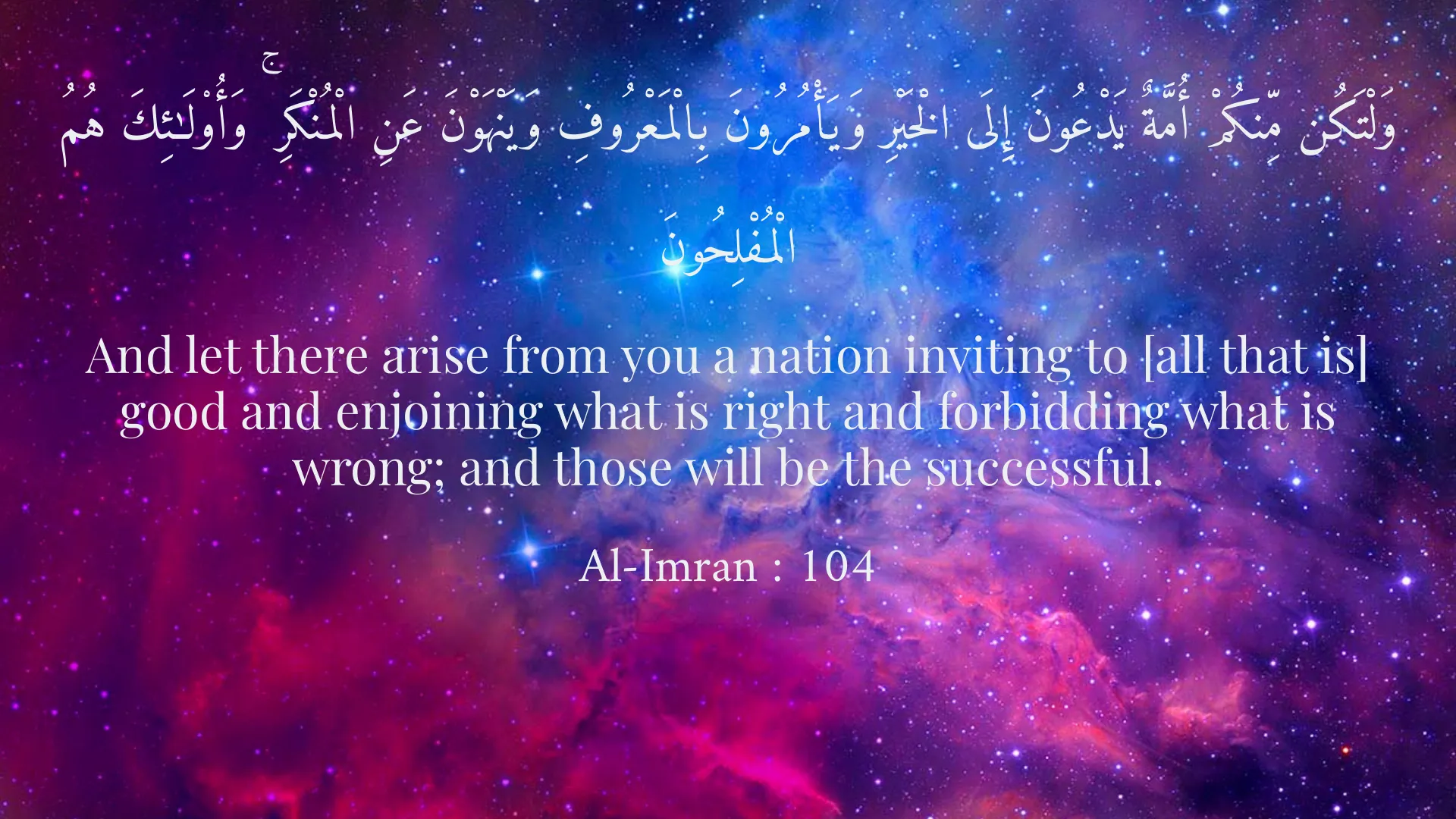
The Holy Quran places a strong emphasis on the individual's responsibility towards society, illustrating the importance of social engagement and moral responsibility throughout its verses. This aspect of the Quran reflects the profound belief in communal welfare and the interconnectedness of individuals within the society. Each individual is not merely a person living in isolation, but a critical member of the larger community, with an obligation to contribute positively to the social fabric. A compelling example can be found in Surah Al-Imran, verse 104, where Allah proclaims: 'And let there arise from you a nation inviting to [all that is] good and enjoining what is right and forbidding what is wrong; and those will be the successful.' This verse encapsulates a universal principle directing individuals to take active roles in societal reform. Here, Allah clearly outlines that the collective effort of the community is dictated by the moral obligation of its members to promote goodness while staunchly confronting evil. This call to action is not merely passive encouragement; it is an urgent invitation to take a stand against injustices and to be advocates for those who may be marginalized or suffering. Moreover, in Surah Al-Ma'idah, verse 2, the Lord issues an important directive: 'And cooperate in righteousness and piety, but do not cooperate in sin and aggression.' This divine guidance stresses the significance of collaboration amongst individuals in their pursuit of virtuous living. It warns against engaging in behaviors that promote division, enmity, or wrongdoing. Instead, the emphasis is placed on building a culture of empathy, solidarity, and cooperation for collective progress. The Quran, therefore, promotes the idea that social activities, initiatives, and collaborations must be rooted in principles of goodness and righteousness. Understanding the responsibility of the individual towards the community requires a recognition that this responsibility is twofold. Firstly, it involves engaging in good deeds oneself; secondly, it requires an active support system among individuals to lift each other up during challenging times. This support is vital in fostering resilience among community members and in addressing the myriad of difficulties that may arise in society, such as poverty, injustice, and discrimination. The Quran encourages believers to recognize that individual wellbeing is intertwined with the welfare of others, shaping a more equitable and just society. These profound teachings exhort Muslims and all individuals to transcend mere contemplation. The call is to not only engage in the spiritual domain but to participate actively in social activities aimed at the betterment of society. This participation is not just a recommended action; it is an obligatory stance that leads to social justice and community development. When individuals focus on the collective destiny of their fellow human beings, they nurture a strong sense of belonging and accountability, essential for societal cohesion. The Quran's persistent theme of individual responsibility evolves into a communal ethos that underscores the need for every individual to act. This action-oriented approach is rooted not only in spiritual undertakings but also emphasizes the importance of establishing social frameworks that ensure fairness and justice for all. Islam promotes a proactive stance on social issues, urging believers to take responsibility not only for their well-being but also for the health of the community. This notion illustrates a recognition that every action has a ripple effect on society, which can either reinforce the existing structures of inequality or transform them into systems of support and equality. As individuals respond to the directives set forth by the Quran, they are reminded of the significance of character and moral uprightness. Good manners, integrity, and ethical behavior become the foundation upon which individuals interact within their communities. This aspect underscores that personal development and moral fortitude enhance an individual's capacity to contribute to social change. Maintaining virtuous behavior fosters an environment where collective good flourishes, therefore, every person becomes a catalyst for societal transformation. The Quran’s teachings about individual responsibility also extend to engaging with the social injustices that pervade the world. It is a moral imperative for individuals, upon recognizing the struggles faced by their community, to actively participate in advocating for justice and equality. This includes challenging oppressive structures, supporting the disenfranchised, and standing against any form of injustices. It is through this proactive engagement that individuals can truly embody the Quranic values and live out their responsibilities as stewards of social good. Furthermore, this message is incredibly pertinent in our contemporary society, which is fraught with challenges and divisive ideologies. The Holy Quran provides guidance that transcends time, urging each person to awaken their innate responsibility towards their community. The messages of collaboration, righteousness, and moral accountability are pathways towards building resilient societies capable of overcoming trials. In conclusion, the Holy Quran serves as a guiding light, emphasizing the profound importance of individual responsibility towards society. Each verse acts as a reminder of the mutual obligations we hold, urging us to take active steps to ensure the wellbeing of our communities. Allah’s messages encourage a comprehensive approach to social engagement, blending righteous deeds with collective efforts towards justice and equity. The lessons gleaned from the Quran compel individuals to foster environments where empathy, collaboration, and good character lead to communities that thrive and flourish together. Ultimately, it is through our unwavering commitment to these teachings that we can pave the way for a just and harmonious society, in alignment with the noble principles espoused by the Holy Quran.
Related Verses
وَلْتَكُن مِّنكُمْ أُمَّةٌ يَدْعُونَ إِلَى الْخَيْرِ وَيَأْمُرُونَ بِالْمَعْرُوفِ وَيَنْهَوْنَ عَنِ الْمُنْكَرِ ۚ وَأُو۟لَـٰئِكَ هُمُ الْمُفْلِحُونَ
And let there arise from you a nation inviting to [all that is] good and enjoining what is right and forbidding what is wrong; and those will be the successful.
Al-Imran : 104
وَتَعَاوَنُوا عَلَى الْبِرِّ وَالتَّقْوَى وَلَا تَعَاوَنُوا عَلَى الإِثْمِ وَالْعُدْوَانِ
And cooperate in righteousness and piety, but do not cooperate in sin and aggression.
Al-Ma'idah : 2
Short Story
In not so distant times, a man was traveling from his village to the city to find a livelihood. Upon entering the city, he noticed many people arguing and fighting. Unable to bear it, he said to them, 'Let us help each other solve these problems!' The people listened to his words, and soon the spirit of love and cooperation blossomed among them. From that day forward, the man became a role model for charitable work and social responsibility in the village.