Quranic Answer
The Holy Quran, as the foundational text of Islam, lays down profound principles concerning the interaction and relationship with followers of other faiths. Far from advocating isolation or hostility, the Quran promotes a framework of respect, justice, and peaceful coexistence, fundamentally rooted in the concept of human dignity and the freedom of belief. It acknowledges the diversity of humanity as a divine will and emphasizes that true faith is a matter of conviction, not coercion. One of the most pivotal and widely cited verses regarding religious freedom is Al-Baqarah (2:256): “There shall be no compulsion in [acceptance of] the religion. The right course has become clear from the error. So whoever disbelieves in Taghut and believes in Allah has grasped the most trustworthy handhold with no break in it. And Allah is Hearing and Knowing.” This verse unequivocally asserts that belief cannot be forced. It highlights that faith is a personal choice, a journey of conviction and understanding, which cannot be truly embraced under duress. This principle forms the cornerstone of Islamic tolerance, ensuring that individuals are free to choose their spiritual path without threat or compulsion. Historically, this verse has been interpreted by Islamic scholars as a foundational legal and ethical guideline, influencing Islamic jurisprudence and ensuring protection for religious minorities within Muslim-majority lands, providing them with the right to practice their own faiths and maintain their personal laws, as long as they do not pose a threat to public order or wage war against Muslims. This concept goes beyond mere tolerance; it's an active recognition of the sanctity of individual choice in matters of belief. Furthermore, the Quran directly addresses the issue of distinct religious identities while advocating for peaceful separation without animosity. Surah Al-Kafirun (109:6) declares: “To you, your religion; and to me, my religion.” This concise yet powerful statement encapsulates a core principle of mutual respect and distinct identity. It is not an endorsement of theological pluralism, but rather a practical guideline for peaceful coexistence where each group maintains its beliefs without interfering with the other's fundamental tenets or practices. It teaches that while theological differences exist and are acknowledged, they should not be a cause for conflict or aggression. This verse sets a boundary, preventing forced conversions or cultural assimilation, and promoting a societal model where diverse belief systems can exist side-by-side without theological compromise on either side. It underscores the idea that spiritual accountability is ultimately to God alone, and therefore, human beings are not to judge or coerce others into their faith. The Quran also provides explicit commands for just and kind treatment of people of other faiths, provided they are not actively hostile. Surah Al-Mumtahanah (60:8) states: “Allah does not forbid you from those who do not fight you because of religion and do not expel you from your homes - from being righteous toward them and acting justly toward them. Indeed, Allah loves those who act justly.” This verse outlines a crucial distinction: while aggression is to be met with defense, peace and justice are to be extended to those who do not wage war against Muslims or oppress them for their faith. The terms “birr” (righteousness, kindness) and “qist” (justice, equity) used here are comprehensive. “Birr” implies good conduct, benevolence, and compassion, extending beyond mere tolerance to active good-doing. “Qist” demands fairness, impartiality, and upholding rights, irrespective of religious affiliation. This means Muslims are commanded to engage in ethical and fair dealings with non-Muslims in all social, economic, and political spheres, reflecting the universal application of justice in Islam. This command highlights the Quran's vision of a society where kindness and justice are universal virtues, not limited to one's co-religionists. Beyond mere tolerance, the Quran encourages respectful dialogue and finding common ground. In Surah Al-Ankabut (29:46), it advises: “And do not dispute with the People of the Scripture except in the best manner, except for those of them who commit injustice, and say, 'We believe in that which has been revealed to us and revealed to you. And our God and your God is one; and we are Muslims [in submission] to Him.'” This verse emphasizes the importance of civil and respectful engagement, even when discussing profound theological differences. The “best manner” implies using wisdom, gentle admonition, and eloquent reasoning, avoiding insults or condescension. It also calls for highlighting commonalities, such as the belief in one God and submission to Him, particularly with Jews and Christians, whom the Quran refers to as “People of the Scripture.” This approach fosters mutual understanding and builds bridges, rather than widening divides. Another powerful verse in this regard is Al-Imran (3:64): “Say, 'O People of the Scripture, come to a word that is equitable between us and you – that we will not worship except Allah and not associate anything with Him and not take one another as lords instead of Allah.'” This is an invitation to principled dialogue based on fundamental monotheistic commonalities, seeking a foundation for cooperation and shared ethical ground. The Quran also posits that the diversity of religions and human paths is part of God's divine plan. Surah Al-Ma'idah (5:48) states: “To each of you We [God] have prescribed a law and a method. Had Allah willed, He would have made you one nation; but [He intended] to test you in what He has given you. So race to [all that is] good. To Allah is your return all together, and He will inform you concerning that over which you used to differ.” This verse implies that religious pluralism is not an accident but a deliberate design by the Creator. It shifts the focus from theological disputes to competing in good deeds, recognizing that ultimate judgment belongs to God alone. This perspective encourages Muslims to engage with diverse communities by demonstrating moral excellence and striving for goodness in all aspects of life, fostering a spirit of benevolent competition in ethical conduct rather than conflict. Finally, the Quran even extends its protection to the places of worship of other faiths. Surah Al-Hajj (22:40) mentions: “...and if Allah had not repelled [some] people by means of others, monastic cells and churches and synagogues and mosques, in which the name of Allah is much mentioned, would have been demolished.” This verse, in the context of permission to fight those who attack Muslims, provides a powerful justification for the defense of all houses of worship, not just mosques. It underscores a universal principle of safeguarding religious sites, indicating a profound respect for the sanctity of worship across different traditions. This further cements the Quran's holistic approach to respecting religious diversity, not just in terms of individuals' rights but also the places where they practice their faith. In conclusion, the Quranic discourse on respect for other religions is multifaceted and robust. It champions freedom of belief, mandates justice and kindness towards peaceful non-Muslims, encourages constructive dialogue based on commonalities, acknowledges religious diversity as part of God's design, and even protects places of worship for all faiths. These principles collectively form a comprehensive ethical framework for peaceful coexistence and harmonious interaction in a pluralistic world, inviting Muslims to be ambassadors of peace, justice, and understanding, upholding human dignity irrespective of creed. It is a call to live by the highest moral standards, demonstrating that true faith empowers one to treat all of God's creation with dignity and respect.
Related Verses
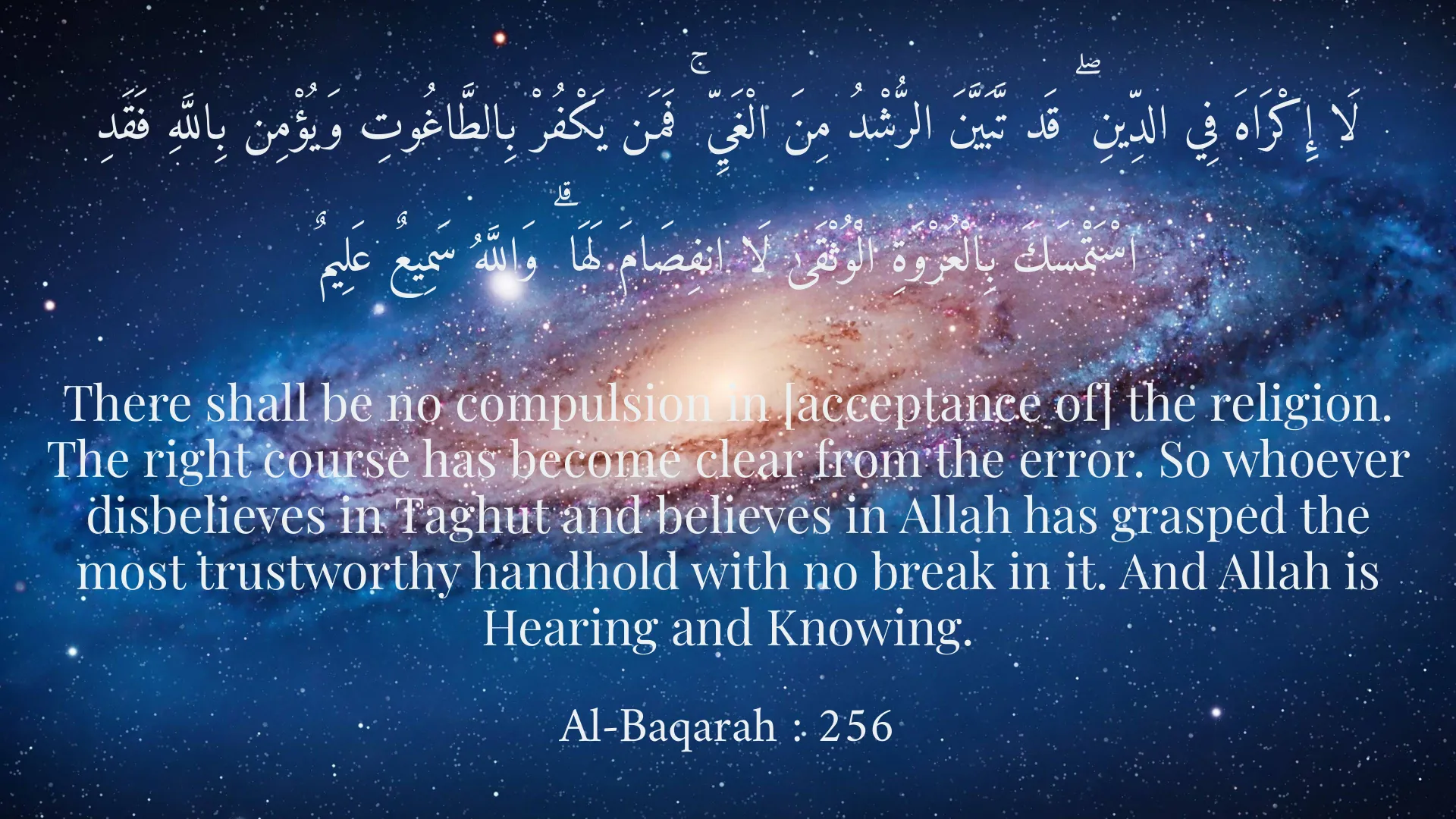
لَا إِكْرَاهَ فِي الدِّينِ ۖ قَد تَّبَيَّنَ الرُّشْدُ مِنَ الْغَيِّ ۚ فَمَن يَكْفُرْ بِالطَّاغُوتِ وَيُؤْمِن بِاللَّهِ فَقَدِ اسْتَمْسَكَ بِالْعُرْوَةِ الْوُثْقَىٰ لَا انفِصَامَ لَهَا ۗ وَاللَّهُ سَمِيعٌ عَلِيمٌ
There shall be no compulsion in [acceptance of] the religion. The right course has become clear from the error. So whoever disbelieves in Taghut and believes in Allah has grasped the most trustworthy handhold with no break in it. And Allah is Hearing and Knowing.
Al-Baqarah : 256
لَّا يَنْهَاكُمُ اللَّهُ عَنِ الَّذِينَ لَمْ يُقَاتِلُوكُمْ فِي الدِّينِ وَلَمْ يُخْرِجُوكُم مِّن دِيَارِكُمْ أَن تَبَرُّوهُمْ وَتُقْسِطُوا إِلَيْهِمْ ۚ إِنَّ اللَّهَ يُحِبُّ الْمُقْسِطِينَ
Allah does not forbid you from those who do not fight you because of religion and do not expel you from your homes - from being righteous toward them and acting justly toward them. Indeed, Allah loves those who act justly.
Al-Mumtahanah : 8
لَكُمْ دِينُكُمْ وَلِيَ دِينِ
To you, your religion; and to me, my religion.
Al-Kafirun : 6
Short Story
It is narrated that in ancient times, a wise and just king ruled over a land where people of various religions and beliefs lived together. One day, a minister approached the king and, with a puzzled expression, asked: 'O righteous king, how is it that you treat followers of other religions with such generosity and justice, as if they were all of the same faith?' The king smiled warmly and replied: 'O discerning minister, God has taught us in His Book that there is no compulsion or oppression in religion, and the right path has been clearly distinguished from error. Every human being has their own path and belief, and we are commanded to treat all people, except those who commit injustice and enmity, with justice and kindness. Is it not true that all humanity is created from one essence and are equal before the Lord?' From that day on, peace and tranquility increased in that land, and people of every faith and creed lived together with respect and affection, and the story of the king's justice became renowned everywhere.