Quranic Answer
In the Holy Quran, pride and arrogance are severely condemned as one of the greatest moral vices and primary obstacles to spiritual growth and proximity to God. This attribute not only leads to the destruction of one's character and social relationships but also directly contradicts the concept of Tawhid (Oneness of God) and sincere servitude before the Almighty. Through various expressions and diverse narratives, the Quran warns of the dire consequences of arrogance and calls upon believers to shun this satanic trait. One of the most prominent examples of the Quran's criticism of pride and arrogance is the story of Iblis (Satan). Iblis was the first being to disobey divine command out of arrogance and self-exaltation. When Allah commanded the angels and Iblis to prostrate before Adam, Iblis refused, stating his reasoning: 'I am better than him. You created me from fire and created him from clay' (Al-A'raf, verse 12). This statement encapsulates the essence of arrogance; Iblis considered himself superior to Adam, failing to comprehend that true superiority lies in obedience to divine command and submission to God's wisdom, not in the material of creation. It was this very arrogance and self-admiration that caused his expulsion from the divine presence and transformed him into an open enemy of humanity. By narrating this story, the Quran identifies the root of arrogance as self-aggrandizement and forgetting one's humble position as a servant before the Creator of the universe. Other examples of pride and arrogance extensively discussed in the Quran are the stories of Pharaoh and Qarun. Pharaoh symbolizes the arrogance of power. He considered himself the god of the people and, due to his boundless power and dominion, refused to accept the truth and the call of the divine prophets, especially Prophet Moses (peace be upon him). With utmost insolence, he enslaved the people and claimed divinity: 'I am your most exalted lord' (An-Nazi'at, verse 24). The Quran narrates his ultimate fate and that of his armies as drowning in the sea. This outcome demonstrates how worldly power, when coupled with arrogance, leads to destruction and ruin. Pharaoh's destiny serves as a warning to all who consider themselves superior based on their might and disobey God's commands. Qarun, too, represents the arrogance stemming from wealth and possessions. He was from the people of Moses (PBUH) and had acquired immense wealth through divine blessings. However, instead of showing gratitude and humility, he boasted about his riches, attributing them to his own knowledge and efforts: 'He said, 'I was only given it because of knowledge I have'' (Al-Qasas, verse 78). He behaved with pride and conceit towards people and those who advised him. The Quran recounts how the earth swallowed him and his treasures. This bitter fate signifies that arrogance based on wealth holds no value and can, in fact, lead to the destruction of an individual and their possessions. These stories depict arrogance as a factor preventing the acceptance of truth and the inability to distinguish between divine blessings and trials. Beyond these narratives, the Quran directly condemns arrogance in numerous verses. Allah explicitly declares: 'Indeed, Allah does not like those who are self-deluded and boastful' (An-Nisa, verse 36, and Luqman, verse 18). This divine dislike signifies the profound ugliness and reprehensibility of this trait in the sight of God. Furthermore, in Surah Luqman (verse 18), Allah advises believers to practice humility even in their walk and speech: 'And do not turn your cheek [in contempt] toward people and do not walk through the earth exultantly. Indeed, Allah does not like those who are self-deluded and boastful.' This verse illustrates that arrogance is reprehensible even in the smallest gestures and behaviors. The Quran also clearly articulates the consequences of arrogance in both this world and the hereafter. The arrogant are deprived of divine guidance because their pride prevents them from accepting the truth and seeing the signs of God. In the Day of Judgment, their abode will be Hellfire: 'So wretched is the residence of the arrogant' (Ghafir, verse 76). Conversely, the Quran invites believers to humility and modesty, considering them characteristics of the righteous servants of God. Humility is a ladder to spiritual progress and the key to entering Paradise, while arrogance hinders all forms of growth and perfection, ultimately leading humanity to destruction. In summary, the Quran, with a comprehensive approach, criticizes arrogance from various dimensions: from its satanic root in self-exaltation to its manifestations in power and wealth, and its severe ultimate consequences in this world and the hereafter. The purpose of this criticism is to warn humans against this destructive trait and to encourage them to embrace humility and sincere servitude before the Lord of the worlds. The Quran teaches that greatness and majesty belong solely to Allah, and whoever attempts to share in this attribute brings ruin upon themselves. These Quranic teachings serve as a guiding light for achieving human perfection and true tranquility under the shade of servitude and humility.
Related Verses
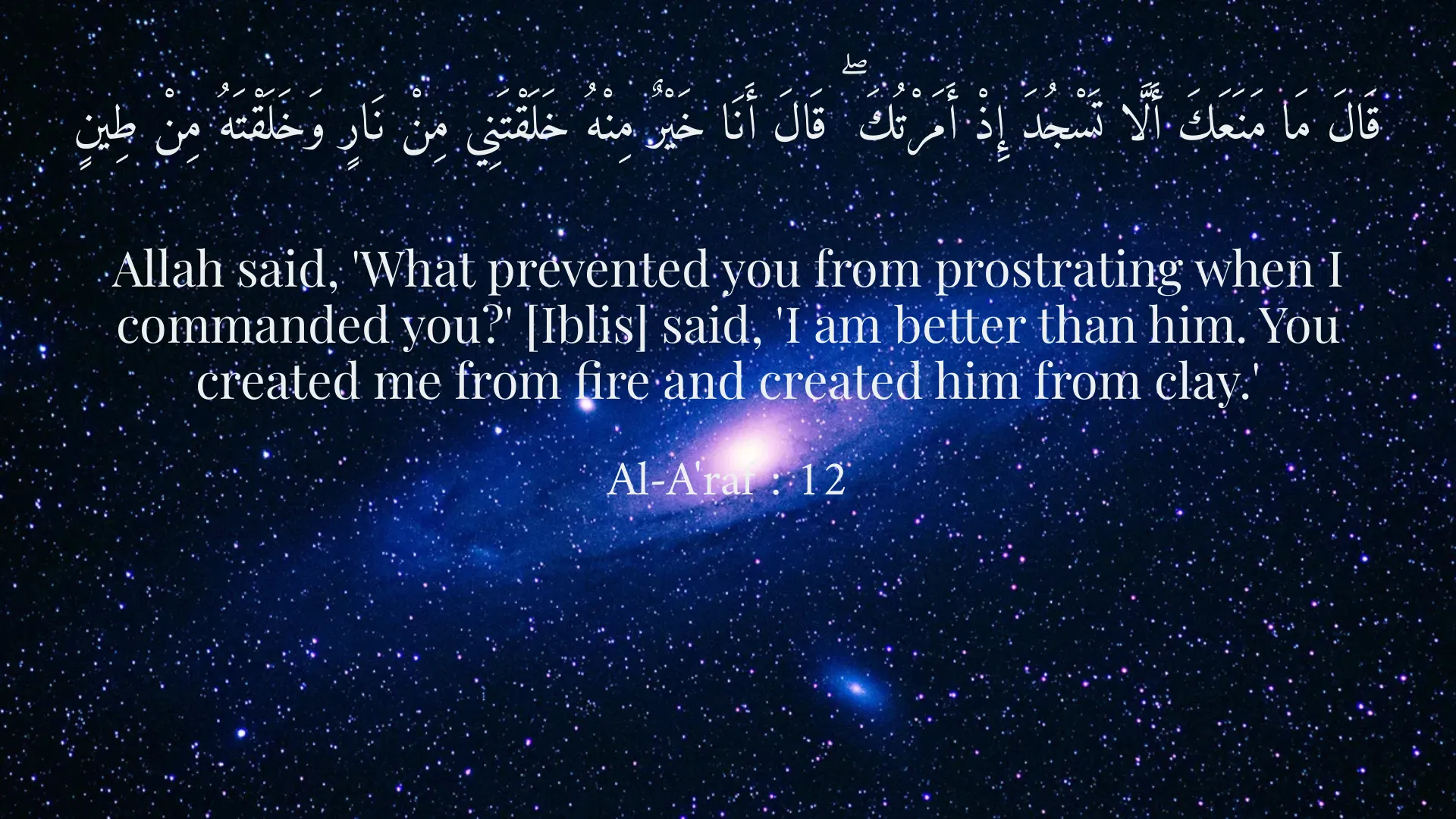
قَالَ مَا مَنَعَكَ أَلَّا تَسْجُدَ إِذْ أَمَرْتُكَ ۖ قَالَ أَنَا خَيْرٌ مِنْهُ خَلَقْتَنِي مِنْ نَارٍ وَخَلَقْتَهُ مِنْ طِينٍ
Allah said, 'What prevented you from prostrating when I commanded you?' [Iblis] said, 'I am better than him. You created me from fire and created him from clay.'
Al-A'raf : 12
لَا جَرَمَ أَنَّ اللَّهَ يَعْلَمُ مَا يُسِرُّونَ وَمَا يُعْلِنُونَ ۚ إِنَّهُ لَا يُحِبُّ الْمُسْتَكْبِرِينَ
Assuredly, Allah knows what they conceal and what they declare. Indeed, He does not like the arrogant.
An-Nahl : 23
وَلَا تُصَعِّرْ خَدَّكَ لِلنَّاسِ وَلَا تَمْشِ فِي الْأَرْضِ مَرَحًا ۖ إِنَّ اللَّهَ لَا يُحِبُّ كُلَّ مُخْتَالٍ فَخُورٍ
And do not turn your cheek [in contempt] toward people and do not walk through the earth exultantly. Indeed, Allah does not like those who are self-deluded and boastful.
Luqman : 18
Short Story
It is narrated that in ancient times, there was a king who was exceedingly arrogant and proud. Whenever he spoke, it was as if he walked on the heavens, considering himself above everyone else. He never listened to the advice of the wise and committed injustices in pursuit of his desires. Yet, in the same city, there lived an old dervish who lived with modesty and humility, thanking God for His blessings with every step. One day, a severe famine struck the city, and the desperate people went to the king, pleading for a solution, but the king, with pride and self-admiration, drove them away. The old dervish, despite his poverty, shared whatever he had with the people and sought help from God through his sincere prayers. Soon after, divine rain poured down, and the earth became green again, but the arrogant king's palace was destroyed by a flood. The people, witnessing the dervish's generosity and the king's demise, understood that true honor lies in humility and submission, and that arrogance leads to nothing but disgrace and annihilation. Saadi wisely said: 'Humility elevates you to eminence, while arrogance casts you down to dust.'