Quranic Answer
How not to fear in crises? This question resonates in the hearts of many people, especially in our challenging era. The Holy Quran, as a book of divine guidance, offers profound and effective solutions for confronting fear and anxiety during times of crisis. The fundamental principles that the Quran puts forth for overcoming fear are deeply rooted in unwavering faith in Allah, complete reliance upon Him (Tawakkul), steadfast patience (Sabr), consistent prayer (Salat), and continuous remembrance (Dhikr). These divine teachings not only bring immense solace and tranquility to the hearts of believers but also bestow an intrinsic, enduring strength upon individuals. This inner fortitude enables them to maintain their serenity and composure even when facing the most difficult and daunting circumstances, liberating them from the clutches of despair and terror. This Quranic approach is not merely an ethical recommendation; it is a practical, comprehensive roadmap for achieving profound inner assurance and spiritual stability, serving as a beacon of hope in the darkest times. Reliance on Allah (Tawakkul): The Secure Haven for Hearts The most crucial pillar for overcoming fear in crises is the profound concept of Tawakkul, or complete reliance on Allah. Tawakkul signifies placing full, unconditional trust in God and entrusting all affairs to Him after having diligently exerted all necessary and legitimate efforts. The Quran repeatedly emphasizes this vital principle, unequivocally stating that Allah is the best Protector, the ultimate Disposer of affairs, and the most reliable Ally. In Surah Al-Imran, verse 173, we read: “Hasbunallahu wa Ni’mal Wakeel” (Sufficient for us is Allah, and [He is] the best Disposer of affairs). When an individual attains this deep-seated conviction that all matters, whether trivial or monumental, are firmly in the hands of the Almighty Divine power, and that not a single leaf falls without His explicit permission, nor does any event occur outside of His infinite knowledge and will, anxiety and fear naturally depart from their heart. This profound reliance does not imply abandoning effort or shirking responsibility; rather, it signifies that after fulfilling all one's duties and utilizing every available resource and faculty of reason, the outcome is surrendered to the All-Powerful and All-Wise God with a calm and assured heart. It is the understanding that whatever He decrees, irrespective of its immediate appearance, is ultimately infused with goodness and divine wisdom. Believing in the absolute truth that Allah Almighty is perpetually merciful, omniscient, and ever-present to His servants, and that He never abandons them but constantly desires their well-being, provides an impenetrable sanctuary for the soul against the overwhelming onslaught of crises and uncertainties. This absolute trust liberates individuals from paralyzing anxieties about the future, allowing them to approach problems with a more tranquil and focused mind. Patience (Sabr) and Prayer (Salat): Two Wings for Flight in Hardships The Holy Quran states with profound clarity in Surah Al-Baqarah, verse 153: “O you who have believed, seek help through patience and prayer. Indeed, Allah is with the patient.” Patience (Sabr) is an exceptionally vital keyword that profoundly teaches human beings to persevere and remain steadfast in the face of problems, adversities, and calamities, never succumbing to despair, weakness, or surrender. Patience, in its true Islamic sense, signifies actively and purposefully enduring hardships, rather than adopting a passive or inactive stance. This active patience is intrinsically accompanied by reliance (Tawakkul) and bestows immense, unparalleled strength upon the individual, empowering them to remain resilient against both external pressures and internal turmoil. Prayer (Salat), on the other hand, represents a direct, profound, and continuous connection between the servant and the Creator. During the sacred moments of prayer, an individual detaches from the clamor of the worldly life, the pressures of daily existence, and mental anxieties, and fully surrenders their heart to the boundless ocean of divine tranquility. Prayer serves as a continuous, gentle reminder that we are never truly alone and are perpetually under the infinite care, grace, and abundant favor of Allah. When we stand for prayer amidst the peak of fear and anxiety, and privately commune with our Lord, it is as if we are carrying the heavy burden of problems and concerns. With each prostration (ruku’ and sujud), we symbolically lay these burdens down, experiencing an indescribable lightness and profound peace. This spiritual connection is an inexhaustible source of power, hope, and unwavering steadfastness, which profoundly aids us in viewing problems with greater clarity and tackling them with a more robust and resilient spirit. Remembrance of Allah (Dhikr): The Soother of Hearts Another exceptionally effective Quranic strategy for conquering fear is “Dhikr Allah,” or the continuous, mindful remembrance of God. In Surah Ar-Ra’d, verse 28, we read: “Those who have believed and whose hearts are assured by the remembrance of Allah. Unquestionably, by the remembrance of Allah hearts are assured.” Dhikr is not merely the mechanical repetition of specific words and phrases; rather, it encompasses the presence of heart, full attention, and a constant, conscious recollection of Allah’s unparalleled greatness, immense power, boundless mercy, infinite love, and flawless wisdom. When, during crises, we consciously choose to focus on the magnitude and limitless nature of Allah’s power instead of fixating on the terrifying scale of the problem, hearts find deep tranquility, and fears gradually dissipate. Uttering phrases such as “La hawla wa la quwwata illa billah” (There is no power or might except with Allah), “Ya Hayyu Ya Qayyum” (O Ever-Living, O Sustainer who manages all affairs), and “Astaghfirullah Rabbi wa atubu ilaih” (I seek forgiveness from Allah, my Lord, and I repent to Him) are all forms of Dhikr that profoundly help individuals maintain their vital connection with the ultimate Source of power and peace, thereby warding off fear and worry. These acts of remembrance function as a secure and impregnable fortress in the midst of life’s fiercest storms, assuring individuals that they are under the unwavering and benevolent protection of Allah. Understanding the Nature of Crises: Divine Tests and Opportunities for Growth The Quran emphatically teaches us that crises and problems are an inseparable part of the transient nature of worldly life and are essentially divine tests. Allah states in Surah Al-Baqarah, verse 155: “And We will surely test you with something of fear and hunger and a loss of wealth and lives and fruits, but give good tidings to the patient.” This verse clearly indicates that trials and tribulations are natural occurrences, and their profound purpose is to test the depth of one's faith, strengthen one’s spirit, elevate spiritual ranks, and purify one’s very being. When we approach crises with the understanding that they are invaluable opportunities for spiritual growth, for drawing closer to Allah, and for discovering our inherent inner capabilities, fear naturally gives way to motivation, hope, and a determined will to successfully navigate the challenge. Every crisis inherently holds a hidden lesson, and every hardship carries with it an underlying ease, paving the way for growth and development, as emphatically stated in Surah Ash-Sharh, verses 5 and 6: “For indeed, with hardship [will be] ease. Indeed, with hardship [will be] ease.” This divine promise instills profound calm in the heart, assuring us that after every difficulty, relief and facilitation are inevitably awaiting. Conclusion: To effectively navigate crises without succumbing to fear, it is imperative to strengthen our bond with Allah and harness all the capacities of our faith. True, unyielding reliance upon Him, seeking refuge in patience and prayer as two powerful instruments, and maintaining continuous remembrance of Him, are the fundamental pillars of this enduring tranquility. By internalizing the truth that crises are divine tests, and that every hardship is invariably accompanied by ease, we can face challenges with a confident heart, a serene soul, and a focused mind. This comprehensive spiritual path not only aids us in liberating ourselves from the transient fears and worries of this worldly life but also guides us towards profound spiritual growth, greater stability, and a closer, more meaningful connection with the Creator of the universe. In this often challenging journey of life, Allah Almighty is perpetually the Helper and Supporter of His believing and patient servants, never abandoning them in the midst of difficulties. This steadfast assurance of continuous divine aid and companionship serves as the strongest possible shield against the onslaught of any fear or worry, bestowing upon us an unparalleled strength to confront the unknown with faith and fortitude.
Related Verses
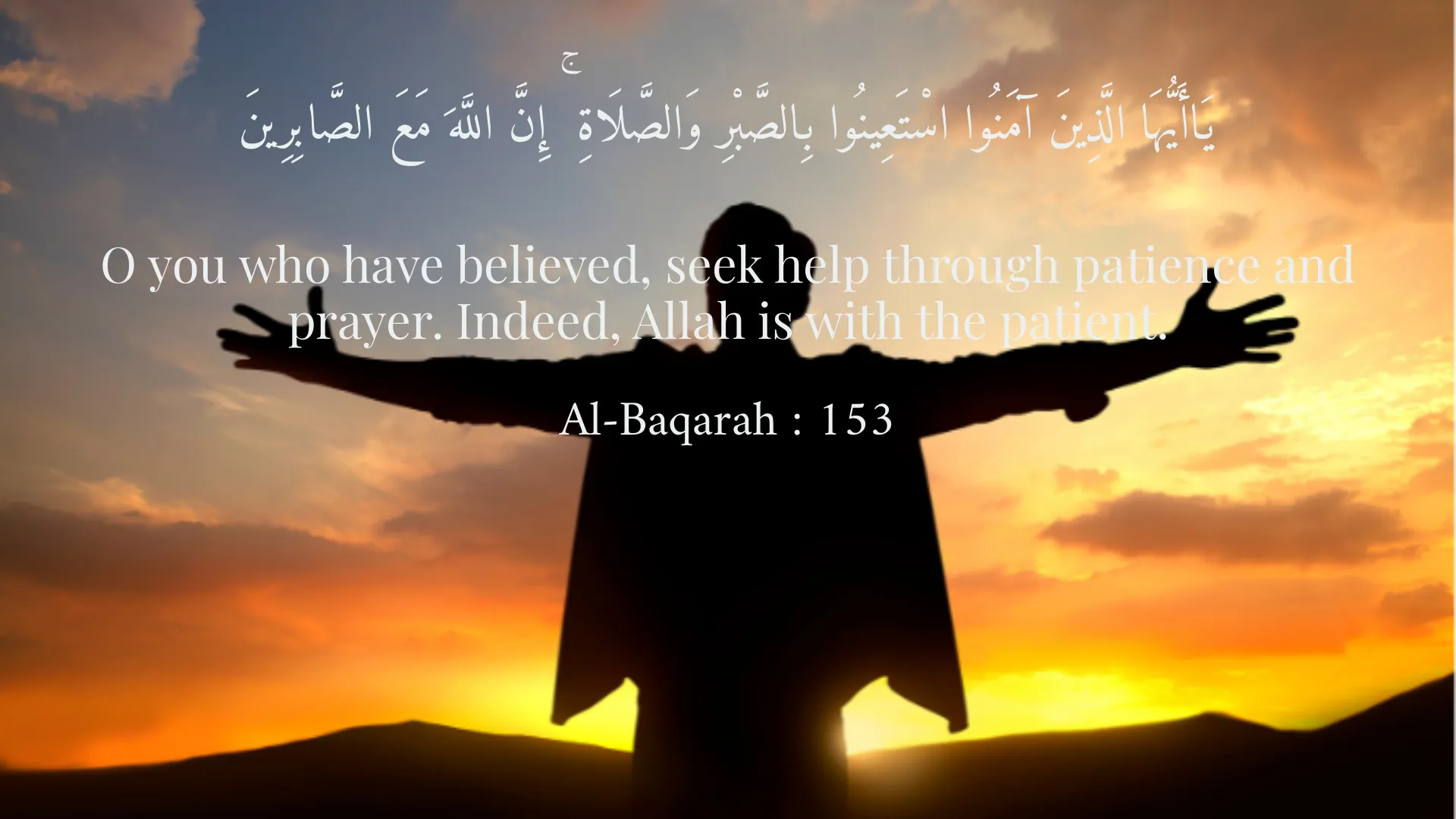
يَاأَيُّهَا الَّذِينَ آمَنُوا اسْتَعِينُوا بِالصَّبْرِ وَالصَّلَاةِ ۚ إِنَّ اللَّهَ مَعَ الصَّابِرِينَ
O you who have believed, seek help through patience and prayer. Indeed, Allah is with the patient.
Al-Baqarah : 153
وَلَنَبْلُوَنَّكُم بِشَيْءٍ مِّنَ الْخَوْفِ وَالْجُوعِ وَنَقْصٍ مِّنَ الْأَمْوَالِ وَالْأَنفُسِ وَالثَّمَرَاتِ ۗ وَبَشِّرِ الصَّابِرِينَ
And We will surely test you with something of fear and hunger and a loss of wealth and lives and fruits, but give good tidings to the patient.
Al-Baqarah : 155
قُل لَّن يُصِيبَنَا إِلَّا مَا كَتَبَ اللَّهُ لَنَا هُوَ مَوْلَانَا ۚ وَعَلَى اللَّهِ فَلْيَتَوَكَّلِ الْمُؤْمِنُونَ
Say, 'Never will we be afflicted except with what Allah has decreed for us; He is our Protector.' And upon Allah let the believers rely.
At-Tawbah : 51
الَّذِينَ آمَنُوا وَتَطْمَئِنُّ قُلُوبُهُم بِذِكْرِ اللَّهِ ۗ أَلَا بِذِكْرِ اللَّهِ تَطْمَئِنُّ الْقُلُوبُ
Those who have believed and whose hearts are assured by the remembrance of Allah. Unquestionably, by the remembrance of Allah hearts are assured.
Ar-Ra'd : 28
Short Story
It is said that in ancient times, there was a merchant who possessed great wealth and traveled extensively. One day, his ship was caught in a stormy sea, and all his possessions were lost. He reached a distant shore, alone and helpless, surrounded by despair. At that moment, a wise old man saw him and asked, "Young man, why are you so distressed?" The merchant recounted his tale and lamented his fear of poverty and solitude. The elder replied, "Fear not! He who caused your ship to be lost in the waves is Himself the hidden captain of hearts. If He takes with one hand, He gives back with another, and if He closes one door, He opens a hundred more. Entrust your heart to Him, and seek refuge in patience and prayer, for He never abandons His sincere servant." When the merchant heard these words, his heart found peace, and he engaged in the remembrance of God. It was not long before a caravan arrived, and seeing his condition, they helped him and led him to a safe city. The merchant started his trade anew, and by the blessing of his reliance and patience, he soon fared better than before, realizing that God's help in hardships is the strongest refuge.