Quranic Answer
True self-confidence, as taught by the Holy Quran, is not about false pride or arrogance. Rather, it is a profound state of inner peace, self-assurance in one's abilities and potential, and, most importantly, an unwavering reliance on the Almighty Creator. This self-confidence originates from an inexhaustible and stable source, thus it does not falter in the face of worldly adversities. The Quran provides fundamental pathways to achieve this authentic self-confidence, which we will explore in detail below. Perhaps the most crucial pillar of Quranic self-confidence is 'complete reliance on Allah (Tawakkul)'. When an individual attains the certainty that an absolute and wise power governs the universe and that He desires what is best for His servants, their heart finds tranquility. This reliance does not imply abandoning effort; instead, it means that after exerting one's utmost effort and utilizing all available resources, the outcome is entrusted to Allah. This approach lifts the heavy burden of anxiety and fear of failure, emboldening individuals to bravely embark on challenging paths. When we know that even in apparent setbacks, there is a hidden good, and that Allah will never abandon us, true self-confidence takes root. The verse, "And whoever relies upon Allah – then He is sufficient for him" (Surah At-Talaq, 65:3), clearly articulates this truth: Allah suffices for whoever places their trust in Him. This sense of divine sufficiency is the strongest source of self-confidence a person can possess, as it relies on an eternal power rather than one's limited abilities or the unstable support of others. The second factor is 'recognizing humanity's role as Allah's vicegerent (Khalifatullah)'. Allah has designated humanity as His 'vicegerent' on Earth (Surah Al-Baqarah, 2:30). This status bestows unparalleled dignity and honor upon human beings. We are not merely weak and insignificant creatures; rather, we are entrusted with a divine trust, and immense capabilities for developing the Earth and attaining perfection have been embedded within us. When a person realizes this inherent dignity and understands their vast potential for learning, growth, creativity, and positive impact, their sense of self-worth and self-confidence is strengthened. This self-confidence originates from a divine source and is not defined by fleeting material achievements. Every human being, regardless of social status, wealth, or appearance, possesses this innate dignity, and recognizing it firmly establishes the foundation of self-confidence. The third strategy is 'piety (Taqwa) and righteous deeds (Amal Salih)'. The Quran repeatedly emphasizes the importance of Taqwa (God-consciousness and mindfulness) and performing righteous deeds. The verse, "Indeed, the most noble of you in the sight of Allah is the most righteous of you" (Surah Al-Hujurat, 49:13), clearly states that the sole criterion for superiority and honor in the sight of Allah is an individual's level of Taqwa, not their race, wealth, or status. When a person is pure internally and aligns their actions with divine pleasure, they achieve inner integrity and peace. This internal coherence leads to a deep self-confidence that is independent of external validation. Someone who knows they are treading the path of truth and whose intentions are sincere does not fear criticism and is not disheartened by setbacks. Every righteous deed, whether small or large, leads to divine reward and contentment, and this very contentment strengthens one's sense of capability and sufficiency. The fourth factor is 'patience (Sabr) and gratitude (Shukr)'. Patience (perseverance in the face of difficulties and steadfastness in the path of truth) and gratitude (appreciation for divine blessings) are two crucial wings for soaring towards self-confidence. The Holy Quran, in numerous verses, highlights the importance of patience, considering it a factor for victory and divine companionship. When facing challenges, being patient means we believe in our ability to endure and overcome hardships, and we perceive wisdom and opportunities for growth behind every difficulty. This perspective not only prevents discouragement but also increases one's self-confidence in confronting crises. On the other hand, gratitude for material and spiritual blessings helps a person to see and appreciate what they possess. Focusing on what one has, rather than what one lacks, boosts a positive outlook and self-confidence, liberating the individual from feelings of inferiority and inadequacy. Someone who is grateful for what they have feels inner richness, and this richness is a source of their self-confidence. Fifth, 'combating fears and doubts'. The Quran commands believers not to fear anyone except Allah. "So fear them not, but fear Me, if you are [true] believers" (Surah Ali 'Imran, 3:175). This liberation from human fears, whether fear of others' judgment, fear of failure, or fear of losing status, nurtures the roots of self-confidence. When a person abandons baseless fears and relies solely on Allah instead of themselves or others, they acquire the necessary courage and boldness to act and progress. Furthermore, self-doubt about one's abilities or worth is a significant obstacle to self-confidence. The Quran, by inviting reflection, contemplation, and recourse to divine signs, paves the way to certainty. Certainty is the antithesis of doubt, and with the elimination of doubt, the light of self-confidence shines in the heart. In summary, true self-confidence from the Quranic perspective is not an external achievement but an internal transformation. This self-confidence depends on a correct understanding of God, a correct understanding of oneself as His servant and vicegerent, living according to the principles of Taqwa and righteous deeds, and arming oneself with patience and gratitude. By strengthening these pillars, an individual attains stable peace and inner strength that makes them independent of external validation and empowers them to fulfill their mission in this world. This path is a continuous journey towards growth and perfection, where every day we take a new step towards true self-confidence.
Related Verses
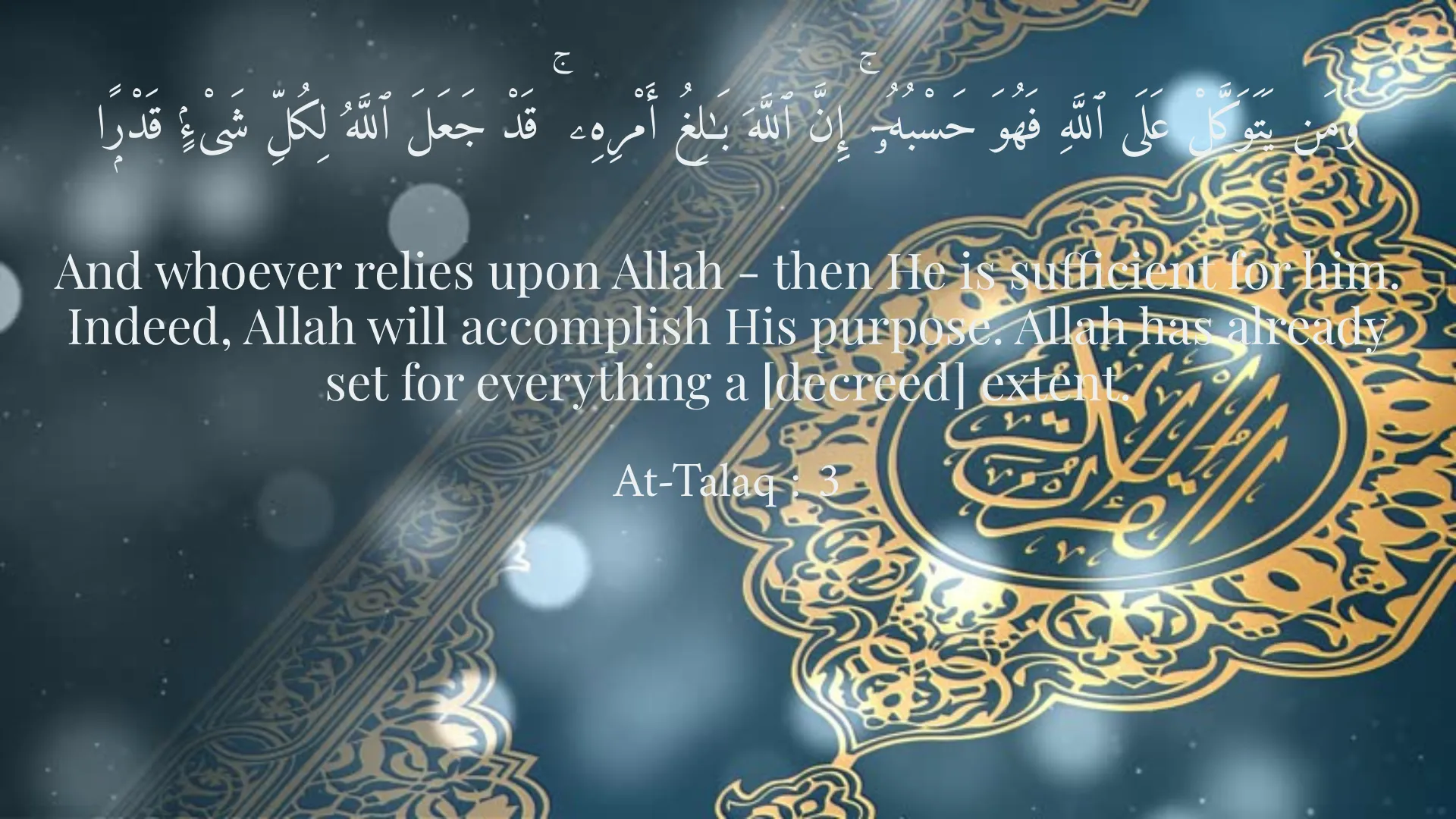
وَمَن يَتَوَكَّلْ عَلَى ٱللَّهِ فَهُوَ حَسْبُهُۥٓ ۚ إِنَّ ٱللَّهَ بَـٰلِغُ أَمْرِهِۦ ۚ قَدْ جَعَلَ ٱللَّهُ لِكُلِّ شَىْءٍۢ قَدْرًۭا
And whoever relies upon Allah - then He is sufficient for him. Indeed, Allah will accomplish His purpose. Allah has already set for everything a [decreed] extent.
At-Talaq : 3
يَـٰٓأَيُّهَا ٱلنَّاسُ إِنَّا خَلَقْنَـٰكُم مِّن ذَكَرٍۢ وَأُنثَىٰ وَجَعَلْنَـٰكُمْ شُعُوبًۭا وَقَبَآئِلَ لِتَعَارَفُوٓا۟ ۚ إِنَّ أَكْرَمَكُمْ عِندَ ٱللَّهِ أَتْقَىٰكُمْ ۚ إِنَّ ٱللَّهَ عَلِيمٌ خَبِيرٌۭ
O mankind, indeed We have created you from male and female and made you peoples and tribes that you may know one another. Indeed, the most noble of you in the sight of Allah is the most righteous of you. Indeed, Allah is Knowing and Acquainted.
Al-Hujurat : 13
وَإِذْ قَالَ رَبُّكَ لِلْمَلَـٰٓئِكَةِ إِنِّى جَاعِلٌۭ فِى ٱلْأَرْضِ خَلِيفَةًۭ ۖ قَالُوٓا۟ أَتَجْعَلُ فِيهَا مَن يُفْسِدُ فِيهَا وَيَسْفِكُ ٱلدِّمَآءَ وَنَحْنُ نُسَبِّحُ بِحَمْدِكَ وَنُقَدِّسُ لَكَ ۖ قَالَ إِنِّىٓ أَعْلَمُ مَا لَا تَعْلَمُونَ
And [mention, O Muhammad], when your Lord said to the angels, "Indeed, I will make upon the earth a successive authority." They said, "Will You place upon it one who will cause corruption therein and shed blood, while we declare Your praise and sanctify You?" Allah said, "Indeed, I know that which you do not know."
Al-Baqarah : 30
Short Story
One day, a wealthy and powerful king asked a pious and poor scholar who lived in solitude: "O virtuous man, how is it that despite your poverty, you possess such a cheerful countenance and a tranquil heart? I, the king of seven realms, find less peace in my heart than you." The scholar, with a warm smile, replied: "O King! I have placed my trust in a Lord whose treasures are boundless and whose generosity knows no end. My heart is firm in Him, and I know that my sustenance is His responsibility, and my honor and humility come from Him. But you have relied on the wealth and power of this world, which are ephemeral and constantly at risk of perishing. Therefore, I have attained a self-confidence that is free from reliance on what is perishable, and in this freedom, I have found true peace and self-assurance that is superior even to your kingdom." The king was astonished by this wise saying and understood the depth of true peace and self-confidence.