Quranic Answer
Pride, or 'kibr' in Arabic, is one of the most destructive spiritual and psychological ailments from an Islamic perspective, deeply rooted in Quranic teachings. This undesirable trait is the source of many sins and deviations, acting as a major barrier to spiritual growth and the establishment of a proper connection with the Creator and His creation. To discern whether pride has taken root within us, we must refer to the signs and characteristics that the Holy Quran outlines for the humble, and in contrast, for the arrogant. The Quran explicitly warns that Allah Almighty does not love the arrogant and does not guide them. For instance, in Surah Luqman, verse 18, it states: "And do not turn your cheek away from people in contempt, nor walk through the earth exultantly. Indeed, Allah does not like every self-deluded and boastful [person]." This verse provides a clear criterion: any behavior, speech, or even thought that smacks of superiority, self-admiration, or belittling others is a sign of pride. For a deeper understanding, we must delve into the roots of pride. The primary root of pride is ignorance; ignorance of the Creator's grandeur, ignorance of one's own weakness and neediness, and ignorance of the inherent dignity of other servants of God. A person who sees themselves as insignificant before the infinite power of Allah and understands that everything they possess is by His grace and mercy will find no room for pride within them. From the Quranic perspective, one of the most crucial indicators of the absence of pride is humility and modesty. The true servants of God are described in Surah Al-Furqan, verse 63, as: "And the servants of the Most Merciful are those who walk upon the earth easily and humbly, and when the ignorant address them [harshly], they say [only], 'Peace.'" This verse not only refers to the manner of walking, which symbolizes a person's overall demeanor, but also addresses how one interacts with the ignorant and foolish. A humble individual, when faced with insult or inappropriate behavior, responds with patience and magnanimity instead of retaliation or assertion of superiority. This demonstrates that their self-worth is not dependent on others' reactions, and they do not feel the need to prove themselves. Another criterion for assessing pride is the acceptance of truth and advice. Arrogant individuals often refuse to acknowledge their faults and mistakes, interpreting any advice or criticism as disrespect or humiliation. In contrast, someone in whom pride has not taken root seeks truth and welcomes counsel, even if it comes from someone seemingly inferior to them. This characteristic is beautifully illustrated in the story of Prophet Moses and Al-Khidr (peace be upon them) in Surah Al-Kahf, where Moses (PBUH), despite his prophetic stature, demonstrates humility in seeking knowledge from Al-Khidr. The absence of boasting about one's possessions, whether material or spiritual, is another sign of freedom from pride. Qarun (Korah) was a symbol of pride in wealth, as mentioned in Surah Al-Qasas, verse 76: "Indeed, Qarun was from the people of Moses, but he tyrannized them. And We gave him of treasures that the keys thereof would burden a band of strong men. When his people said to him, 'Do not exult. Indeed, Allah does not like the exultant.'" This verse and the subsequent ones refer to Qarun's fate, who was swallowed by the earth due to his pride. Therefore, if someone becomes arrogant about their knowledge, beauty, power, wealth, or even their acts of worship, considering them their own achievements and flaunting them to others, it indicates the presence of pride. A true believer acknowledges every blessing as coming from Allah and is grateful, not proud. Striving to serve others and feeling responsible towards society is yet another indicator of the absence of pride. The arrogant individual sees themselves as the center of the universe and expects everyone to serve them, whereas the humble person approaches life with a servant's mentality, considering themselves a servant of Allah's creation. The Prophet Muhammad (PBUH), who was the epitome of humility, always served people and never considered himself superior to others. Finally, one of the most important methods for diagnosing and treating pride is continuous self-purification and introspection. A person must constantly review their actions and intentions, examining whether there is even a trace of superiority, belittling others, or rejection of truth in their conduct. Remembering death and the transience of this world, recalling one's origin and ultimate return to Allah, and contemplating the infinite majesty of God, all can help a person cast aside their illusory grandeur and submit to truth. Let us remember that the more one's knowledge and understanding of Allah's greatness increase, the deeper the sense of humility and reverence will become within them, serving as the best shield against the infiltration of pride.
Related Verses
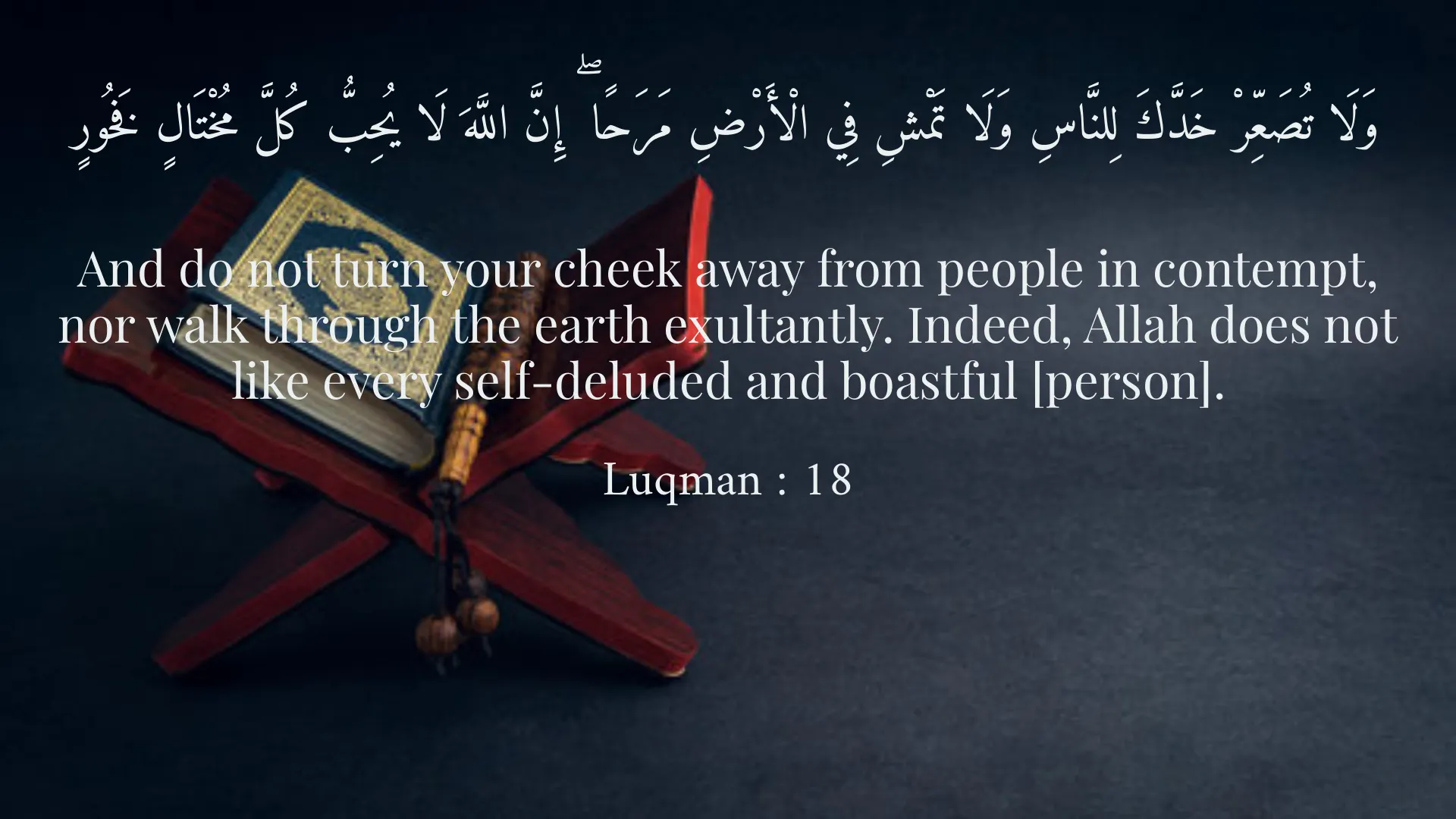
وَلَا تُصَعِّرْ خَدَّكَ لِلنَّاسِ وَلَا تَمْشِ فِي الْأَرْضِ مَرَحًا ۖ إِنَّ اللَّهَ لَا يُحِبُّ كُلَّ مُخْتَالٍ فَخُورٍ
And do not turn your cheek away from people in contempt, nor walk through the earth exultantly. Indeed, Allah does not like every self-deluded and boastful [person].
Luqman : 18
وَعِبَادُ الرَّحْمَٰنِ الَّذِينَ يَمْشُونَ عَلَى الْأَرْضِ هَوْنًا وَإِذَا خَاطَبَهُمُ الْجَاهِلُونَ قَالُوا سَلَامًا
And the servants of the Most Merciful are those who walk upon the earth easily and humbly, and when the ignorant address them [harshly], they say [only], 'Peace.'
Al-Furqan : 63
إِنَّ قَارُونَ كَانَ مِن قَوْمِ مُوسَىٰ فَبَغَىٰ عَلَيْهِمْ ۖ وَآتَيْنَاهُ مِنَ الْكُنُوزِ مَا إِنَّ مَفَاتِحَهُ لَتَنُوءُ بِالْعُصْبَةِ أُولِي الْقُوَّةِ إِذْ قَالَ لَهُ قَوْمُهُ لَا تَفْرَحْ إِنَّ اللَّهَ لَا يُحِبُّ الْفَرِحِينَ
Indeed, Qarun was from the people of Moses, but he tyrannized them. And We gave him of treasures that the keys thereof would burden a band of strong men. When his people said to him, 'Do not exult. Indeed, Allah does not like the exultant.'
Al-Qasas : 76
Short Story
It is narrated that a very wealthy and arrogant man, one day adorned in luxurious and dazzling attire, passed by a humble and ascetic dervish. The rich man looked down upon the dervish with disdain and self-importantly said: 'It is you who lives in poverty and simplicity, and it is I who am immersed in blessings, status, and prestige.' The dervish, with a calm smile and an illuminated heart, replied: 'O noble man, this difference is merely in outward appearance. Otherwise, I, in my old clothes and with a tranquil heart, am happier than you, who, despite your gold and jewels, possess a heart filled with fear. For you dread that what you possess might diminish, while I have no fear of my poverty, for I know that all belongs to Him and to Him it shall return. True honor lies in contentment and independence from creation, not in accumulating wealth.' The rich man was initially offended by the dervish's words, but as time passed and he experienced life's ups and downs, he came to understand the dervish's meaning and embraced humility and contentment. He realized that true wealth is peace of heart and freedom from pride.