Quranic Answer
Addressing the crucial question of how to avoid arrogance in the face of praise and fame is deeply rooted in the profound and fundamental teachings of the Holy Quran. The Quran, as a beacon of guidance for humanity, offers practical and comprehensive solutions for confronting psychological and ethical challenges, including the hidden traps of pride and arrogance. While praise and fame might initially appear as desirable and sweet achievements, they can in reality transform into a significant test for one's faith, character, and ethics. Indeed, they can pave the way for the emergence of one of the most perilous spiritual maladies: arrogance and self-admiration, which the Quran vehemently warns against and highlights their severe consequences. At the zenith of adoration and popularity, individuals require continuous reminders and profound self-awareness to safeguard themselves from this immense spiritual downfall. One of the primary and most powerful Quranic strategies for combating arrogance is the constant and deep remembrance of the true source of all success, talent, or virtue that a person possesses. One must always and at every moment bear in mind that every blessing – be it extensive knowledge, physical beauty, innate talents, abundant wealth, high social status, or even widespread popularity and fame – all are gifts and bounties from Almighty Allah, and not merely the result of personal efforts or inherent superiority. This foundational concept is explicitly emphasized in numerous verses of the Holy Quran. For instance, in Surah An-Nahl, verse 53, Allah explicitly states: "And whatever you have of favor - it is from Allah." (Quran 16:53). When a person attains this deep and internal conviction that everything they possess is due to divine grace and generosity, and not solely by their own merit, there remains no room for self-praise, arrogance, or boasting. Praises and commendations from others, instead of leading an individual towards self-admiration and conceit, should in fact guide them towards greater gratitude and thankfulness to Almighty Allah. If someone attributes their successes solely to their own abilities and efforts, they easily fall into the snare of arrogance; but if they perceive them as a manifestation of divine favor and mercy, their humility towards both the Creator and creation increases. The second and highly effective strategy is to pay attention to the fleeting and unstable nature of this world and all its manifestations. Worldly fame and praise, like other material possessions and transient pleasures, are temporary and impermanent. What truly matters in the end and what endures is the pleasure of Allah and the reward in the Hereafter, for which humanity was created. This Hereafter-centric perspective, which is referenced and emphasized in many Quranic verses, prevents a person from becoming excessively attached to worldly fame and reputation, and from making them their ultimate goal and aspiration. In Surah Al-Qasas, verses 79-82, after describing Qarun, who became arrogant and intoxicated by his immense wealth and fame, Allah narrates his bitter end. In verse 80, it is stated: "But those who had been given knowledge said, 'Woe to you! The reward of Allah is better for he who believes and does righteousness, and none are granted it except the patient ones.'" (Quran 28:80). This verse clearly shows that true value and real happiness lie in the divine reward, not in worldly luxuries and fleeting compliments. Worldly fame can be like a beautiful bubble that bursts with the slightest touch of reality, but divine pleasure and the reward of the Hereafter are eternal and lasting. The third strategy involves the constant remembrance of humanity's true position before the boundless grandeur of the Almighty. No matter how powerful, famous, wealthy, or successful a person may be in this world, they are but a small, transient, and powerless being before the One, incomparable Creator. This continuous reminder and self-awareness prevent the self from inclining towards arrogance and conceit. Many verses in the Holy Quran refer to this truth and forbid arrogance. In Surah Luqman, verse 18, Allah, through the words of the wise Luqman advising his son, says: "And do not turn your cheek [in contempt] toward people and do not walk through the earth exultantly. Indeed, Allah does not like every self-deluded and boastful person." (Quran 31:18). This verse directly warns against arrogant behaviors and pride stemming from fame or high social standing. Walking with haughtiness, looking down on others, belittling, and self-admiration are all clear manifestations of arrogance that are strongly condemned in the Holy Quran and distance a person from divine mercy. The fourth strategy is the active cultivation of humility. Humility must be practiced not only before Almighty Allah but also towards all His creatures, with utmost respect and courtesy. Prophet Muhammad (peace be upon him), who attained the pinnacle of spiritual and social status, was always the epitome of humility. Despite his unparalleled position as the Messenger of Allah, he never succumbed to arrogance and treated everyone – rich and poor, young and old – with the utmost humility, kindness, and respect. The Holy Quran in Surah Al-Furqan, verse 63, describes the distinguished qualities of Allah's special servants as follows: "And the servants of the Most Merciful are those who walk upon the earth easily, and when the ignorant address them [harshly], they say [words of] peace." (Quran 25:63). This verse indicates that humility in movement, speech, and all aspects of life is a characteristic of true believers and those close to Allah. When fame and praise reach their peak, maintaining this humility becomes more challenging, but by constantly recalling divine majesty and our own insignificance, we can successfully pass this great test and keep our hearts pure from the defilement of arrogance. Finally, avoiding heedlessness and maintaining constant remembrance of Allah is crucial. Arrogance often thrives and strengthens in an environment of heedlessness towards God and His infinite power. A person who is continuously engaged in the remembrance of Allah perceives themselves in His presence and thus avoids any form of arrogance and self-admiration. The Holy Quran in Surah Al-A'raf, verse 205, states: "And remember your Lord within yourself in humility and in fear without loudness in words in the mornings and in the evenings, and do not be among the heedless." (Quran 7:205). This verse emphasizes that the remembrance of Allah must be accompanied by humility and heartfelt awe, and one should not be heedless of this remembrance even for a moment. Persistence in daily prayers, supplication to Allah, regular recitation and contemplation of the Quran, and reflection on divine creation and power are all spiritual tools that keep a person away from heedlessness and, consequently, from the deadly disease of arrogance, establishing them firmly on the path of servitude and humility. In summary, arrogance in the face of praise and fame is a significant and perilous test that can be overcome by relying on Quranic teachings. The constant reminder that every blessing is from Allah, acknowledging the transient and perishable nature of this world, recognizing one's true and humble place before divine majesty, cultivating and demonstrating practical humility in all aspects of life, active and continuous gratitude in word and deed, and constant and heartfelt remembrance of Allah, are the strong and firm pillars for combating this undesirable and destructive trait. This path not only protects a person from the danger of arrogance and its dire consequences but also guides them towards continuous spiritual growth, proximity to Allah, and attaining His pleasure, granting them lasting, true, and profound tranquility that no worldly fame or status can equal. These guidelines are applicable, essential, and vital for every individual in every walk of life, ensuring that their heart remains pure and undefiled by the blight of arrogance, always moving on the path of divine pleasure.
Related Verses
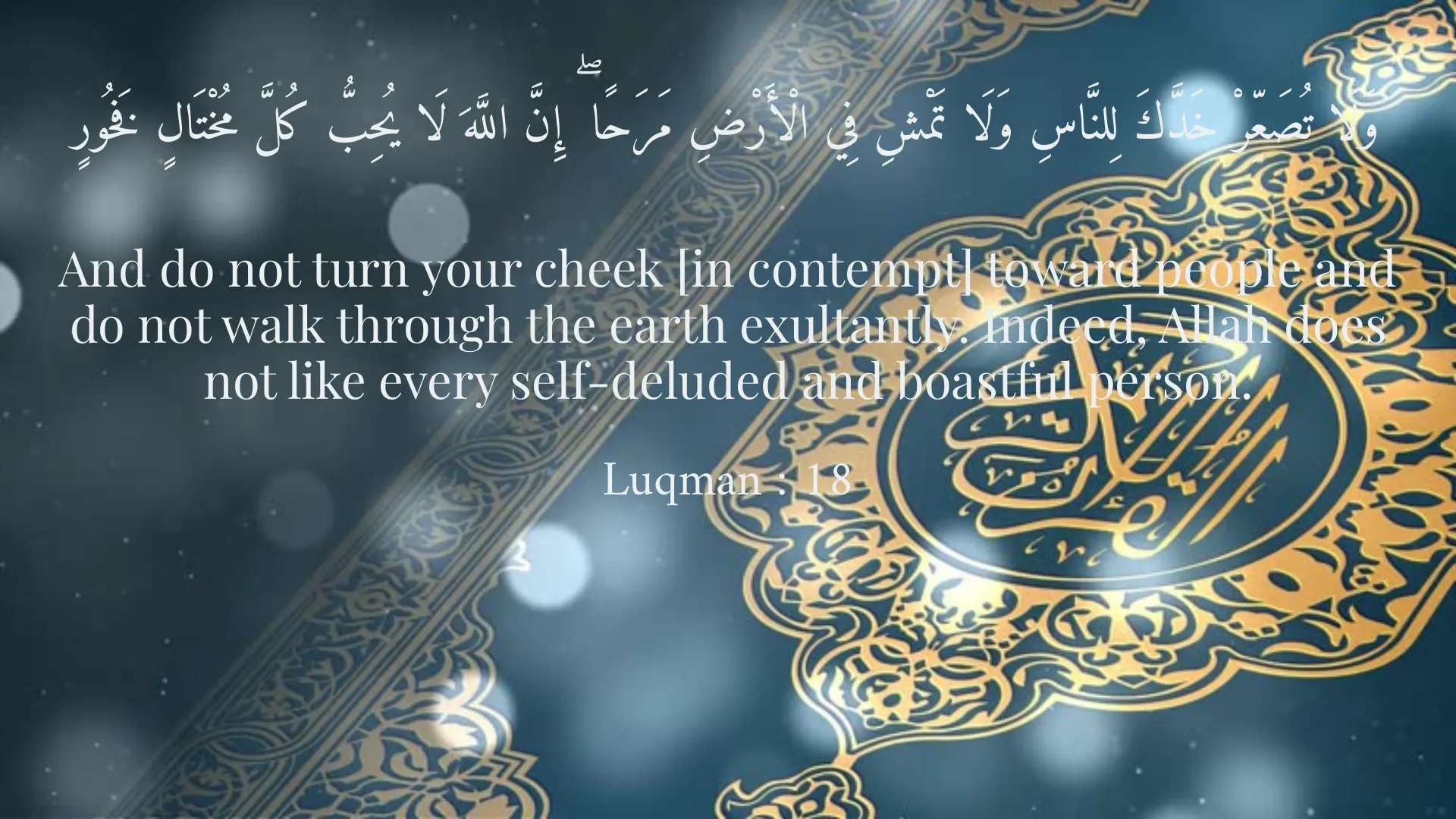
وَلَا تُصَعِّرْ خَدَّكَ لِلنَّاسِ وَلَا تَمْشِ فِي الْأَرْضِ مَرَحًا ۖ إِنَّ اللَّهَ لَا يُحِبُّ كُلَّ مُخْتَالٍ فَخُورٍ
And do not turn your cheek [in contempt] toward people and do not walk through the earth exultantly. Indeed, Allah does not like every self-deluded and boastful person.
Luqman : 18
لَا جَرَمَ أَنَّ اللَّهَ يَعْلَمُ مَا يُسِرُّونَ وَمَا يُعْلِنُونَ ۚ إِنَّهُ لَا يُحِبُّ الْمُسْتَكْبِرِينَ
Undoubtedly, Allah knows what they conceal and what they declare. Indeed, He does not like the arrogant.
An-Nahl : 23
وَاذْكُر رَّبَّكَ فِي نَفْسِكَ تَضَرُّعًا وَخِيفَةً وَدُونَ الْجَهْرِ مِنَ الْقَوْلِ بِالْغُدُوِّ وَالْآصَالِ وَلَا تَكُن مِّنَ الْغَافِلِينَ
And remember your Lord within yourself in humility and in fear without loudness in words in the mornings and in the evenings, and do not be among the heedless.
Al-A'raf : 205
Short Story
It is narrated that in ancient times, there was a just and beloved king whose fame for justice and generosity spread far and wide. People praised him with fervor and excitement, and wherever his name was mentioned, there was nothing but admiration. One day, a courtier asked him, "O virtuous king! With all this praise and admiration you receive, how is it that not a speck of arrogance is ever seen on your face, and you remain perpetually humble and modest?" The king smiled and said, "My dear friend, I know well that all this power and grandeur are from the grace of the Almighty, and these praises are also a blessing from Him, so that I may adhere more to His path and serve His creatures. How can I be arrogant about something that is a divine trust and perishable? Whenever people praise me, my heart remembers the greatness of the Creator, and I realize my own insignificance before His majesty. I know that this worldly fame is like a fleeting breeze, and what remains is righteous deeds and the pleasure of the Most High." And thus, the king always possessed a humble heart at the peak of his fame, and remained safe from the snare of arrogance.