Quranic Answer
The exalted teachings of the Holy Quran provide a clear path to achieving balance between the material and spiritual dimensions of life. Islam does not advocate for a separation of these two realms; rather, it considers them interconnected and complementary. The key to this balance is the Quranic concept of 'Wasatiyyah,' or moderation, which calls upon Muslims to avoid extremism and negligence in all aspects of life. The Quran never encourages monasticism or the abandonment of worldly life, just as it condemns being solely immersed in materialism. Instead, it portrays worldly life as the 'sowing field for the Hereafter' and a means to attain eternal bliss. One of the most eloquent verses illustrating this concept is Surah Al-Qasas, verse 77, which states: "But seek, through that which Allah has given you, the home of the Hereafter; and [yet], do not forget your share of the world. And do good as Allah has done good to you. And desire not corruption in the land. Indeed, Allah does not like corrupters." This verse establishes a fundamental principle: we should utilize the worldly blessings Allah has bestowed upon us to prepare for the Hereafter, while simultaneously not neglecting our legitimate and lawful share of this world. This implies that work, effort, earning a lawful livelihood, raising a family, enjoying the permissible beauties of this world, and attending to financial matters are not only allowed but, when done with divine intention and within the framework of Islamic ethics, are considered acts of worship. Therefore, striving to fulfill material needs, if aimed at seeking Allah's pleasure, supporting one's family, and serving the community, can serve as a means for spiritual growth. Another verse that highlights this balance is Surah Al-Jumu'ah, verse 10: "And when the prayer has been concluded, disperse within the land and seek from the bounty of Allah, and remember Allah often that you may succeed." This verse, immediately after commanding the establishment of the Friday prayer, a great collective act of worship, instructs believers to then disperse in the land and seek livelihood. This directive demonstrates that worldly activities should not impede the remembrance of Allah; rather, they should be accompanied by it and even become a means of remembering Allah and showing gratitude for His blessings. Constant remembrance (Dhikr) of Allah during daily activities helps a person maintain their connection with the Creator amidst worldly preoccupations and escape the snare of heedlessness. This continuous mindfulness keeps the heart alive and purifies intentions, so much so that even a business transaction or a professional activity can transform into an act of worship if performed with the right intention and adherence to justice and fairness. The Holy Quran teaches believers that the best supplication is to seek good in both this world and the Hereafter simultaneously, as we read in Surah Al-Baqarah, verse 201: "And among them are those who say, 'Our Lord, give us in this world [that which is] good and in the Hereafter [that which is] good and protect us from the punishment of the Fire.'" This supplication not only shows that seeking good in this world does not contradict seeking good in the Hereafter but that both are interdependent. True happiness in Islam's view is a synthesis of these two: a material life built upon spiritual values and oriented towards the noble goal of divine pleasure and the eternal blessings of the Hereafter. This balance ensures that a person does not merely accumulate worldly wealth and status but utilizes these resources to promote justice, perform good deeds, assist the needy, and enhance the quality of life for themselves and others on the path to drawing closer to Allah. Ultimately, balancing material and spiritual life means viewing this world as a tool to reach the Hereafter, not as the ultimate goal. This perspective grants us peace and purpose, making our lives full of meaning and blessings, because every step we take, whether in work or worship, takes on a divine color and guides us towards eternal bliss.
Related Verses
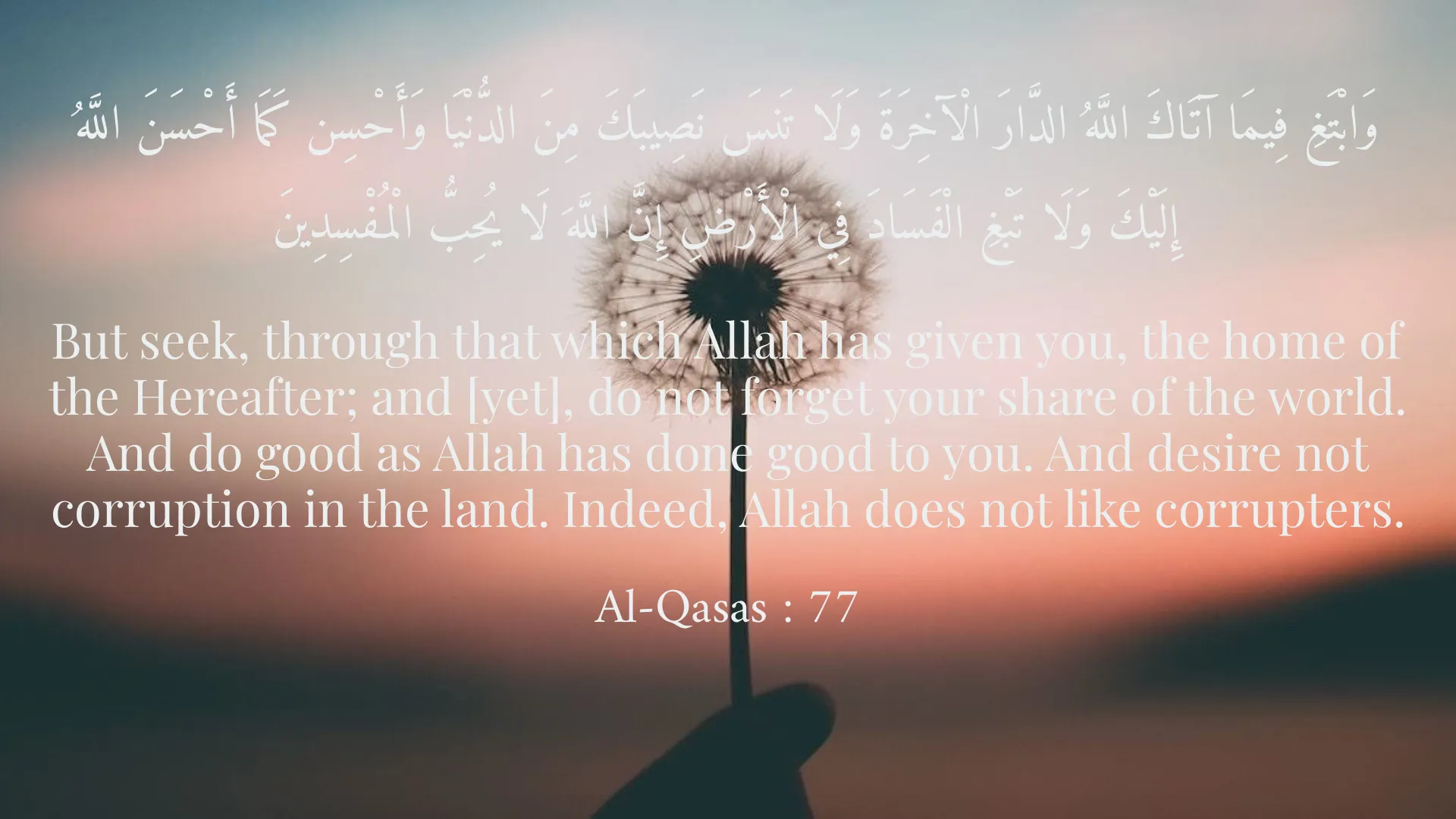
وَابْتَغِ فِيمَا آتَاكَ اللَّهُ الدَّارَ الْآخِرَةَ وَلَا تَنسَ نَصِيبَكَ مِنَ الدُّنْيَا وَأَحْسِن كَمَا أَحْسَنَ اللَّهُ إِلَيْكَ وَلَا تَبْغِ الْفَسَادَ فِي الْأَرْضِ إِنَّ اللَّهَ لَا يُحِبُّ الْمُفْسِدِينَ
But seek, through that which Allah has given you, the home of the Hereafter; and [yet], do not forget your share of the world. And do good as Allah has done good to you. And desire not corruption in the land. Indeed, Allah does not like corrupters.
Al-Qasas : 77
فَإِذَا قُضِيَتِ الصَّلَاةُ فَانتَشِرُوا فِي الْأَرْضِ وَابْتَغُوا مِن فَضْلِ اللَّهِ وَاذْكُرُوا اللَّهَ كَثِيرًا لَّعَلَّكُمْ تُفْلِحُونَ
And when the prayer has been concluded, disperse within the land and seek from the bounty of Allah, and remember Allah often that you may succeed.
Al-Jumu'ah : 10
وَمِنْهُم مَّن يَقُولُ رَبَّنَا آتِنَا فِي الدُّنْيَا حَسَنَةً وَفِي الْآخِرَةِ حَسَنَةً وَقِنَا عَذَابَ النَّارِ
And among them are those who say, "Our Lord, give us in this world [that which is] good and in the Hereafter [that which is] good and protect us from the punishment of the Fire."
Al-Baqarah : 201
Short Story
It is said that in ancient times, there lived a wealthy merchant who possessed abundant riches, yet his heart was always restless, and he tasted no peace. In the same city, there was an ascetic dervish who owned nothing but a worn cloak and a morsel of bread, yet his heart was illuminated by the light of knowledge, and his tongue was ever mindful of God. One day, the distressed merchant sought out the dervish and recounted his troubles. The dervish, with a gentle smile, said: "My friend, the difference between us is that you consider this world the destination, while I see it as a means to reach the ultimate abode. Wealth, if accumulated only for oneself, becomes a burden, but if spent in the way of God and for the benefit of creation, it becomes wings for flight. Conduct your business with the intention of pleasing God, not merely for accumulating riches. And at every opportunity, devote your heart to the remembrance of God and sincerely step onto the path of servitude. Then you will see how material possessions will serve your spiritual growth, and your life, like a garden full of flowers of wisdom and material fruits, will bear fruit simultaneously, and you will find true peace." The merchant listened to the dervish's words with an open heart. From then on, he neither completely abandoned the world nor forgot the Hereafter. He spent his wealth in good causes, conducted his business with honesty and fairness, and always had the remembrance of God on his lips. Before long, a tranquility settled in his heart that no treasure could buy, and from then on, he was a merchant who was prosperous in this world and also advanced on the path of the Hereafter.