Quranic Answer
Sincerity in prayer, known in Islamic culture as “Ikhlas,” is one of the fundamental pillars for the acceptance and effectiveness of supplication to the Lord. Prayer is not merely a movement of the tongue, but an opening of the heart and soul towards the Creator who is aware of all that is hidden and apparent, knowing what passes through all hearts. The Holy Quran repeatedly emphasizes the importance of sincerity in all acts of worship, including supplication (du'a). Ikhlas means purifying one's intention from any non-divine motive, making the pleasure of Allah the sole aim and purpose. When a person raises their hands in prayer with a pure heart and sincere intention, veils are lifted, and a direct and profound connection is established between the servant and the Creator. This intimate and unmediated connection forms the true essence of prayer, transforming it from a mere outward act into a deep spiritual experience. One of the most crucial aspects of sincerity in prayer is “Hudur al-Qalb,” or presence of heart. This implies that during the act of supplication, one's mind and soul are fully attentive to Allah, free from any worldly distractions or temptations. Just as numerous Quranic verses emphasize the necessity of humility (khushu') in formal prayer (Salah), this humility and presence of heart also apply to du'a. In Surah Al-Mu'minun, verse 2, Allah states: “Those who are during their prayer humbly submissive.” This humility and concentration not only enhance the quality of the supplication but also signify the inner sincerity of the individual in seeking and requesting from the Lord. A prayer offered out of mere habit, for show to others, or with a distracted mind unaware of the meaning of the words, lacks the spirit of sincerity and is unlikely to bear fruit; for, as stated in narrations, Allah does not answer the prayer of a heedless and distracted heart. To attain sincerity in prayer, several important principles must be observed. Firstly, one must have firm faith in Allah's infinite power and His knowledge of all our needs and inner secrets. It is this faith that strengthens the supplication and assures the person that their prayer is heard and will be answered at the appropriate time and in the best possible way. In Surah Al-Baqarah, verse 186, Allah says: “And when My servants ask you, [O Muhammad], concerning Me - indeed I am near. I respond to the invocation of the supplicant when he calls upon Me. So let them respond to Me [by obedience] and believe in Me that they may be [rightly] guided.” This verse clearly indicates that the acceptance of du'a is conditioned upon sincerity in seeking and firm belief in Allah's power and proximity. Secondly, avoiding “Riya,” or showing off, is a cornerstone of sincerity. Prayer should be solely for the pleasure of Allah and out of genuine need, not to attract the attention of others or gain reputation among people. Riya is the bane of sincerity and invalidates the value of any act of worship, as it shifts the goal from the Creator to the creation. The Holy Quran severely condemns those who perform their deeds for display, not for Allah. In Surah Al-Ma'un, verses 4-6, it states: “So woe to those who pray; [But] who are heedless of their prayer; Those who make show [of their deeds].” Although these verses refer to formal prayer (Salah), their meaning applies to all acts of worship, including du'a. Sincerity in du'a means that whether in private or public, our intention remains singular, addressing only the Creator. Thirdly, “Yaqin,” or certainty in the acceptance of prayer, even if the outcome does not appear immediately, is very important. Allah, with His profound wisdom, knows the best time and the best way for a supplication to be answered. Sometimes, an answer is delayed for a greater good to manifest for the servant, or to ward off some hardship or affliction. Patience and persistence in du'a are themselves signs of sincerity and trust in divine providence. A prayer accompanied by haste, despair, or lack of certainty in divine power may lack sufficient depth and sincerity. Certainty that Allah leaves no prayer unanswered, even if the response is in a form other than what we expect, brings peace to the heart and gives continuity to the prayer. Fourthly, repentance (Tawbah) and seeking forgiveness (Istighfar) before prayer pave the way for greater sincerity. Sins can create a significant veil and barrier between the servant and Allah, negatively impacting the sincerity of the supplication. Purifying the soul and self from the impurities of sin prepares the heart for a pure connection with the Lord. Acknowledging shortcomings and seeking forgiveness strengthens humility and submission within a person, which are key components of sincere prayer. The sincere supplicant first purifies themselves before the divine presence to become worthy of receiving divine favor. Fifthly, commencing the supplication with praise and glorification of Allah (Hamd and Thana) and sending blessings upon Prophet Muhammad (peace be upon him) and his purified family (Ahlul Bayt) is an etiquette that gives spirit and direction to the du'a. This introduction not only demonstrates reverence in the presence of the Lord but also aids in focusing the mind and heart, guiding the person from worldly clamor towards a spiritual realm. This practice facilitates sincere prayer and adds depth to it. Sincerity in supplication means inner and outer integrity. It means that what we utter with our tongue corresponds to what is in our heart. If we ask Allah for guidance, we must also strive to walk on the path of guidance in our actions and avoid what He has forbidden. If we seek forgiveness, we must genuinely regret our sins to the best of our ability and strive to abandon them. This harmony between word and deed is the true manifestation of sincerity in du'a and shows that prayers are not just words uttered, but expressions of one's inner state and practical commitment. Ultimately, sincerity in prayer is a continuous process that requires nurturing. The closer one gets to Allah and perceives Him present and observing in all aspects of life, the more sincere and profound their prayers will become. Sincere du'a not only helps change external circumstances but, more importantly, brings about an internal transformation in one's soul and character, connecting them to the source of divine peace and assurance. This path is a way to find inner tranquility and an unbreakable bond with the absolute power of the universe, which itself is the pinnacle of sincerity and servitude, and causes the human heart to be filled with divine light and true peace.
Related Verses
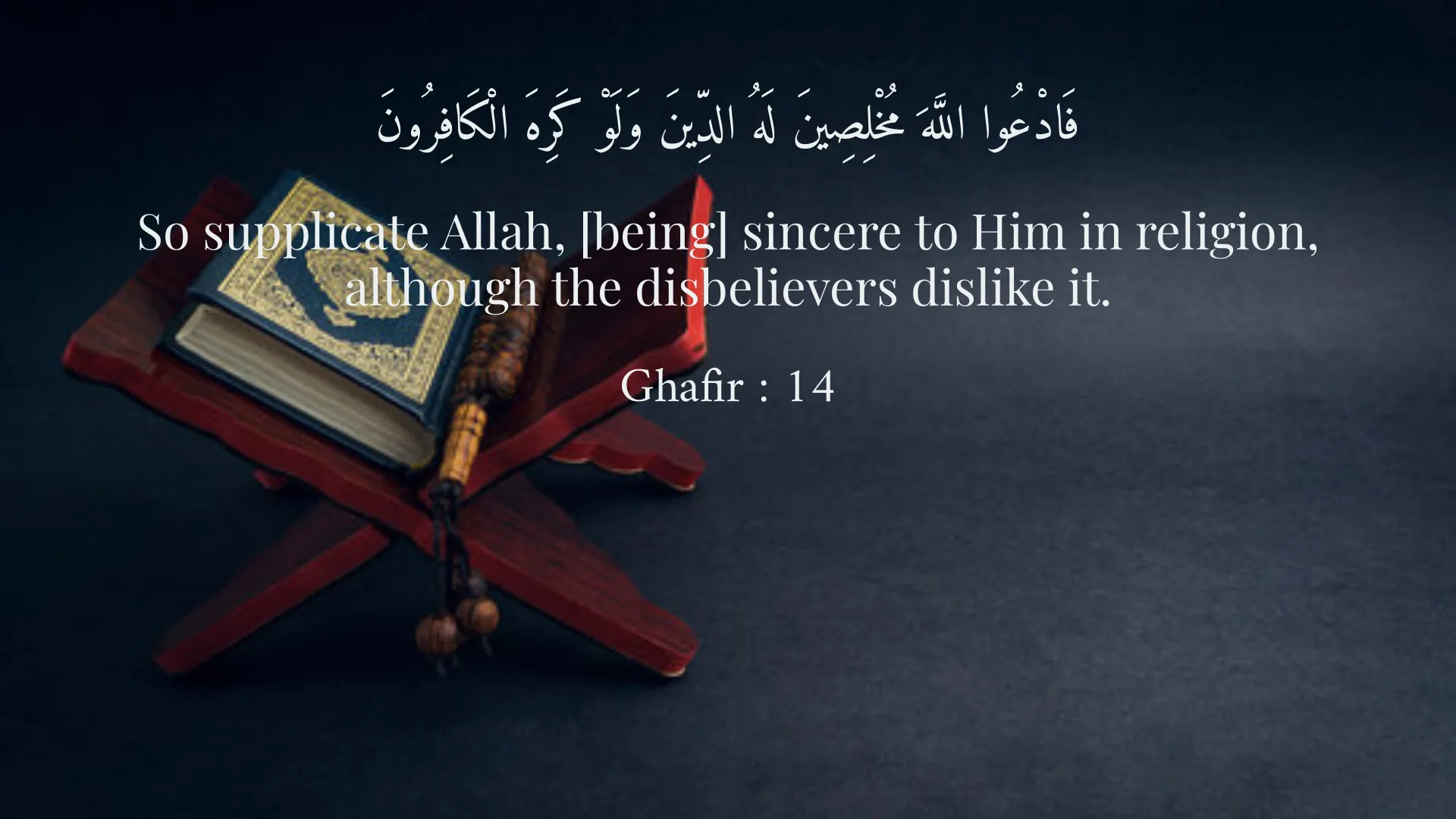
فَادْعُوا اللَّهَ مُخْلِصِينَ لَهُ الدِّينَ وَلَوْ كَرِهَ الْكَافِرُونَ
So supplicate Allah, [being] sincere to Him in religion, although the disbelievers dislike it.
Ghafir : 14
وَمَا أُمِرُوا إِلَّا لِيَعْبُدُوا اللَّهَ مُخْلِصِينَ لَهُ الدِّينَ حُنَفَاءَ وَيُقِيمُوا الصَّلَاةَ وَيُؤْتُوا الزَّكَاةَ ۚ وَذَٰلِكَ دِينُ الْقَيِّمَةِ
And they were not commanded except to worship Allah, [being] sincere to Him in religion, inclining to truth, and to establish prayer and to give zakah. And that is the correct religion.
Al-Bayyinah : 5
قُلْ أَمَرَ رَبِّي بِالْقِسْطِ ۖ وَأَقِيمُوا وُجُوهَكُمْ عِندَ كُلِّ مَسْجِدٍ وَادْعُوهُ مُخْلِصِينَ لَهُ الدِّينَ ۚ كَمَا بَدَأَكُمْ تَعُودُونَ
Say, [O Muhammad], 'My Lord has ordered justice and that you maintain yourselves [in worship] at every place of prostration, and invoke Him, sincere to Him in religion.' As He originated you, you will return.
Al-A'raf : 29
Short Story
It is narrated that there was a man who used to raise his voice excessively when praying, exerting himself to be seen by everyone. A wise elder observed him and smiled. He said: "O brother, from whom are you making your request? God is the All-Hearing and has no need of your loud voice. He hears even the silent sigh that arises from the heart. Sincerity in prayer is not in shouting, but in the whispers of the heart that no one but He hears." This saying made him ponder, and he realized that sincerity is the essence of prayer, not outward performance.