Quranic Answer
Arrogance is one of the unacceptable qualities in humans that is repeatedly condemned and forbidden in the Holy Quran. It is a trait that leads to a myriad of negative behaviors and attitudes, driving a wedge between individuals and promoting a false sense of superiority. This destructive characteristic not only harms relationships between people but also distances them from their Creator. The Quran emphasizes the importance of humility and civility in human interactions. This article aims to explore the concept of arrogance as discussed in the Quran and other Islamic teachings, providing an in-depth analysis of its implications, causes, and ways to combat this detrimental trait. In Surah Al-Isra, verse 37, Allah advises the believers, 'And do not walk upon the earth with arrogance. Indeed, you will never tear the earth, nor will you be as tall as the mountains.' This verse serves as a profound reminder of our place in the universe. In the grand scheme of creation, human beings are but a minute part of Allah's extraordinary design. Arrogance is a manifestation of a distorted self-view, where individuals elevate their own significance while diminishing the greatness of God and the majesty of His creations. The Quran seeks to instill a sense of humility in believers, highlighting that no matter what achievements one may acquire during their lifetime, they are ultimately insignificant compared to the power and authority of Allah. The Quran repeatedly emphasizes self-awareness and the recognition of human weaknesses as a means to combat arrogance. The first step in realizing one’s own limitations is to engage in self-reflection. In a world that constantly pushes individuals to succeed and stand out, it is crucial to remember that one's abilities and achievements are not solely their own doing but rather a result of divine assistance. As put forth in Nahj al-Balagha, the compilation of the teachings of Imam Ali (AS), one should consider self-love within the framework of truth. This means that instead of allowing self-love to foster arrogance, individuals should control their self-perception in accordance with the understanding of Allah’s greatness and their true worth in His eyes. The negative consequences of arrogance are manifold. Arrogant individuals often find themselves isolated and estranged from others. Their inflated sense of self-worth may result in dismissing others' viewpoints, undermining cooperation, and damaging the bonds of friendship and family. The arrogant person often believes they are superior because of career success, education, wealth, or social status. Such behaviors can lead to a lack of empathy, understanding, and compassion, qualities that are essential for fostering positive relationships within any community. The Quran also describes the believers in Surah Al-Furqan, verse 63, stating, 'And the servants of the Most Merciful are those who walk upon the earth humbly.' This verse encapsulates the essence of humility as a central characteristic of a devoted believer. Humility is not synonymous with weakness; rather, it is a sign of strength and self-awareness. A humble person recognizes their limitations and the value of others, which creates an environment conducive to support, kindness, and collective progress. By embodying humility, believers are reassured of their standing in the eyes of Allah, who loves those who exhibit such behavior. Combating arrogance requires a conscious effort. One effective means is through sincere prayer and seeking Allah's guidance. Praying for humility and to be devoid of arrogance can be tremendously beneficial, as it aligns the individual’s heart with divine will. Moreover, surrounding oneself with individuals who model humility and compassion can inspire positive changes in behavior. The company of humble people serves as a constant reminder of one’s own humanity and the importance of treating others with respect and dignity. Additionally, developing an attitude of gratitude can also minimize feelings of arrogance. Recognizing and appreciating Allah’s countless blessings fosters a sense of contentment with what one has, rather than fostering jealousy or feelings of superiority. Reflecting daily on the blessings one brings to their life enhances appreciation for Allah’s grace and encourages a more humble demeanor toward oneself and others. Moreover, a practice of active listening and open-mindedness in conversations reinforces humility. By genuinely acknowledging and respecting others' opinions and experiences, one develops the ability to understand and empathize with them. This not only combats arrogance but also fosters social harmony and stronger interpersonal relationships. Education plays a pivotal role in mitigating arrogance as well. Knowledge instills wisdom, and the wise recognize their own ignorance and the vastness of what there is to learn. In the pursuit of knowledge, one should remain aware that education is a tool to serve others and better oneself, not a means to elevate their status above others. It is vital to remain humble in the quest for learning, continuously attributing knowledge and understanding to Allah, rather than allowing it to inflate one’s ego. In conclusion, arrogance is an undesirable quality that disrupts relationships and distances individuals from both people and Allah. The teachings of the Holy Quran and practices of self-awareness, humility, gratitude, and active engagement with others serve as crucial methods in combating this trait. Believers are encouraged to seek Allah's help through prayer, surround themselves with humble companions, and constantly reflect on the blessings of life, embracing a mindset of humility. By doing so, one not only nurtures their spirit but also contributes to a more compassionate, understanding, and unified society.
Related Verses
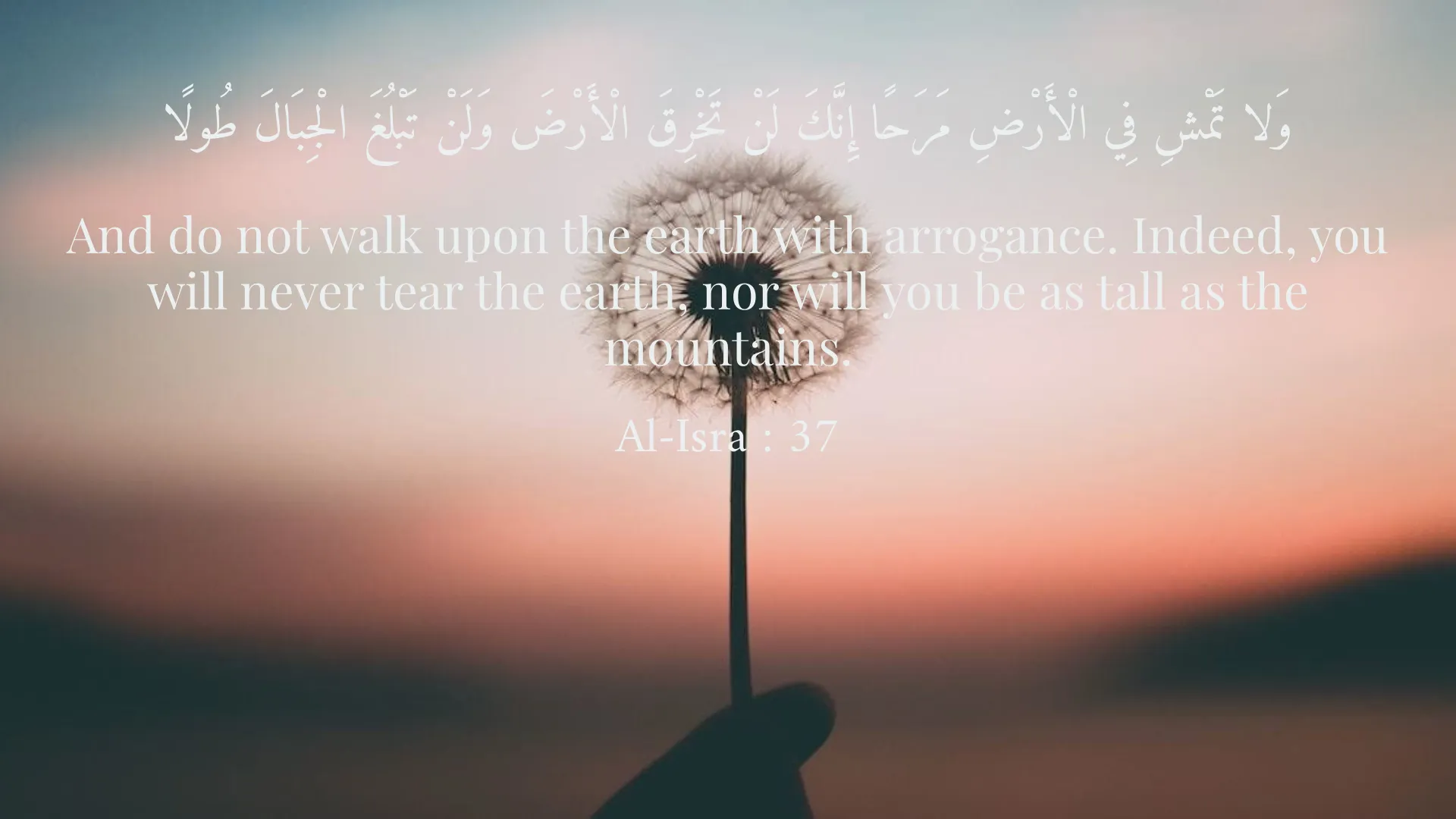
وَلا تَمْشِ فِي الْأَرْضِ مَرَحًا إِنَّكَ لَنْ تَخْرِقَ الْأَرْضَ وَلَنْ تَبْلُغَ الْجِبَالَ طُولًا
And do not walk upon the earth with arrogance. Indeed, you will never tear the earth, nor will you be as tall as the mountains.
Al-Isra : 37
وَعِبَادُ الرَّحْمَـٰنِ الَّذِين يَمْشُونَ عَلَى الْأَرْضِ هَوْنًا
And the servants of the Most Merciful are those who walk upon the earth humbly.
Al-Furqan : 63
Short Story
Once upon a time, there was a man named Hassan who was trying to make positive changes in his life. He sometimes felt that he had become arrogant due to his successes, but remembering the verses of the Quran helped him distance himself from that feeling. Over time, Hassan decided to help others with humility and learn that superiority lies only in the essence of Allah. He engaged in charitable works with his friends, which brought him more happiness and peace.