Quranic Answer
This profound and significant question touches upon the core Islamic understanding of truth and humanity's place in the universe. From an Islamic perspective, faith, science, and reason are not in conflict; rather, they are complementary paths that all lead to knowing the Creator and gaining a deeper understanding of His creation. The Holy Quran repeatedly invites human beings to reflect, reason, and ponder upon the divine signs (Ayat), both those observable in the cosmos (afaq) and those within human beings themselves (anfus). This approach provides a solid foundation for integrating faith with scientific discoveries and leveraging the power of reason. The first step in this integration is a correct understanding of each component's role. "Faith" provides the foundation and the ultimate purpose. Belief in God shapes our worldview and imbues our lives with meaning, purpose, and direction. Faith answers the fundamental "why" questions: Why does the universe exist? Why am I here? What is the purpose of life? Faith acts as a compass that guides our moral and spiritual path. It extends beyond dry logic, encompassing a sense of trust and submission to a Creator who is absolute goodness and absolute knowledge. This trust brings peace to the heart and serves as a strong anchor when facing the unknowns and complexities of life. Faith teaches us that the universe was not created in vain or without purpose, but that every particle within it is a sign of the Almighty Creator's power, wisdom, and beauty, and every discovery within it can draw us closer to Him. In contrast, "science" is a tool for discovering "how" the world works. Science involves observation, experimentation, analysis, and inference. It helps us uncover the laws governing nature, the structure of the universe, and the mechanisms of living beings. In Islam, the pursuit of knowledge (ilm) is not only encouraged but is considered an obligation. Numerous verses in the Quran highlight the importance of knowledge and call upon believers to reflect on creation. The Prophet Muhammad (peace be upon him) stated, "Seeking knowledge is obligatory upon every Muslim." This emphasis demonstrates that Islam considers the progress and elevation of humanity to be dependent on the acquisition of knowledge. Every new scientific discovery, such as the laws of gravity, the complexities of DNA, or the vastness of galaxies, can open new windows to God's magnificence and deepen faith. Science does not weaken faith; rather, if viewed with the correct perspective, it can strengthen it by revealing more signs of infinite divine power and creativity. This perspective transforms the scientist into an explorer of divine signs. "Reason" acts as a bridge between faith and science. Reason is a divine gift that grants humans the ability to argue, distinguish right from wrong, comprehend abstract concepts, solve problems, and make decisions. The Quran repeatedly urges people to "reason" (ta'qiloon) and "reflect" (yatafakkaroon). Reason is the tool by which we can understand divine revelations, both in the revealed book (the Quran) and in the book of creation (nature). Reason helps us resolve apparent contradictions, establish connections between scientific discoveries and religious concepts, and avoid extremism or intellectual stagnation. Reason enables us to process sensory data and scientific observations and place them within the framework of an informed worldview. This faculty prevents us from blind imitation and guides us towards critical thinking and the pursuit of truth, laying the groundwork for a deeper understanding of the unity and harmony of creation. To practically combine these three, the following points can be considered: Firstly, observation and reflection on Creation. The Quran constantly invites us to look at the heavens, the earth, mountains, seas, rain, plants, animals, and even at ourselves (e.g., Surah Adh-Dhariyat, verses 20-21). Every natural element is an "Ayat" or a sign that guides us towards the Creator. Scientific studies of these phenomena further introduce us to the details and intricacies of creation, increasing our awe of the Almighty. When a biologist examines the complexity of a cell or a physicist understands the laws governing the universe, they are, in fact, discovering signs of divine power and knowledge. These discoveries can transform faith from a purely theoretical level into a deep and tangible experience, enhancing a sense of humility and gratitude in humans. Secondly, acknowledging the limits of each. Science cannot answer all questions; for example, science cannot determine the ultimate purpose of existence or the absolute meaning of life. This is where faith comes into play, giving meaning to existence. On the other hand, faith should not hinder scientific inquiry and the discovery of truth. Both should operate within their respective domains but with mutual respect and a comprehensive understanding of each other. Where science reaches its limits, faith illuminates the path, and where faith requires a deeper understanding of itself and the world, science provides the tools. This coexistence does not create internal contradictions but forms a complete paradigm. Thirdly, Islamic history as a witness to this combination. During the Golden Age of Islamic civilization, Muslim scholars were pioneers in various scientific fields. Inspired by Islamic teachings that emphasized the pursuit of knowledge and wisdom, they made tremendous advancements in medicine, astronomy, mathematics, chemistry, and philosophy. For them, scientific inquiry was a form of worship and a means of drawing closer to knowing God. Ibn Sina, Jabir ibn Hayyan, Al-Khwarizmi, and others are prominent examples of scholars who combined deep faith with scientific insight, demonstrating that the two can go hand in hand. Fourthly, the role of reason in facing challenges. In cases where there appears to be a contradiction between religious texts and scientific findings, reason plays a vital role. Reason helps us to: interpret religious texts correctly and avoid superficial or illogical interpretations, distinguish between scientific theories (which may change) and established scientific facts, understand that human knowledge is limited and that our understanding of divine revelations or natural laws may become more complete over time. Also, always keep in mind that the Creator of the universe has instilled order and harmony in creation, and therefore, there is no true contradiction between definitive revelation and definitive science, and any conflict arises from misunderstanding or a deficiency in our knowledge. Ultimately, combining faith with science and reason means living a balanced and rich life. Faith that is devoid of reason and science can lead to superstition or blind fanaticism. And science that is devoid of faith and moral values can become a tool for destruction or for neglecting human dignity. Therefore, the synergy of these three not only paves the way for individual growth and development but also contributes to the progress of a wise and committed society. This balance helps individuals live in a world full of wonders, draw closer to their Creator, and better understand their responsibility towards the world and their fellow human beings. This coexistence leads humanity towards greater truths that transcend any compartmentalization and encompass all dimensions of its being. This is a path to achieving a comprehensive and integrated vision of existence and our role within it.
Related Verses
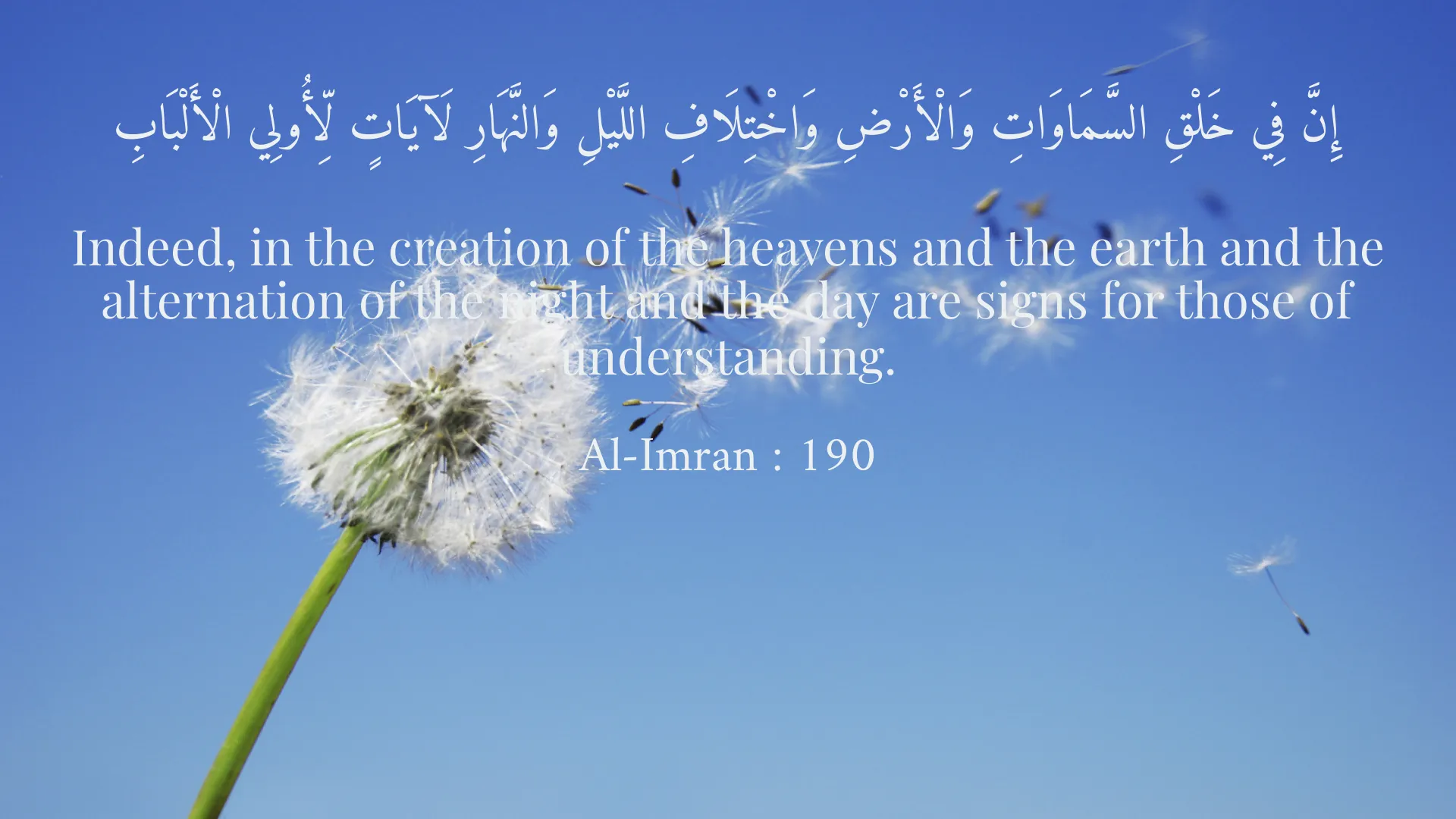
إِنَّ فِي خَلْقِ السَّمَاوَاتِ وَالْأَرْضِ وَاخْتِلَافِ اللَّيْلِ وَالنَّهَارِ لَآيَاتٍ لِّأُولِي الْأَلْبَابِ
Indeed, in the creation of the heavens and the earth and the alternation of the night and the day are signs for those of understanding.
Al-Imran : 190
الَّذِينَ يَذْكُرُونَ اللَّهَ قِيَامًا وَقُعُودًا وَعَلَىٰ جُنُوبِهِمْ وَيَتَفَكَّرُونَ فِي خَلْقِ السَّمَاوَاتِ وَالْأَرْضِ رَبَّنَا مَا خَلَقْتَ هَٰذَا بَاطِلًا سُبْحَانَكَ فَقِنَا عَذَابَ النَّارِ
Who remember Allah while standing or sitting or [lying] on their sides and give thought to the creation of the heavens and the earth, [saying], 'Our Lord, You did not create this in vain; exalted are You [above such a thing]; then protect us from the punishment of the Fire.'
Al-Imran : 191
وَفِي الْأَرْضِ آيَاتٌ لِّلْمُوقِنِينَ
And in the earth are signs for those of assured faith,
Adh-Dhariyat : 20
وَفِي أَنفُسِكُمْ أَفَلَا تُبْصِرُونَ
And in yourselves. Then will you not see?
Adh-Dhariyat : 21
يَرْفَعِ اللَّهُ الَّذِينَ آمَنُوا مِنكُمْ وَالَّذِينَ أُوتُوا الْعِلْمَ دَرَجَاتٍ ۚ وَاللَّهُ بِمَا تَعْمَلُونَ خَبِيرٌ
Allah will raise those who have believed among you and those who were given knowledge, by degrees. And Allah is Acquainted with what you do.
Al-Mujadila : 11
Short Story
In ancient times, there was a tireless student named 'Pazhohesh' (Researcher) who spent years delving into books of philosophy and science. He accumulated vast knowledge from every branch, yet felt a void in his heart. One day, he sought out an old, wise dervish and asked him, "O Sheikh, with all this knowledge, why do I not find peace, nor the complete truth?" The dervish, instead of lecturing, took his hand and led him to a lush garden. He told Pazhohesh, "Look at this flower, listen to this singing bird, and observe this flowing spring. Books teach you the 'how,' but nature, when observed with an awakened heart and discerning eye, reveals the 'why.' True knowledge blossoms when intellect bows before the wisdom of the Creator and science is illuminated by the light of faith." Pazhohesh pondered deeply upon nature, and from that day on, his study of science was infused with a profound sense of wonder and faith, and he understood how to blend knowledge and belief.