Quranic Answer
Facing the profound and often debilitating feelings of despair and depression, which can engulf the human spirit and dim the light of hope, the Holy Quran opens a window of unparalleled guidance and illumination. While the term 'depression' in its modern clinical sense is not directly mentioned in the Quran, it extensively addresses concepts such as despair (ya's), grief (huzn), sadness (gham), and anxiety, meticulously outlining ways to combat them and achieve inner peace. The Quran, as a book of guidance, teaches us how to remain steadfast like mountains against the towering waves of life's challenges, placing our trust in the boundless grace of the Almighty. These divine instructions not only serve as a balm for our spiritual wounds but also pave a path for profound inner growth and perfection. One of the most paramount Quranic principles in combating despair is its emphatic prohibition against losing hope in Allah's mercy. In Surah Az-Zumar, verse 53, Allah addresses humanity with profound kindness and compassion: "Say, 'O My servants who have transgressed against themselves [by sinning], do not despair of the mercy of Allah. Indeed, Allah forgives all sins. Indeed, it is He who is the Forgiving, the Merciful.'" This verse is a comforting message not only for sinners but for anyone entrapped in the abyss of hopelessness and self-blame. Despairing of Allah's mercy is tantamount to disregarding His boundless power and forgiveness. Such despair often stems from an excessive focus on past shortcomings, failures, and sins, whereas Allah desires us to always return to Him, fostering hope in His forgiveness and grace. Despair is a gateway through which Satan enters to divert humans from the path of truth. In the story of Prophet Ya'qub (Jacob) in Surah Yusuf, verse 87, he advises his sons: "O my sons, go and find out about Joseph and his brother and despair not of the relief of Allah. Indeed, no one despairs of relief from Allah except the disbelieving people." This demonstrates that even amidst the gravest hardships and the loss of dearest ones, the hope for divine relief must never be abandoned, for despairing of Allah's relief and solace is a characteristic of the disbelievers. This perspective transforms one's outlook from a passive, victimized stance to an active, hopeful approach. Secondly, a fundamental and deeply embedded solution offered by the Quran for confronting difficulties is seeking help through patience (Sabr) and prayer (Salat). In Surah Al-Baqarah, verse 153, it states: "O you who have believed, seek help through patience and prayer. Indeed, Allah is with the patient." Patience here is not merely passive endurance of problems; rather, it signifies active steadfastness and perseverance in Allah's path, self-control against temptations, and resilience in the face of adversities. Patience is an inner strength that fortifies an individual against hardships. Prayer, as the pillar of faith and the believer's ascension, is the most central tool for connecting with the infinite source of power and tranquility. During prayer, detached from worldly concerns, one directly communicates with their Lord, expressing grievances, making supplications, and submitting to His will. This profound connection purifies the soul and fills the heart with peace and assurance. Prayer and patience are like two wings that enable a person to soar through the skies of hardship, granting them the strength to face challenges. The third Quranic remedy is the remembrance of Allah (Dhikr), considered the primary source of inner peace. In Surah Ar-Ra'd, verse 28, Allah declares: "Those who have believed and whose hearts are assured by the remembrance of Allah. Unquestionably, by the remembrance of Allah hearts are assured." Dhikr transcends mere utterance of words; it encompasses presence of heart, contemplation of divine verses, recitation of the Quran, and seeking forgiveness (Istighfar). When one fills their heart with the remembrance of Allah, there is no room left for satanic whispers, undue sorrow, or anxiety. Remembering Allah constantly reminds an individual that they are not alone but are always under the watchful eye and support of a compassionate and wise Lord. This continuous remembrance empowers a person to transcend focus on personal problems and limitations and to ponder on divine majesty and wisdom. The Quran also teaches us that hardships and trials are an inseparable part of worldly life, and their purpose is to test and purify believers. In Surah Al-Baqarah, verse 155, it states: "And We will surely test you with something of fear and hunger and a loss of wealth and lives and fruits, but give good tidings to the patient." These verses offer a different perspective on calamities; they are not merely punishments but opportunities for growth, drawing closer to Allah, and expiation of sins. This insight helps individuals to view problems with a constructive and purposeful approach instead of feeling victimized and despairing, enabling them to learn lessons from every difficult experience. Another pivotal point in the Quran is the definite promise of "For indeed, with hardship [will be] ease. Indeed, with hardship [will be] ease." (Surah Ash-Sharh, verses 5 and 6). This repetition serves to emphasize and reassure believers that no hardship is everlasting, and ease follows every difficulty. These verses keep hope alive in hearts, reminding people that the dark tunnel of problems will eventually lead to light. This is a divine promise that never fails, instilling in humanity the power of resilience and hope for the future. Alongside these profound spiritual teachings, it is crucial to remember that severe and chronic depression is a clinical condition that can have physical and chemical dimensions. Islam consistently emphasizes the preservation of both physical and spiritual health and encourages seeking knowledge and remedies. The Prophet Muhammad (peace be upon him) said: "For every disease, there is a cure." (Sahih Muslim). Therefore, consulting mental health professionals (such as psychiatrists or psychologists) for diagnosis and appropriate therapeutic help is not contradictory to reliance on Allah; rather, it is part of utilizing the means provided by Allah for recovery. Faith and reliance on God complement scientific treatments, they do not replace them. Furthermore, practices such as maintaining a healthy diet, regular exercise, adequate sleep, fostering positive social connections, and helping others (which itself is a source of joy and satisfaction) can significantly contribute to improving one's mental state. Ultimately, by combining strong faith, reliance on Allah, adherence to Quranic teachings, and utilization of human knowledge, one can effectively cope with despair and depression and attain true tranquility.
Related Verses
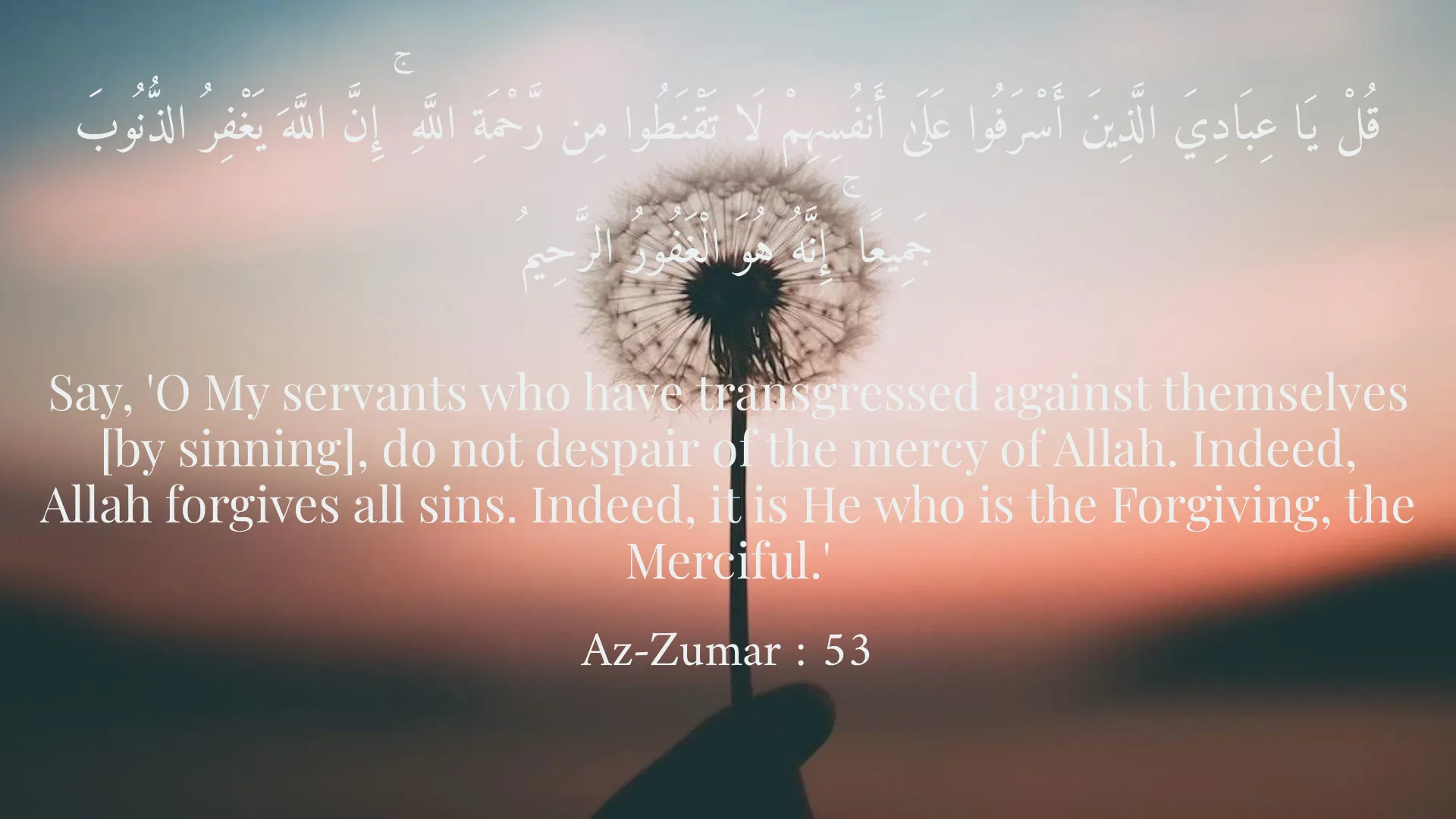
قُلْ يَا عِبَادِيَ الَّذِينَ أَسْرَفُوا عَلَىٰ أَنفُسِهِمْ لَا تَقْنَطُوا مِن رَّحْمَةِ اللَّهِ ۚ إِنَّ اللَّهَ يَغْفِرُ الذُّنُوبَ جَمِيعًا ۚ إِنَّهُ هُوَ الْغَفُورُ الرَّحِيمُ
Say, 'O My servants who have transgressed against themselves [by sinning], do not despair of the mercy of Allah. Indeed, Allah forgives all sins. Indeed, it is He who is the Forgiving, the Merciful.'
Az-Zumar : 53
يَا بَنِيَّ اذْهَبُوا فَتَحَسَّسُوا مِن يُوسُفَ وَأَخِيهِ وَلَا تَيْأَسُوا مِن رَّوْحِ اللَّهِ ۖ إِنَّهُ لَا يَيْأَسُ مِن رَّوْحِ اللَّهِ إِلَّا الْقَوْمُ الْكَافِرُونَ
O my sons, go and find out about Joseph and his brother and despair not of the relief of Allah. Indeed, no one despairs of relief from Allah except the disbelieving people.
Yusuf : 87
يَا أَيُّهَا الَّذِينَ آمَنُوا اسْتَعِينُوا بِالصَّبْرِ وَالصَّلَاةِ ۚ إِنَّ اللَّهَ مَعَ الصَّابِرِينَ
O you who have believed, seek help through patience and prayer. Indeed, Allah is with the patient.
Al-Baqarah : 153
الَّذِينَ آمَنُوا وَتَطْمَئِنُّ قُلُوبُهُم بِذِكْرِ اللَّهِ ۗ أَلَا بِذِكْرِ اللَّهِ تَطْمَئِنُّ الْقُلُوبُ
Those who have believed and whose hearts are assured by the remembrance of Allah. Unquestionably, by the remembrance of Allah hearts are assured.
Ar-Ra'd : 28
Short Story
It is narrated that a wealthy merchant lost his entire fortune when his ship sank at sea. Such deep sorrow and despair overcame him that he withdrew from everyone and sought solitude. One day, sitting alone in the marketplace of Baghdad in the guise of a pauper, a wise dervish saw him. The dervish, with a gentle smile, asked, "O friend, what sorrowful plight has withered you so?" The merchant, with a cold sigh, recounted his story. The dervish calmly replied, "O young man, know that though the sea takes treasures, it sometimes bestows pearls. Your true wealth is not in your lost coffers, but in your hopeful and trusting heart. Have you forgotten that He who takes is also capable of giving? Lift your head, for despair is a heavier burden than poverty. Trust in your Lord, and strive anew, for after every dark night, a bright dawn is on its way." The merchant was stirred by these words and found solace. He returned to prayer and remembrance of God, and with renewed resolve, he set about his work. Although worldly wealth did not return to him quickly, a profound peace took root in his heart that no gold or silver could buy. He realized that true prosperity lay in the tranquility of the soul and unwavering hope in the grace of the Almighty.