Quranic Answer
Addressing the question of how to deal with hidden fears has deep roots in the luminous teachings of the Holy Quran. Fear is a natural emotion that Allah has instilled in human beings to protect them from dangers and encourage caution. However, sometimes these fears spiral out of control, becoming hidden and subconscious, thereby disrupting peace and comfort in life. The Holy Quran offers practical and profound solutions for confronting and overcoming these types of fears, primarily based on strengthening faith and connection with the Creator of the universe. One of the most fundamental Quranic principles for dealing with hidden fears is "Tawakkul alal-Allah" – absolute reliance on God. Tawakkul means placing complete trust in the infinite power, knowledge, and wisdom of Allah. When a person understands that all affairs are in His hands and that He is capable of all things, their heart finds tranquility and is freed from worries about the future or undesirable events. In Surah At-Talaq, verse 3, we read: "And whoever relies upon Allah - then He is sufficient for him." This verse is a divine guarantee for those who surrender their hearts to Allah. Tawakkul does not mean abandoning effort and struggle; rather, it means exerting one's utmost effort and then entrusting the outcome to divine providence. Hidden fears often stem from uncertainties and a feeling of lack of control over circumstances. Tawakkul lifts this heavy burden from a person's shoulders and connects them to the source of all power and peace. Indeed, Tawakkul teaches a person that they are a tiny speck in the universe, and a vast, boundless force supports them. This perspective significantly reduces the fear of the unknown, the fear of loss, the fear of failure, and even the fear of others' judgment, because one realizes that divine decree and planning are superior and transcend any human design. Trusting in Allah brings a heart filled with certainty that will not waver in the face of life's storms. This certainty not only lessens the intensity of fears but also transforms them into opportunities for growth and closer proximity to Allah. It fosters a deep sense of security, knowing that ultimately, whatever befalls you is by Allah's will, and His will is always just and wise, even if its wisdom is not immediately apparent to us. This deep understanding allows one to embrace challenges not as threats, but as tests or opportunities for divine blessings. A second Quranic solution is "Dhikr Allah" – the remembrance of Allah. The Quran explicitly states in Surah Ar-Ra'd, verse 28: "Unquestionably, by the remembrance of Allah hearts are assured." This verse is a healing prescription for any anxiety and fear. The remembrance of Allah is not merely repeating words; it is the presence of the heart and constant attention to His greatness, mercy, power, and presence. When a person remembers Allah at every moment and in every state, they create an inner space of security and tranquility that fears cannot penetrate. Prayer (Salat), recitation of the Quran, supplication (Du'a), and even contemplation of creation are all forms of Dhikr that can cleanse the heart from turmoil and worries. Specific forms of Dhikr, such as "Hasbunallahu wa Ni'mal Wakeel" (Allah is sufficient for us, and He is the best Disposer of affairs) or "La hawla wa la quwwata illa billah" (There is no might or power except with Allah), are particularly effective in moments of fear and anxiety. These remembrances connect a person to the inexhaustible source of power and remind them that they are not alone and have unparalleled support. This continuous remembrance gradually builds a psychological and spiritual shield against hidden fears. With each Dhikr, a person sees themselves connected to the infinite power of Allah, and this connection makes any other fear seem insignificant. The constant state of remembrance acts as a spiritual anchor, preventing the mind from drifting into whirlpools of negative thoughts and overwhelming anxieties. It reorients one's focus from finite worldly concerns to the infinite divine presence, bringing a profound and lasting calm. "Sabr (Patience) and Salat (Prayer)" are other powerful tools that the Quran recommends in Surah Al-Baqarah, verse 153, for facing difficulties and fears: "O you who have believed, seek help through patience and prayer. Indeed, Allah is with the patient." Patience means steadfastness in the face of hardships and adversities, and prayer is the pinnacle of a servant's communication and communion with their Lord. Prayer offers a person the opportunity to disconnect from the noisy material world and, in their solitude, speak with Allah, seek His help, and fill their heart with divine tranquility. Patience increases a person's inner resilience and makes them more resistant to events and fears. Indeed, patience teaches a person that every hardship and fear is temporary, and ease follows every difficulty. Prayer is also a safe haven for the soul. In prayer, a person presents all their concerns and fears before Allah and, by relying on Him, finds lightness and peace. The five daily prayers are like stations throughout the day that remind a person of Allah and provide an opportunity for spiritual and moral renewal. This repeated connection prevents the accumulation of fears and anxieties and creates a space for spiritual growth and self-discovery. These daily rituals serve as constant reminders of one's purpose, one's dependence on Allah, and the temporary nature of worldly concerns, thereby diminishing the power of hidden fears over the mind and heart. "Taqwa" (piety or God-consciousness) is also an important factor in liberation from fears. The Quran states that for those who are conscious of Allah, He will make a way out for them from their difficulties and provide for them from sources they could never imagine (Surah At-Talaq, verses 2-3). The fear of Allah (meaning awe, reverence, and avoidance of disobeying Him) leads one not to fear anything else besides Allah. When a person's heart is filled with the awe and greatness of Allah, the fear of creatures and worldly events becomes insignificant in comparison. This kind of "sacred fear" is a positive and constructive fear that guides a person to the right path and prevents them from falling into sin and deviation, thereby granting them spiritual peace and security. Furthermore, focusing on the Hereafter and eternity reduces the fear of death and annihilation, providing a person with a broader and deeper perspective on life. If a person understands that this world is merely a temporary passage and the ultimate destination is meeting the Lord, many fears related to worldly losses become insignificant. This larger perspective helps put daily anxieties and hidden fears into their proper, often minor, context. Ultimately, the Holy Quran teaches us that hidden fears often stem from ignorance, heedlessness of Allah, and excessive attachment to worldly matters. By strengthening faith, relying on Allah, persistently engaging in Dhikr and prayer, and practicing Taqwa, one can overcome these fears and achieve lasting peace. This path is not achieved overnight; it requires continuous practice, self-awareness, and deep trust in divine promises. The Quran serves not only as a book of guidance but also as a healer of the soul and mind, offering comprehensive solutions for confronting human inner challenges. By acting upon these teachings, we can unveil our hidden fears and, under the protection of Allah's grace and mercy, experience a calmer and more secure life. Indeed, the deeper and purer a person's connection with their Creator, the less they will be entangled in inner fears and obsessions. True faith in Allah's absolute power acts as a strong shield, protecting the human soul and mind against the arrows of temptation and anxiety. Let us not forget that Satan constantly tries to mislead people from the right path by instilling fear and despair; however, the Quran teaches us that by seeking refuge in Allah and remembering Him, we can neutralize satanic whispers. In Surah An-Nahl, verse 98, we read: "So when you recite the Quran, [first] seek refuge in Allah from Satan, the expelled [from His mercy]." This seeking of refuge is necessary and vital not only during recitation but at all moments of life, especially when hidden fears attack. This refuge is a strong sanctuary that no power can break.
Related Verses
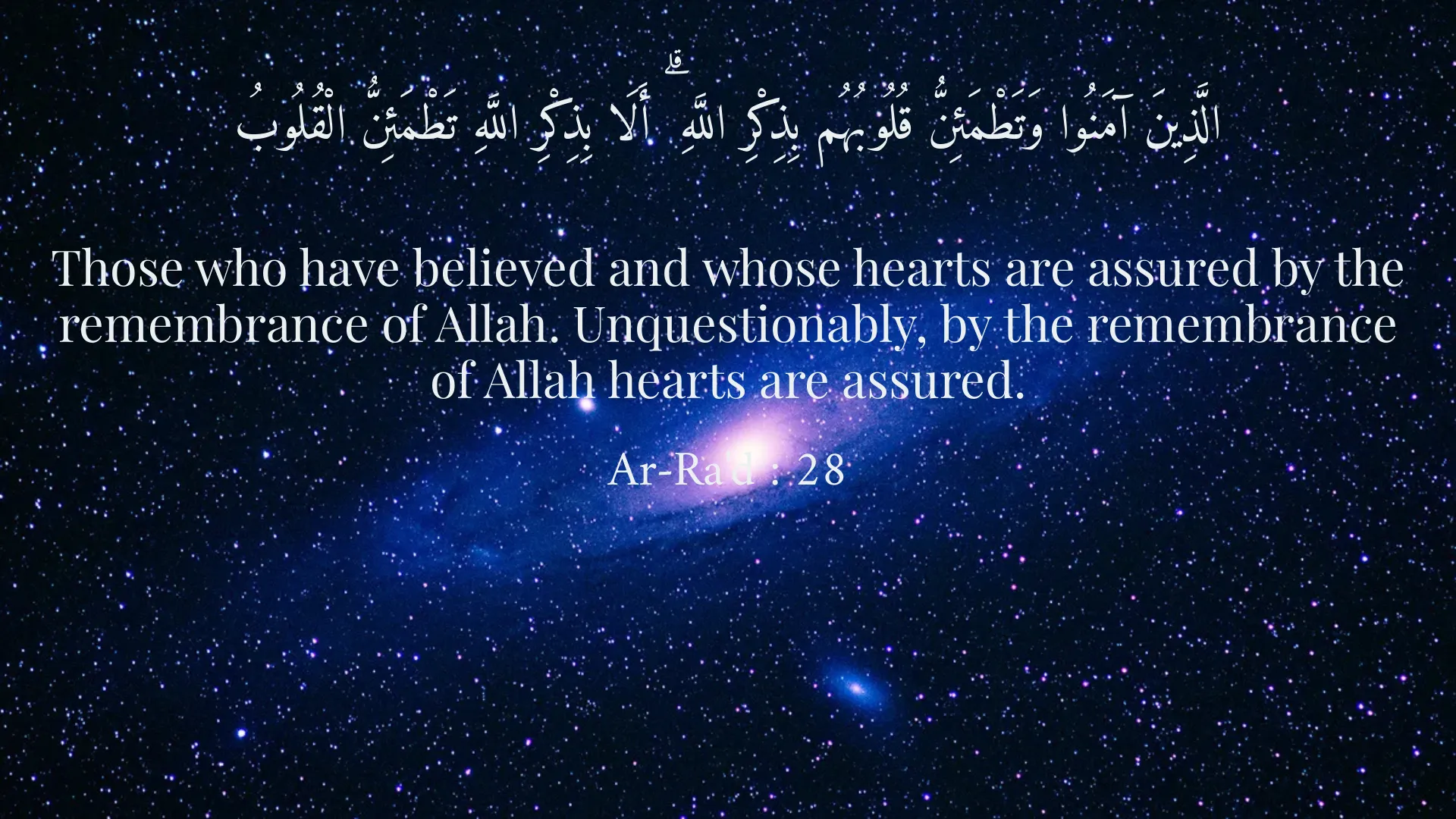
الَّذِينَ آمَنُوا وَتَطْمَئِنُّ قُلُوبُهُم بِذِكْرِ اللَّهِ ۗ أَلَا بِذِكْرِ اللَّهِ تَطْمَئِنُّ الْقُلُوبُ
Those who have believed and whose hearts are assured by the remembrance of Allah. Unquestionably, by the remembrance of Allah hearts are assured.
Ar-Ra'd : 28
وَمَن يَتَوَكَّلْ عَلَى اللَّهِ فَهُوَ حَسْبُهُ ۚ إِنَّ اللَّهَ بَالِغُ أَمْرِهِ ۚ قَدْ جَعَلَ اللَّهُ لِكُلِّ شَيْءٍ قَدْرًا
And whoever relies upon Allah - then He is sufficient for him. Indeed, Allah will accomplish His purpose. Allah has already set for everything a [decreed] extent.
At-Talaq : 3
يَا أَيُّهَا الَّذِينَ آمَنُوا اسْتَعِينُوا بِالصَّبْرِ وَالصَّلَاةِ ۚ إِنَّ اللَّهَ مَعَ الصَّابِرِينَ
O you who have believed, seek help through patience and prayer. Indeed, Allah is with the patient.
Al-Baqarah : 153
Short Story
In ancient times, there was a wealthy merchant who was constantly terrified of the future and losing his fortune. Every night, his hidden fears kept him awake, robbing him of peace. One day, he sought refuge with a wise sage who lived in a humble abode but with a tranquil heart. The merchant asked the sage, "O wise one, I possess immense wealth, yet I never find peace. How do you, with such simplicity, live so contentedly?" The sage smiled and said, "My friend, I have entrusted all that I possess to the Merciful God. I know that He is the Sustainer, and whatever He wills, that alone shall come to pass. My only fear is of Him, and whoever fears God, fears nothing else. Let go of this heavy burden of the world and entrust your heart to Him, and you shall see how tranquility returns to your being." The merchant, upon hearing these words, fell into deep thought. Gradually, by relying on God, he was able to set aside his hidden fears and taste the true essence of peace.