Quranic Answer
Stress and anxiety are integral parts of the human experience, manifesting in response to life's challenges, environmental pressures, or even internal thoughts and obsessions. In today's fast-paced world, confronting these mental states has become a universal concern. The Holy Quran, as a divine revelation and a comprehensive guide for life, has not remained indifferent to this psychological phenomenon. Instead, it offers profound and effective guidance for managing and even eradicating stress. These teachings are more than mere psychological recommendations; they are spiritual and existential solutions that, by altering one's perspective and strengthening one's connection with God, bring about true and lasting tranquility. Here, we delve into these Quranic strategies for coping with stress in detail. 1. Trust in Allah (Tawakkul): One of the most central Quranic teachings for combating stress is the concept of Tawakkul, or complete reliance on God. Tawakkul does not imply abandoning effort or becoming passive; rather, it means that after exerting all one's strength and effort, one entrusts the outcome to Allah Almighty, relying on His wisdom and planning. The Quran emphasizes this principle in numerous verses. When a person realizes that everything is within God's power and that He is the best Disposer of affairs, the heavy burden of worries and anxieties is lifted from their shoulders. This trust frees the heart from future apprehension and past regrets, bestowing deep serenity upon the individual. The verse, "And whoever relies upon Allah, then He is sufficient for him. Indeed, Allah will accomplish His purpose. Allah has already set for everything a [decreed] extent" (Surah At-Talaq: 3), clearly states that whoever trusts in Allah, He is sufficient for them. This means Allah will take care of their affairs and provide a way out of their difficulties. This principle uproots many anxieties stemming from a feeling of lack of control over circumstances. 2. Remembrance of Allah (Dhikr - The Soother of Hearts): The Holy Quran explicitly states that the remembrance of Allah brings peace to hearts. The verse, "Those who have believed and whose hearts are assured by the remembrance of Allah. Unquestionably, by the remembrance of Allah hearts are assured" (Surah Ar-Ra'd: 28), is one of the most beautiful and powerful verses in this regard. Dhikr is not merely uttering words; it encompasses every form of heartfelt, intellectual, and practical remembrance of God's presence and His greatness. Reciting the Quran, glorifying Allah (Tasbih, Tahmid, Tahlil, Takbir), seeking forgiveness (Istighfar), reflecting on divine verses, and even expressing gratitude for blessings are all forms of Dhikr. When a person occupies their mind with the remembrance of God, there is no room left for negative and anxiety-inducing thoughts. This focus on divine power and mercy gives a person a sense of support and security, preventing them from being overwhelmed by worldly matters. Continuous Dhikr gradually transforms a person's mental structure, leading them towards inner peace and psychological stability. 3. Patience (Sabr) and Prayer (Salat - Seeking Aid from God): Allah invites believers in the Holy Quran to seek help through patience and prayer: "O you who have believed, seek help through patience and prayer. Indeed, Allah is with the patient" (Surah Al-Baqarah: 153). Patience in the face of problems, calamities, and temptations is a moral and spiritual virtue that strengthens a person. Patience does not mean passive endurance; rather, it signifies active and hopeful resilience in the face of hardships, with the knowledge that indeed, with hardship comes ease. "For indeed, with hardship [will come] ease. Indeed, with hardship [will come] ease" (Surah Ash-Sharh: 5-6). Prayer (Salat), as the pillar of faith, represents the pinnacle of a servant's connection with their Creator. Prayer is a safe refuge where a person can detach from the commotion of the world, share their problems with their Lord, and seek His assistance. The rhythmic and repetitive movements of prayer, the concentration on the meaning of verses and supplications, and the state of prostration all contribute to reducing stress and increasing tranquility. Prayer is not merely a religious obligation; it is a profound meditation and an opportunity for spiritual recharge that frees a person from material concerns and connects them to the infinite source of power. 4. Acceptance of Divine Decree (Qada and Qadar - Submission to God's Will): Another key aspect of inner peace is understanding and accepting the concept of divine decree (Qada and Qadar). This does not absolve a person of responsibility but means that some events are beyond our control and are part of God's preordainment. The verse, "No disaster strikes except by permission of Allah. And whoever believes in Allah - He will guide his heart. And Allah is Knowing of all things" (Surah At-Taghabun: 11), clearly states that no calamity befalls except by Allah's permission. Whoever believes in Allah, He guides his heart. This belief helps a person to feel less regret and remorse when facing adverse events, and instead of dwelling on "if onlys," to seek solutions and divine wisdom. Accepting the reality that Allah is All-Wise and that whatever He decrees contains goodness (even if initially incomprehensible) removes a significant psychological burden from a person and paves the way for tranquility. 5. Gratitude (Shukr) and Focusing on Blessings: Focusing on what we have, instead of what we lack, is a powerful strategy for coping with stress. The Quran repeatedly emphasizes the importance of gratitude. "If you are grateful, I will surely increase you [in favor]; but if you deny, indeed, My punishment is severe" (Surah Ibrahim: 7). When a person consciously acknowledges Allah's countless blessings (health, family, abilities, opportunities), their sense of contentment and satisfaction is strengthened. This perspective shifts their view from deficiencies and problems towards abundance and divine grace, thereby reducing anxiety stemming from a sense of deprivation or failure to achieve worldly goals. Active gratitude elevates the human spirit and rekindles a sense of hope and optimism. 6. Piety (Taqwa) and Avoiding Sin (Inner Peace): The Quran repeatedly emphasizes the concept of Taqwa, which is God-consciousness and piety. Taqwa means living by adhering to divine limits and avoiding prohibitions. The verse, "And whoever fears Allah - He will make for him a way out and will provide for him from where he does not expect" (Surah At-Talaq: 2-3), promises that whoever fears Allah, He will make a way out for them and provide for them from sources they never imagined. A pious life grants a person an inner sense of tranquility and purity, because sins often lead to feelings of guilt, regret, and anxiety. Purity of soul and a clear conscience are among the greatest factors in reducing stress. 7. Righteous Deeds and Serving Others (Moving Beyond Oneself): Focusing solely on oneself and personal problems can escalate stress. The Quran encourages believers to perform righteous deeds and help others. "Indeed, those who have believed and done righteous deeds - for them will be the Gardens of Paradise as a lodging" (Surah Al-Kahf: 107). When a person dedicates themselves to serving others, they divert their attention from personal concerns and gain a sense of purpose and worth. Helping the needy, engaging in charitable activities, and even simply smiling at others can have a profound impact on a person's mental state, bringing feelings of satisfaction and tranquility. This outward focus and connection to a larger purpose can eliminate many root causes of anxiety. Conclusion: The Holy Quran offers comprehensive and profound strategies for dealing with stress that go beyond temporary solutions. These strategies, by strengthening a person's connection with their Creator, altering their perspective towards the world and its challenges, and cultivating noble moral attributes, lead to lasting and inner peace. Trust in Allah, remembrance of Allah, patience, prayer, acceptance of divine decree, gratitude, piety, and righteous deeds are all tools by which a believer can not only overcome their stresses but also experience a life full of meaning and tranquility. These guidelines are, above all, an invitation to return to the human's divine nature and find peace in the refuge of the One and Only God.
Related Verses
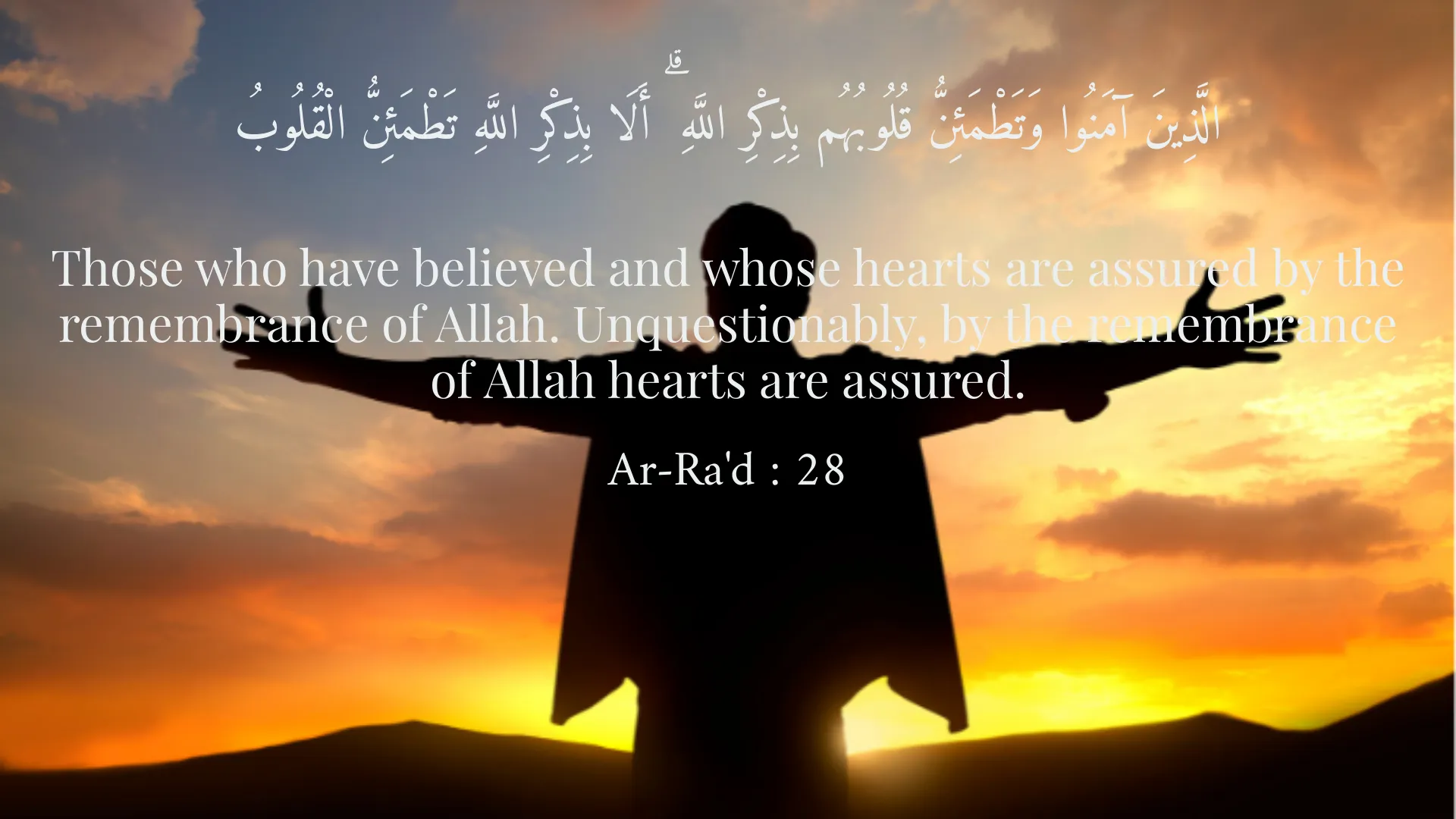
الَّذِينَ آمَنُوا وَتَطْمَئِنُّ قُلُوبُهُم بِذِكْرِ اللَّهِ ۗ أَلَا بِذِكْرِ اللَّهِ تَطْمَئِنُّ الْقُلُوبُ
Those who have believed and whose hearts are assured by the remembrance of Allah. Unquestionably, by the remembrance of Allah hearts are assured.
Ar-Ra'd : 28
يَا أَيُّهَا الَّذِينَ آمَنُوا اسْتَعِينُوا بِالصَّبْرِ وَالصَّلَاةِ ۚ إِنَّ اللَّهَ مَعَ الصَّابِرِينَ
O you who have believed, seek help through patience and prayer. Indeed, Allah is with the patient.
Al-Baqarah : 153
وَمَن يَتَوَكَّلْ عَلَى اللَّهِ فَهُوَ حَسْبُهُ ۚ إِنَّ اللَّهَ بَالِغُ أَمْرِهِ ۚ قَدْ جَعَلَ اللَّهُ لِكُلِّ شَيْءٍ قَدْرًا
And whoever relies upon Allah, then He is sufficient for him. Indeed, Allah will accomplish His purpose. Allah has already set for everything a [decreed] extent.
At-Talaq : 3
Short Story
One of the wise men told his students: "One day in the field, I saw a sparrow with a grain in its beak, flying joyfully. Suddenly, a strong wind blew, and the grain fell from its beak. The sparrow was bewildered for a moment and landed on the ground, but when it saw that another gust of wind carried the grain far away, it looked up to the sky and seemed to say to itself: 'He who provided this grain for me will provide another.' So it took flight again and, with a tranquil heart, went in search of its sustenance. Know that tranquil hearts come not from the absence of stress, but from seeking refuge in the safe haven of God."