Quranic Answer
The question of 'How to enjoy a simple life?' resonates deeply in our contemporary world, often burdened by consumerism, the relentless pursuit of material wealth, and an unending competition for 'more.' While the Holy Quran does not explicitly use the term 'simple life' in the modern sense of minimalism, it lays down profound principles that inherently lead to a life characterized by peace, contentment, and a lack of excessive attachment to worldly possessions. The core of enjoying a simple life, from an Islamic perspective, lies in understanding the true nature of this worldly existence, fostering a deep connection with the Creator, and cultivating an inner state of gratitude and tranquility. This path not only leads to a calmer life in this world but also lays the foundations for enduring success in the Hereafter. The first and most foundational principle is gratitude (Shukr). The Quran repeatedly emphasizes the importance of recognizing and appreciating Allah's countless blessings, both apparent and hidden. When we truly reflect on the myriad provisions we have – health, family, sustenance, knowledge, our senses, and even the simple act of breathing – our perspective shifts from what we lack to what we possess. Allah states in Surah Ibrahim (14:7): “And [remember] when your Lord proclaimed, ‘If you are grateful, I will surely increase you [in favor]; but if you deny, indeed, My punishment is severe.’” This verse is a powerful reminder that gratitude is not merely a polite acknowledgment but a profound spiritual act that unlocks further blessings and, crucially, fosters contentment. A grateful heart finds joy in the simplest things, freeing itself from the endless craving for more that often complicates life. Instead of constantly seeking external sources of happiness, gratitude allows us to find joy within our current circumstances, transforming perceived deficiencies into abundant blessings. This appreciation for the seemingly mundane aspects of daily existence – a warm meal, a gentle breeze, the laughter of loved ones, a quiet moment of reflection – which are often overlooked in the pursuit of grander, material gains, naturally leads to a more minimalist and uncomplicated way of living, where happiness is derived from internal states rather than external acquisitions. This intrinsic satisfaction serves as a bulwark against the societal pressures to constantly accumulate and consume, thus simplifying one's entire outlook on life. Secondly, the Quran encourages contentment (Qana'ah) and moderation (I'tidal), while strongly warning against excessive materialism and heedless accumulation of wealth. The worldly life (dunya) is often depicted as transient and a mere amusement, a testing ground for the hereafter. Surah Al-Hadid (57:20) vividly describes this: “Know that the life of this world is but amusement and diversion and adornment and boasting among yourselves and competition in increase in wealth and children - like the example of a rain whose [resulting] plant growth pleases the tillers; then it dries and you see it turned yellow; then it becomes [scattered] debris. And in the Hereafter is severe punishment and forgiveness from Allah and approval. And what is the worldly life except the enjoyment of delusion.” This verse serves as a profound lens through which to view our priorities. When we understand that wealth and possessions are temporary and can quickly vanish, our attachment to them diminishes. This perspective liberates us from the exhausting race to acquire more, to compare ourselves with others, or to define our worth by our possessions. Moderation in spending, eating, and even in ambitions helps maintain balance, preventing us from becoming enslaved by worldly desires. It’s not about asceticism, but about putting things in their proper place, using worldly means as a tool for good, rather than making them the ultimate goal. This detachment allows us to find joy in sufficiency, recognizing that true wealth lies in spiritual tranquility and peace of mind, not in material abundance. It fosters a mindset where one is satisfied with what is enough, rather than constantly striving for what is more than enough, thereby reducing stress, simplifying choices, and cultivating an enduring sense of calm that is unaffected by the fleeting nature of worldly possessions. This balanced approach to material life is a cornerstone of true simplicity. Thirdly, remembrance of Allah (Dhikr) and reliance on Him (Tawakkul) are central to achieving inner peace and a truly simple life. In a world full of anxieties and uncertainties, the human heart often seeks solace and stability. The Quran offers the ultimate solution: “Those who have believed and whose hearts are assured by the remembrance of Allah. Unquestionably, by the remembrance of Allah hearts are assured” (Surah Ar-Ra'd, 13:28). Engaging in Dhikr – whether through formal prayers, recitation of Quran, or simply remembering Allah in daily activities – brings profound tranquility. This inner peace is independent of external circumstances; a person can be in a difficult situation but still experience calm if their heart is connected to Allah. Coupled with Dhikr is Tawakkul, or complete reliance on Allah. When we trust that Allah is our ultimate Sustainer and Protector, we shed the burden of excessive worry and anxiety about the future or about securing our provisions. Surah At-Talaq (65:3) states: “And will provide for him from where he does not expect. And whoever relies upon Allah - He is sufficient for him. Indeed, Allah will accomplish His purpose. Allah has already set for everything a [decreed] extent.” This trust simplifies life dramatically, as it frees us from the overwhelming need to control every outcome, allowing us to focus on our efforts while leaving the results to divine wisdom. This spiritual anchor provides a stable foundation, making us less susceptible to the turbulence of worldly changes and enabling us to approach life with a serene and contented heart. The regular practice of Dhikr keeps one's priorities aligned with the divine, thereby naturally steering one away from the complexities and stresses associated with material pursuits. Finally, the concept of giving (Infaq) and prioritizing relationships over possessions also contributes significantly to a simple and fulfilling life. Islam encourages spending from one's wealth for the sake of Allah, whether through charity, supporting family, or helping those in need. This act of giving purifies wealth and, more importantly, purifies the heart from greed and excessive attachment. When we give, we reinforce the understanding that true ownership belongs to Allah and that we are merely custodians of His provisions. This detachment from material things cultivates generosity and compassion, fostering stronger community bonds and a sense of purpose beyond personal accumulation. Prioritizing relationships – with family, friends, and the wider community – over material pursuits also simplifies life. Genuine human connection brings far more lasting happiness and fulfillment than any material possession. The Prophet Muhammad (peace be upon him) himself lived a life of simplicity, prioritizing service, spiritual devotion, and community welfare over luxury or personal gain. His example teaches us that true richness lies in character, good deeds, and a heart content with Allah's decree. By focusing on giving rather than taking, and on connecting with people rather than things, one finds a deeper, more meaningful simplicity that transcends transient pleasures. In essence, enjoying a simple life according to the Quran is not about deprivation or abandoning the world entirely. It is about a conscious choice to live with purpose, to prioritize spiritual growth over material accumulation, to find joy in gratitude, to cultivate inner peace through remembrance of Allah, and to build strong, meaningful connections with others. It is a life lived with moderation, awareness, and profound trust in Allah, leading to a deep sense of tranquility and fulfillment, irrespective of external circumstances. This holistic approach ensures that one’s journey through life is not a frantic pursuit of fleeting pleasures, but a peaceful progression towards eternal success, finding solace and joy in every moment, both big and small, through the lens of faith and contentment. This simplicity is a pathway to true freedom and enduring happiness, enabling an individual to navigate the complexities of modern existence with grace and inner serenity.
Related Verses
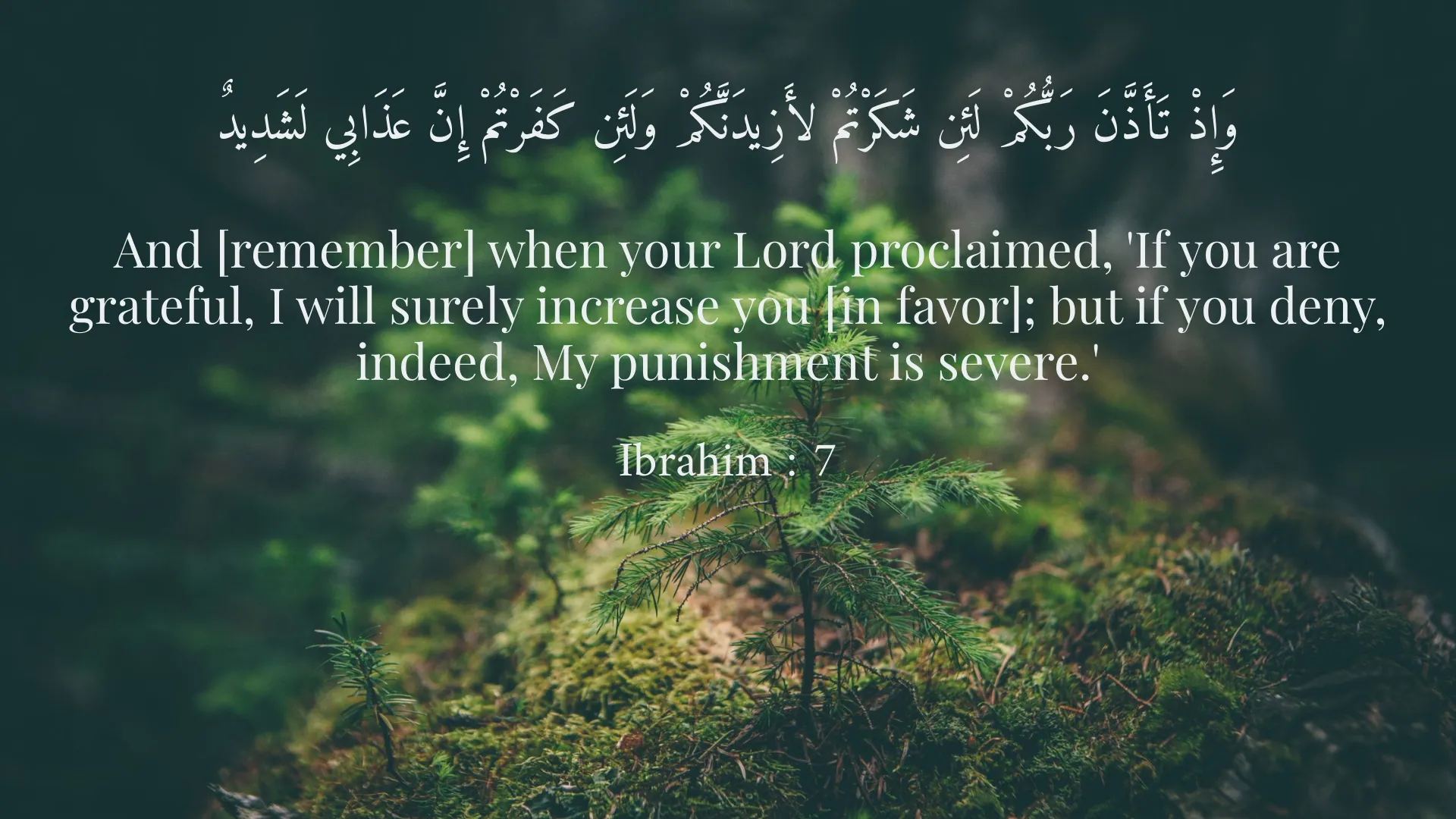
وَإِذْ تَأَذَّنَ رَبُّكُمْ لَئِن شَكَرْتُمْ لأَزِيدَنَّكُمْ وَلَئِن كَفَرْتُمْ إِنَّ عَذَابِي لَشَدِيدٌ
And [remember] when your Lord proclaimed, 'If you are grateful, I will surely increase you [in favor]; but if you deny, indeed, My punishment is severe.'
Ibrahim : 7
الَّذِينَ آمَنُوا وَتَطْمَئِنُّ قُلُوبُهُم بِذِكْرِ اللَّهِ ۗ أَلَا بِذِكْرِ اللَّهِ تَطْمَئِنُّ الْقُلُوبُ
Those who have believed and whose hearts are assured by the remembrance of Allah. Unquestionably, by the remembrance of Allah hearts are assured.
Ar-Ra'd : 28
اعْلَمُوا أَنَّمَا الْحَيَاةُ الدُّنْيَا لَعِبٌ وَلَهْوٌ وَزِينَةٌ وَتَفَاخُرٌ بَيْنَكُمْ وَتَكَاثُرٌ فِي الْأَمْوَالِ وَالْأَوْلَادِ ۖ كَمَثَلِ غَيْثٍ أَعْجَبَ الْكُفَّارَ نَبَاتُهُ ثُمَّ يَهِيجُ فَتَرَاهُ مُصْفَرًّا ثُمَّ يَكُونُ حُطَامًا ۖ وَفِي الْآخِرَةِ عَذَابٌ شَدِيدٌ وَمَغْفِرَةٌ مِّنَ اللَّهِ وَرِضْوَانٌ ۚ وَمَا الْحَيَاةُ الدُّنْيَا إِلَّا مَتَاعُ الْغُرُورِ
Know that the life of this world is but amusement and diversion and adornment and boasting among yourselves and competition in increase in wealth and children - like the example of a rain whose [resulting] plant growth pleases the tillers; then it dries and you see it turned yellow; then it becomes [scattered] debris. And in the Hereafter is severe punishment and forgiveness from Allah and approval. And what is the worldly life except the enjoyment of delusion.
Al-Hadid : 20
Short Story
One day, a busy and worried king was constantly striving to expand his domain and amass wealth, yet he never found peace. Nearby, a simple-hearted dervish sat by a stream, living with complete contentment and tranquility on just a piece of dry bread. The king, observing his serenity and ease, asked in wonder, 'How can you be so content and peaceful with so little, while I, with all my vast possessions, find no peace?' The dervish, with a kind smile, replied, 'My lord, your burdens increase with your possessions, while my freedom grows with my detachment. True wealth lies not in what you own, but in how little you need to be happy.' This tale from Saadi teaches us that peace of mind is found in simplicity and freedom from material attachments.