Quranic Answer
In a world that often views work merely as a means to earn income and sustain life, the teachings of the Holy Quran offer a deeper, more comprehensive perspective. The Quran presents daily work not just as a material activity, but as a vast arena for spiritual growth, drawing closer to the Almighty, and serving society. From the Quranic perspective, any legitimate and beneficial activity, when performed with pure intention and in a righteous manner, can be transformed into an act of worship. Experiencing spirituality in daily work means living in divine presence at every moment of one's professional activities, whether big or small, and transforming them into a means to achieve higher goals. One of the most fundamental concepts in this regard is intention (Niyyah). Although the Prophet Muhammad (peace be upon him) said: “Indeed, actions are by intentions,” the Quranic roots of this principle emphasize sincerity and seeking divine pleasure. When a Muslim begins their work with the intention of pleasing Allah, serving humanity, and earning a lawful livelihood, they imbue it with a spiritual essence. For instance, consider a civil engineer working with the intention of providing a safe and sturdy building that brings peace to its inhabitants, or a doctor aiming for healing and alleviating patients' suffering, or a teacher intending to nurture the next generation and foster knowledge. These pure intentions elevate their work beyond a mere material duty, transforming it into a profound act of worship. This approach to work not only enhances quality and productivity but also brings deep inner peace and contentment to the individual, as they know that every breath and every action is directed towards divine pleasure. The second principle is Ihsan (Excellence) in work. The Quran repeatedly emphasizes performing tasks in the best possible manner. Allah states in numerous verses, “Indeed, Allah loves those who do good (Muhsinin)” (e.g., Al-Baqarah 2:195). This goodness is not limited to specific acts of worship; it manifests in every action, including one's work and profession. Performing duties accurately and diligently, striving to improve skills, innovating, and being creative in one's field are all manifestations of “Ihsan.” When we carry out our work with high quality and dedication, we not only respect ourselves but also serve society and ultimately the Creator. This level of commitment and effort is a sign of faith and piety, turning daily work into a means of achieving spiritual perfection. The importance of this issue is so profound that the Prophet (PBUH) said: “Indeed, Allah loves that when one of you does a job, he does it with excellence.” This pursuit of excellence in work is a direct outcome of a spiritual outlook towards it, which causes the individual to think not only of fulfilling a duty but of perfecting its execution. Thirdly, trusteeship (Amanah) is a crucial concept. The Quran states in Surah An-Nisa (4:58): “Indeed, Allah commands you to render trusts to whom they are due...” In the workplace, Amanah has various dimensions, including being trustworthy with work time, resources, and assets of the company or organization, maintaining professional confidentiality, and fulfilling responsibilities properly. A trustworthy employee not only performs their duties correctly but also never abuses their position and always prioritizes collective and ethical interests over personal gain. This sense of responsibility and commitment towards the trusts placed upon us not only leads to professional success but also results in spiritual purification and attainment of divine pleasure. Upholding Amanah in work is a strong pillar for building a healthy society based on trust and justice, where every individual feels secure and confident. The fourth approach is Dhikr (Remembrance of God) during work. One might think that Dhikr is limited to specific supplications or prayers, but the Quran teaches us to be mindful of God at all times and in all places. In Surah Al-Jumu'ah (62:10), we read: “And when the prayer has been concluded, disperse through the land and seek from the bounty of Allah, and remember Allah often that you may succeed.” This verse clearly illustrates the connection between seeking livelihood and remembering Allah. A Muslim can engage in Dhikr, whether silently or verbally, during work (e.g., saying Bismillah before starting, Alhamdulillah after finishing, or Astaghfirullah if a mistake occurs). Remembering God during work brings spiritual tranquility, strengthens motivation, and prevents worldly temptations. This mindful presence helps ensure that work is not used merely for unspiritual gains, and the individual constantly perceives themselves in the divine presence. The fifth point is earning a lawful livelihood (Halal Rizq). The Holy Quran strongly emphasizes the lawfulness of one's earnings. In Surah Al-Mulk (67:15), Allah says: “It is He who made the earth subservient to you, so traverse its regions and eat from His provisions. And to Him is the resurrection.” This verse, while encouraging work and effort, points out that provisions come from God and must be obtained through legitimate means. Avoiding usury (riba), deception, short-changing, bribery, and any unlawful business is a fundamental principle of spirituality in work. Halal earnings not only provide pure energy to the human body but also enlighten the soul and make one's acts of worship more acceptable, bringing blessings into life. Finally, the balance between this world and the hereafter (Al-Muwazanah bayna ad-Dunya wal-Akhirah) is a vital Quranic teaching. In Surah Al-Qasas (28:77), we read: “But seek, through that which Allah has given you, the home of the Hereafter; and [yet], do not forget your share of the world.” This verse shows that worldly work, if done with the right intention and according to divine principles, can be a means to achieve the hereafter. Working to build a just society, helping those in need, developing science and technology for the benefit of humanity are all examples of seeking the hereafter through worldly endeavors. Spirituality in work helps us transform daily tasks from a heavy burden into an enjoyable and meaningful journey, where every step brings us closer to Allah and earns His pleasure. This perspective not only leads to increased productivity and success in worldly life but also plants lasting peace and contentment in the heart, resulting from a connection to the infinite source of existence. With this approach, work is no longer merely “work,” but a “living worship” woven into the fabric of our daily lives.
Related Verses
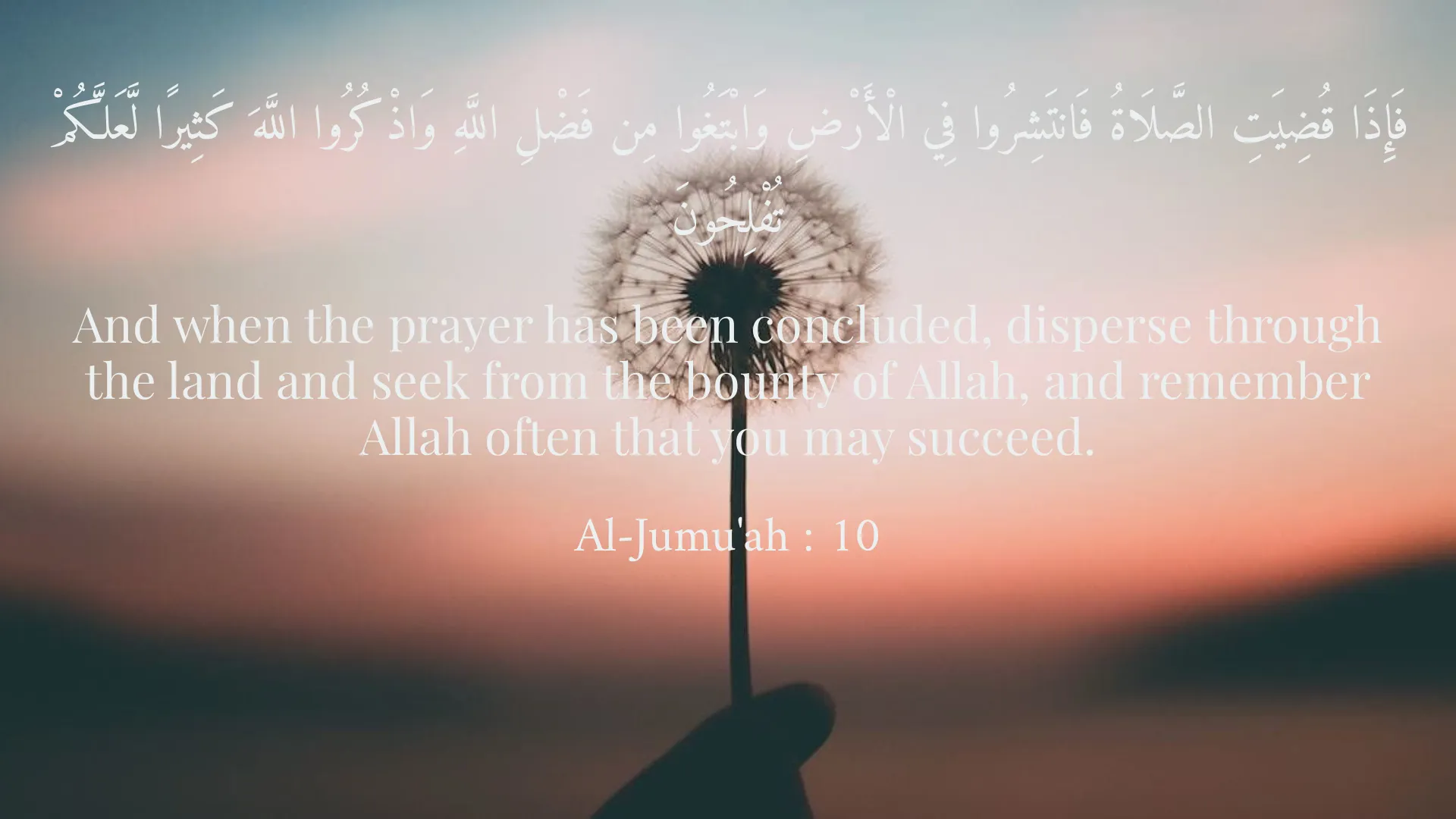
فَإِذَا قُضِيَتِ الصَّلَاةُ فَانتَشِرُوا فِي الْأَرْضِ وَابْتَغُوا مِن فَضْلِ اللَّهِ وَاذْكُرُوا اللَّهَ كَثِيرًا لَّعَلَّكُمْ تُفْلِحُونَ
And when the prayer has been concluded, disperse through the land and seek from the bounty of Allah, and remember Allah often that you may succeed.
Al-Jumu'ah : 10
هُوَ الَّذِي جَعَلَ لَكُمُ الْأَرْضَ ذَلُولًا فَامْشُوا فِي مَنَاكِبِهَا وَكُلُوا مِن رِّزْقِهِ ۖ وَإِلَيْهِ النُّشُورُ
It is He who made the earth subservient to you, so traverse its regions and eat from His provisions. And to Him is the resurrection.
Al-Mulk : 15
إِنَّ اللَّهَ يَأْمُرُكُمْ أَن تُؤَدُّوا الْأَمَانَاتِ إِلَىٰ أَهْلِهَا وَإِذَا حَكَمْتُم بَيْنَ النَّاسِ أَن تَحْكُمُوا بِالْعَدْلِ ۚ إِنَّ اللَّهَ نِعِمَّا يَعِظُكُم بِهِ ۗ إِنَّ اللَّهَ كَانَ سَمِيعًا بَصِيرًا
Indeed, Allah commands you to render trusts to whom they are due and when you judge between people to judge with justice. Excellent is that which Allah instructs you. Indeed, Allah is ever Hearing and Seeing.
An-Nisa : 58
وَابْتَغِ فِيمَا آتَاكَ اللَّهُ الدَّارَ الْآخِرَةَ ۖ وَلَا تَنسَ نَصِيبَكَ مِنَ الدُّنْيَا ۖ وَأَحْسِن كَمَا أَحْسَنَ اللَّهُ إِلَيْكَ ۖ وَلَا تَبْغِ الْفَسَادَ فِي الْأَرْضِ ۖ إِنَّ اللَّهَ لَا يُحِبُّ الْمُفْسِدِينَ
But seek, through that which Allah has given you, the home of the Hereafter; and [yet], do not forget your share of the world; and do good as Allah has done good to you. And desire not corruption in the land. Indeed, Allah does not like corrupters.
Al-Qasas : 77
Short Story
One day, a wise Sheikh asked a diligent disciple, “What do you do in this world?” The disciple replied, “I work from dawn till dusk to earn a lawful living, and at night, I dedicate myself to worship.” The Sheikh smiled and said warmly, “My young friend! If, in your daily work, you also have the intention of pleasing God and serving His creation, and perform every action with sincerity and excellence, then every moment of your work is worship itself. Spirituality is not only found in the mihrab and prayer mat, but flows in every step and every honest deed done for the sake of truth and the benefit of creation.” From that moment, the disciple understood that his entire life was a field for drawing closer to God, and thereafter, his work took on a new dimension, and he felt the Divine presence in every action.