Quranic Answer
Experiencing true love for God (Allah) is one of the deepest and most dynamic stages of spiritual growth in Islam. This love is not merely a fleeting emotion, but a profound state of being, deeply rooted in knowledge, gratitude, obedience, and unwavering trust in the Divine essence. The Holy Quran consistently invites believers to cultivate this love, promising tranquility, guidance, and ultimate salvation as its fruits. This inner journey is one of the heart, yet it is accompanied by actions and thoughts, profoundly influencing every aspect of human life. 1. Knowledge and Recognition (Ma'rifah Billah): The cornerstone of any love is knowledge. How can one truly love someone they do not know? The Quran introduces Allah to us through His beautiful names and attributes (Asma al-Husna). Reflecting on Allah's infinite power, His boundless wisdom in creation, His vast mercy, His absolute justice, His compassion, and His ever-present nature deepens our understanding of Him. When we ponder the intricate design of the universe, the unparalleled order of the cosmos, His limitless provision, and the countless blessings He bestows upon us, our hearts naturally incline towards Him in awe and admiration. The Quran encourages us to contemplate His signs in the horizons and within ourselves: “We will show them Our signs in the horizons and within themselves until it becomes clear to them that it is the truth.” (Quran 41:53). Understanding that He is the Creator, the Sustainer, the Provider, and the sole source of all good inherently fosters a love born of recognition and profound appreciation. This intellectual journey is not dry or academic; rather, it is a vibrant exploration that leads to a deep and affectionate connection with the Divine. 2. Obedience and Servitude (Ibadah and Itaa'ah): Love for God is intrinsically linked to obedience to His commands and abstaining from His prohibitions. The Quran states: “Say, [O Muhammad], 'If you should love Allah, then follow me, [so] Allah will love you and forgive you your sins. And Allah is Forgiving and Merciful.'” (Quran 3:31). This verse beautifully encapsulates the practical dimension of divine love. It is not enough merely to claim love; this love must be demonstrated through submission to His will, as revealed in the Quran and exemplified by the Prophet Muhammad (peace be upon him). Performing prayers (Salat) with presence of heart, fasting (Sawm) with sincerity, giving charity (Zakat and Sadaqah) generously, and performing Hajj (if able) are not mere rituals; they are acts of devotion and affection that express and deepen our love. Every act of worship is an opportunity to connect with the Divine, to converse with Him, and to affirm our sincerity and servitude. When we willingly surrender our desires to His commands, we prove our love to Him, and He, in turn, draws us closer. This obedience stems not from fear, but from love and recognition of the Beloved's greatness. 3. Constant Remembrance (Dhikr Allah): The Holy Quran repeatedly emphasizes the importance of remembering Allah. “Those who have believed and whose hearts are assured by the remembrance of Allah. Unquestionably, by the remembrance of Allah hearts are assured.” (Quran 13:28). Dhikr is not merely the repetition of words, but a conscious state of mind where Allah is ever-present in our thoughts, actions, and intentions. This includes reciting the Quran, contemplating its meanings, repeating Allah's names, seeking forgiveness (Istighfar), and sending blessings upon the Prophet Muhammad (PBUH). Constant remembrance keeps the heart alive and prevents it from falling into heedlessness and misguidance. It establishes a continuous, uninterrupted connection, a spiritual lifeline that strengthens our bond and fills the heart with divine light and love. When we remember Him often, we feel His presence, and His love permeates our entire being. 4. Gratitude (Shukr Allah): Allah reminds us in the Quran of His countless blessings: “And if you should count the favor of Allah, you could not enumerate them.” (Quran 14:34). Recognizing and being grateful for every blessing, whether small or grand – from the breath we take and our health to family, sustenance, and divine guidance – fosters a deep sense of appreciation and love for the Giver. Shukr is not just uttering “Alhamdulillah” (Praise be to Allah); it is utilizing His blessings in ways that please Him, acknowledging His boundless generosity, and avoiding arrogance or neglect. A grateful heart is a loving heart, constantly marveling at the benevolence of its Creator. This gratitude deeply entrenches love within us. 5. Trust and Reliance (Tawakkul 'ala Allah): True love for God involves complete trust in His plan and His wisdom, even when facing difficulties. “And whoever relies upon Allah – then He is sufficient for him.” (Quran 65:3). When we surrender our anxieties, fears, and hopes to Him, knowing that He is the best Disposer of affairs, we experience a profound inner peace. This trust emanates from knowing His limitless power, His infinite mercy, and His perfect justice. Tawakkul frees the heart from the heavy burdens of the world and allows it to rest in the certainty of His care, thereby deepening our emotional bond with Him. 6. Patience and Perseverance (Sabr): The path to true love often involves trials and tribulations. The Quran teaches us that Allah tests those He loves: “And We will surely test you with something of fear and hunger and a loss of wealth and lives and fruits, but give good tidings to the patient.” (Quran 2:155). Facing challenges with patience, seeking help through prayer and supplication, and maintaining reliance on divine wisdom strengthens our spiritual resolve and purifies our love. It teaches us that our ultimate refuge and solace is always with Him. 7. Love for God's Creation: A beautiful byproduct of loving the Creator is developing love for His creation. This love manifests as compassion for fellow human beings, kindness to animals, and care for the environment. The Prophet Muhammad (PBUH) taught: “None of you will believe until he loves for his brother what he loves for himself.” (Hadith). This outward manifestation of love for God completes the circle, demonstrating how our internal state of divine love transforms our interactions with the world. In summary, experiencing true love for God is a comprehensive spiritual endeavor that encompasses knowledge, sincere servitude, continuous remembrance, profound gratitude, unwavering trust, and patient perseverance. This love transforms every aspect of a believer's life, filling it with purpose, peace, and ultimate contentment, as the heart finds its true solace in His remembrance and obedience. It is a lifelong journey, continually deepening with every act of devotion and every moment of reflection on His boundless grace. This love is the very essence of faith, making all other dimensions of our religion vibrant and meaningful. It is the fuel that drives us to do good, to abstain from evil, and to strive for His pleasure with every breath we take. This love is reciprocated by Allah, as He states: “He loves them and they love Him” (Quran 5:54), a promise of immense spiritual reward.
Related Verses
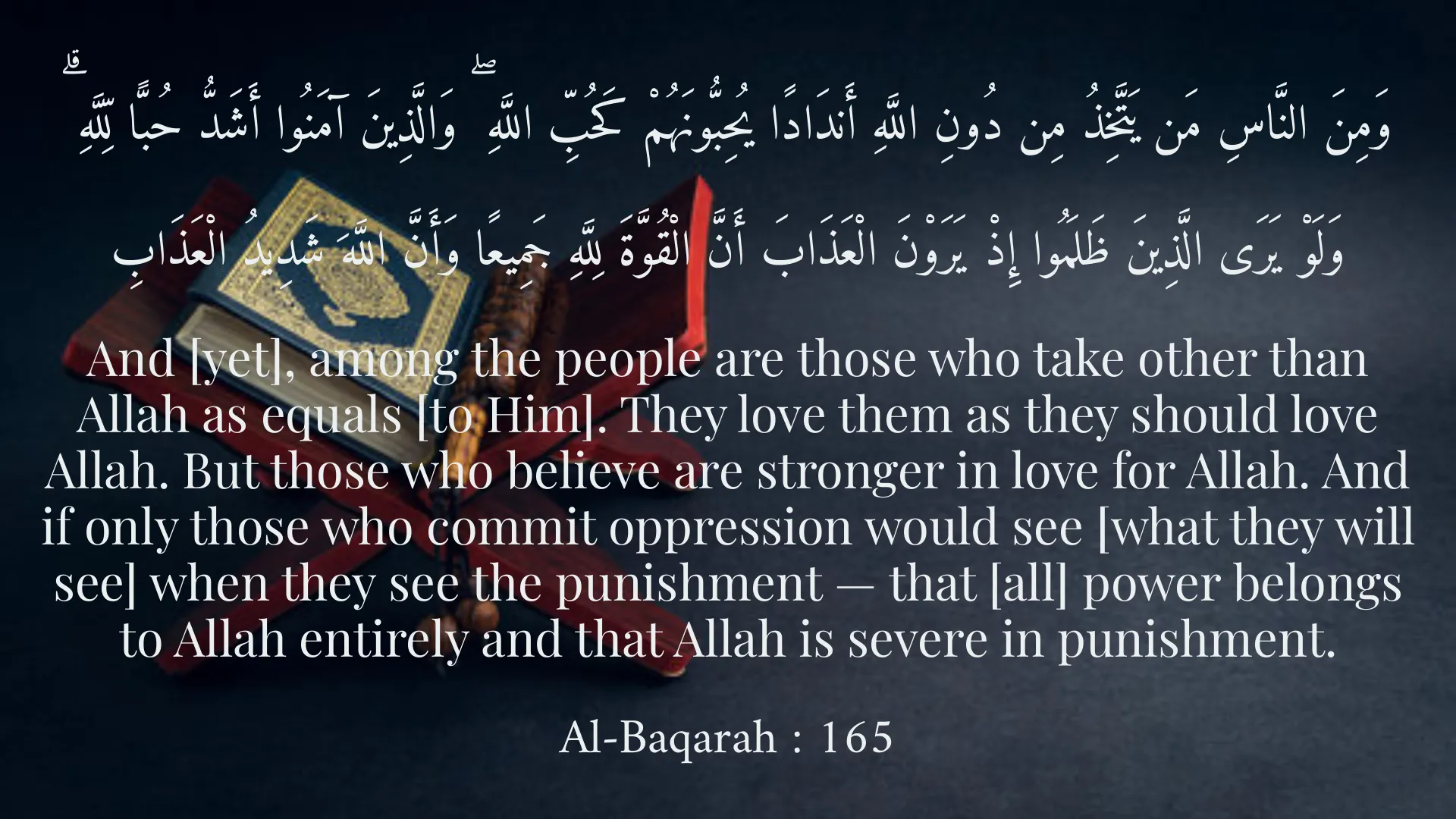
وَمِنَ النَّاسِ مَن يَتَّخِذُ مِن دُونِ اللَّهِ أَندَادًا يُحِبُّونَهُمْ كَحُبِّ اللَّهِ ۖ وَالَّذِينَ آمَنُوا أَشَدُّ حُبًّا لِّلَّهِ ۗ وَلَوْ يَرَى الَّذِينَ ظَلَمُوا إِذْ يَرَوْنَ الْعَذَابَ أَنَّ الْقُوَّةَ لِلَّهِ جَمِيعًا وَأَنَّ اللَّهَ شَدِيدُ الْعَذَابِ
And [yet], among the people are those who take other than Allah as equals [to Him]. They love them as they should love Allah. But those who believe are stronger in love for Allah. And if only those who commit oppression would see [what they will see] when they see the punishment — that [all] power belongs to Allah entirely and that Allah is severe in punishment.
Al-Baqarah : 165
قُلْ إِن كُنتُمْ تُحِبُّونَ اللَّهَ فَاتَّبِعُونِي يُحْبِبْكُمُ اللَّهُ وَيَغْفِرْ لَكُمْ ذُنُوبَكُمْ ۗ وَاللَّهُ غَفُورٌ رَّحِيمٌ
Say, [O Muhammad], "If you should love Allah, then follow me, [so] Allah will love you and forgive you your sins. And Allah is Forgiving and Merciful."
Al-Imran : 31
الَّذِينَ آمَنُوا وَتَطْمَئِنُّ قُلُوبُهُم بِذِكْرِ اللَّهِ ۗ أَلَا بِذِكْرِ اللَّهِ تَطْمَئِنُّ الْقُلُوبُ
Those who have believed and whose hearts are assured by the remembrance of Allah. Unquestionably, by the remembrance of Allah hearts are assured.
Ar-Rad : 28
Short Story
One day, a devout and selfless dervish was engrossed in worship and remembrance of God in a dry, barren desert. A king happened to pass by and, seeing him in such a state of purity, envied his condition and asked, 'O man of God, how is it that you are more at peace in this desolate desert than I am in my own palace?' The dervish, with a welcoming face and a comforting smile, replied, 'O King, it is because I have given my heart to none but God, and He suffices me. The tranquility of my heart lies solely in His remembrance. This world is a prison for me, and my freedom is in abandoning it; for anything other than the Beloved hinders the heart from truth.' The king was astonished and asked, 'But how do you detach your heart from all these worldly attachments and achieve such peace of mind?' The dervish, with wisdom springing from his heart, replied, 'When you connect your heart to the original source of love, which is the Lord, everything else besides Him becomes worthless and fleeting in your eyes. This is the true love that eclipses all else and brings eternal peace to the soul. When the heart finds truth, it becomes free from the bondage of everything other than Him.' This anecdote from Sa'di illustrates that true love for God means letting go of worldly attachments and finding tranquility in His presence and remembrance, ultimately leading to the liberation of the heart and soul, and the only path to eternal joy.