Quranic Answer
Feeling the presence of God in silence is a profoundly spiritual and deeply personal experience, rooted in the teachings of the Holy Quran and the Prophetic tradition. The Quran consistently emphasizes God's closeness to humanity and the paramount importance of His remembrance (Dhikr). Silence, in this context, is not merely an absence of sound but a fertile ground for profound connection with the Creator of the universe. In the clamor of daily life, our minds are often overwhelmed by thoughts, worries, and external stimuli. Silence acts like a mirror, wiping away the dust of worldly distractions, allowing us to perceive the reflection of divine light within ourselves and all around us. This sense of presence, more than being a physical sensation, is a heartfelt and soulful experience, achieved through self-purification, contemplation, and the continuous remembrance of God. One of the most crucial Quranic concepts addressing this question is the notion of 'Divine Proximity' (Qurb Ilahi). In Surah Qaf, verse 16, Allah states: "And We are closer to him than [his] jugular vein." This verse indicates that God's presence is not physical or tangible, but rather an all-encompassing, knowing, and surrounding presence. He encompasses everything and is present with every human being at all times and in every place. Silence helps us to not only intellectually grasp this perpetual presence but to feel it with our entire being. When the external world quiets down, the inner ear becomes ready to listen, and the heart becomes receptive to divine inspirations. It's in this stillness that the subtle whispers of the divine become audible to the soul. Another pivotal concept is 'Dhikr' or the remembrance of Allah. Dhikr is not confined to the mere repetition of specific words or phrases; it extends to a state of mindfulness and constant awareness of God's existence in every moment of life. The Quran declares in Surah Ar-Ra'd, verse 28: "Unquestionably, by the remembrance of Allah hearts are assured." In silence, the opportunity for heartfelt Dhikr (Dhikr al-Qalb) becomes readily available. When the tongue ceases to speak, the heart begins its conversation. This inner remembrance transcends words, encompassing contemplation on God's attributes and beautiful names, gratitude for His blessings, and an absolute feeling of need and dependence on the Divine Essence. Silence provides an unparalleled opportunity for this profound type of Dhikr, leading to true tranquility and inner certainty, thereby strengthening the feeling of the Lord's presence. Furthermore, 'Tafakkur' (contemplation) and 'Tadabbur' (reflection) are fundamental avenues for perceiving God's presence, and silence greatly assists them. The Holy Quran repeatedly invites humanity to ponder over the creation of the heavens and the earth, the alternation of night and day, and the wonders of the universe (e.g., Surah Al-Imran, verses 190-191). In silence, the mind is freed from mental clutter, gaining a greater capacity for deeper reflection on God's signs (Ayat) in the cosmos and within oneself. By looking more deeply at trees, mountains, seas, and even our own selves, one can grasp the infinite power and wisdom of God. This profound contemplation engenders a sense of awe, humility, and 'khushu' (devotion) in the heart, which is itself a form of comprehending God's presence and majesty. Every raindrop, every leaf on a tree, and every breath we take is a sign of divine power and wisdom, which becomes more discernible and comprehensible in deep silence. To experience this presence in silence, there are practical steps one can take. Firstly, finding a quiet place free from noise – this could be a corner of one's home, a secluded mosque, or even amidst nature. Secondly, calming the body and mind. One can achieve this by sitting in a comfortable posture and focusing on the breath. Mindful breathing – the inhale and exhale – can act as an anchor, bringing the wandering mind back to the present moment. In this state, one can begin heartfelt Dhikr, even without verbal repetition. Simply focusing on the name "Allah" or one of His beautiful names, or cultivating a feeling of gratitude and love towards God, can initiate this connection. In these moments, one can silently implore God to illuminate their heart with His presence. Supplication (Du'a) and intimate communion (Munajat) in silence are also powerful means. When a person speaks to their Lord in solitude, without any intermediaries or loud words, they experience a direct sense of closeness and connection. In such a state, not only do we speak, but we feel that God is listening and present. This heartfelt dialogue is a bridge to perceiving the Lord's presence. Silence also helps us to listen to the 'inner voice', which can indeed be divine inspirations. These inspirations may manifest as peace, insight, or even solutions to life's challenges. Ultimately, feeling God's presence in silence is a process that requires patience, practice, and persistence. It is not a destination to be reached all at once but a continuous journey into the depths of one's being and the Divine Essence. The more we expose ourselves to this conscious silence and purify our hearts with the remembrance of God, the more we can feel His merciful and infinite presence in every moment of our lives, and even in the deepest silences. This experience is not only calming but also makes life meaningful and purposeful, drawing us closer to the ultimate source of existence. This tranquility and connection will serve as a source of strength and guidance to overcome life's challenges, assuring us that we are never alone, for God is "near" and "with us."
Related Verses
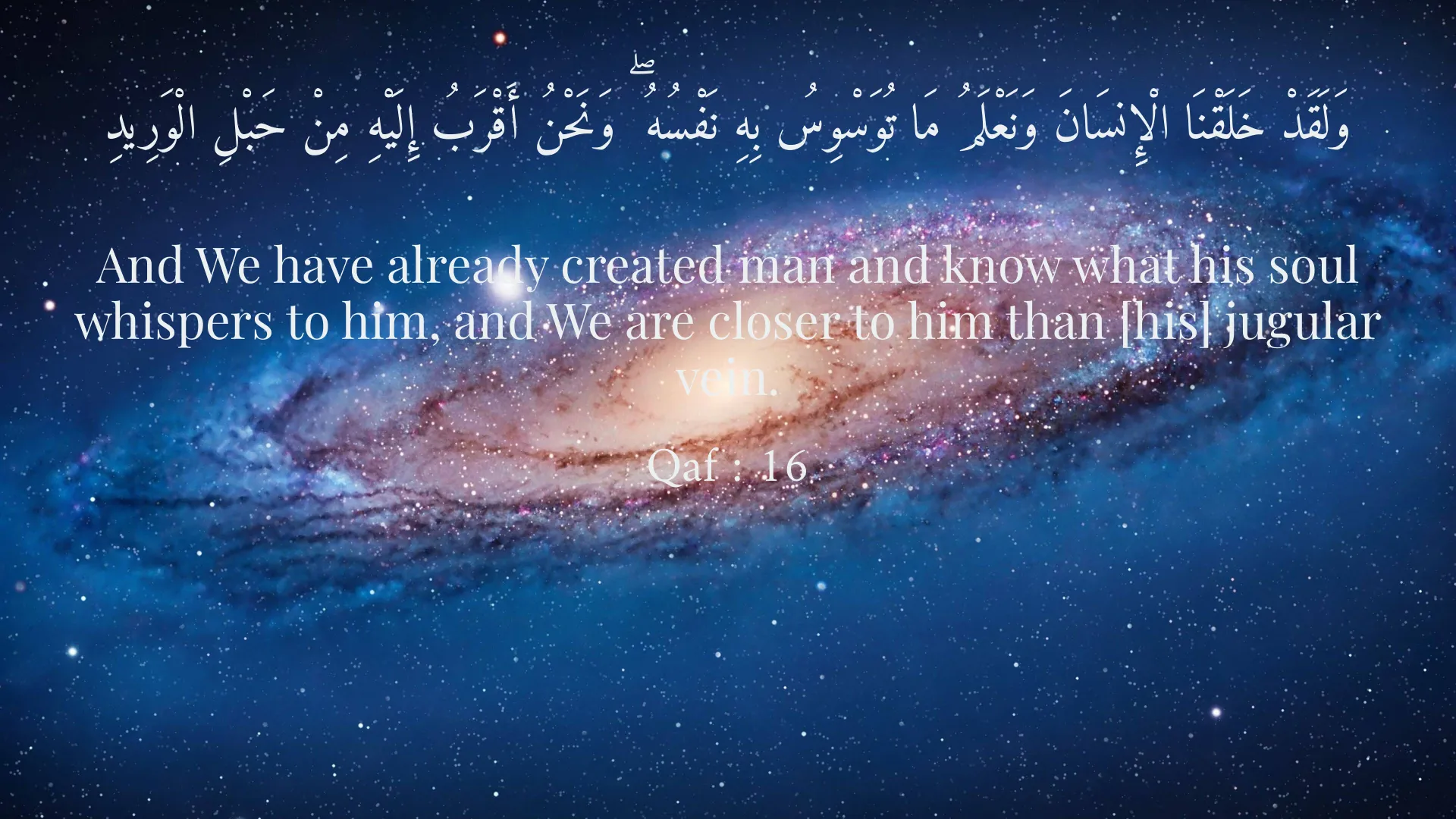
وَلَقَدْ خَلَقْنَا الْإِنسَانَ وَنَعْلَمُ مَا تُوَسْوِسُ بِهِ نَفْسُهُ ۖ وَنَحْنُ أَقْرَبُ إِلَيْهِ مِنْ حَبْلِ الْوَرِيدِ
And We have already created man and know what his soul whispers to him, and We are closer to him than [his] jugular vein.
Qaf : 16
الَّذِينَ آمَنُوا وَتَطْمَئِنُّ قُلُوبُهُم بِذِكْرِ اللَّهِ ۗ أَلَا بِذِكْرِ اللَّهِ تَطْمَئِنُّ الْقُلُوبُ
Those who have believed and whose hearts are assured by the remembrance of Allah. Unquestionably, by the remembrance of Allah hearts are assured.
Ar-Ra'd : 28
فَاذْكُرُونِي أَذْكُرْكُمْ وَاشْكُرُوا لِي وَلَا تَكْفُرُونِ
So remember Me; I will remember you. And be grateful to Me and do not deny Me.
Al-Baqarah : 152
Short Story
It is narrated that a wise man asked a great sage, "How can one find true peace in this noisy world?" The sage smiled warmly and said, "My friend, peace resides in the silence of the heart, not in the silence of the world." He continued: "One day, a fisherman sat by a pond. No sound came from him, nor did he move; he was like a statue. People passed by, assuming he had fallen asleep. Yet, in that absolute silence, the fisherman caught more fish than ever before. The secret was that in that stillness, his mind too had become calm, allowing him to focus all his attention on the water and the movement of the fish. Like the fisherman, we too must quiet our hearts and, in silence, listen to the inner voice to feel the presence of that unique King in the depths of our being. True peace is not in fleeing the world, but in finding God within one's own heart."