Quranic Answer
Living a purposeful life is one of the most important issues addressed in the Holy Quran, which offers us guidelines on how to achieve it. The pursuit of a life rich in purpose is deeply embedded within the teachings of Islam, serving as a blueprint for personal growth, social responsibility, and spiritual fulfillment. In today’s complex world, where many individuals may feel lost or disconnected from their deeper selves, turning to the Quran can provide much-needed direction and clarity. The Quran lays out fundamental principles that help us orient our lives toward meaningful goals. The starting point is faith, which serves as the bedrock of a purposeful existence. In Surah Yasin, verse 26, Allah states: 'Indeed, I believed in your Lord, so listen to me.' This powerful line emphasizes that the first step in living a purposeful life is to place one’s faith in Allah. Such belief is not merely a passive acknowledgment but an active commitment to understanding and implementing Allah's will in our daily lives. By firmly rooting ourselves in faith, we begin to develop a set of values and priorities that resonate with our deepest selves. Furthermore, faith provides immense peace and contentment, both of which are essential for a purposeful life. Surah Al-Imran, verse 169, articulates this promise: 'And do not think that those who have died in the cause of Allah are dead; rather, they are alive with their Lord, receiving provision.' This verse reminds us that our lives have continuity and significance beyond the material world. When we dedicate ourselves to the service of Allah and embark on a path of righteousness, we transcend the ordinary and connect with a higher purpose. Consequently, the pursuit of a meaningful existence is not solely about worldly achievements but about aligning ourselves with the divine will and experiencing an enriching life filled with spiritual nuances. The Quran also advises us to focus on generosity and serving others as key components of a purposeful life. In Surah Al-Baqarah, verse 177, Allah explains: 'Righteousness is not that you turn your faces toward the east or the west, but [true] righteousness is in one who believes in Allah, the Last Day, the Angels, the Book, and the Prophets.' This verse emphasizes that true righteousness goes beyond rituals or mere interpretations of faith; it encapsulates an active engagement with the community and a commitment to social justice. Generosity towards others not only enhances the lives of those we help but also cultivates a sense of belonging and connectedness within ourselves. Helping others is a rewarding experience that fosters humility, compassion, and love. Our actions towards fellow beings echo what is truly essential in life: to respect rights, offer help, and act with kindness. This focus on altruism becomes a critical element in defining our purpose. Living a purposeful life is not a one-time act but a continual journey of self-improvement and commitment to the higher principles enshrined in the Quran. To be genuinely fruitful in our pursuits, we must engage in reflection, prayer, and a sincere effort to align our actions with our faith. The Quran encourages us to constantly examine our intentions and ensure that our motives are genuine. Aiming for personal growth is vital; it involves taking responsibility for our spiritual, mental, and emotional development. Beyond the personal sphere, the Quran teaches that individual purposes intertwine with communal objectives. Humans are inherently social beings, meant to thrive in communities. Therefore, we are encouraged to look outward and consider the impact of our actions on others. Creating a society that reflects the values of righteousness, justice, and unity is essential for a fulfilling communal life. Each person has a role to play, and collectively, these roles contribute to the greater good. Additionally, the Quran reassures us that hardships and challenges are part of life’s journey toward fulfillment. In Surah Al-Baqarah, verse 155, Allah reminds us: 'And We will surely test you with something of fear and hunger and a loss of wealth and lives and fruits, but give good tidings to the patient.' Trials are formative experiences that can help us build resilience and fortitude. By facing challenges with patience and trust in Allah, we learn to navigate the trials of existence without losing sight of our ultimate purpose. Moreover, it is essential to recognize that living purposefully often means making sacrifices. The Quran highlights the importance of self-denial and prioritizing long-term goals over immediate gratification. Engaging in a purposeful life may demand that we forego certain pleasures or comforts in the name of higher ideals and principles. In doing so, we cultivate an inner strength that enables us to persevere in our convictions. In conclusion, living a purposeful life, as advocated in the Holy Quran, entails a multifaceted journey that centers on faith, generosity, self-improvement, community engagement, and resilience in the face of adversity. By understanding and internalizing these principles, we can carve out a meaningful existence that ultimately leads us to Allah's favor and a sense of fulfillment. In a world that often distracts us from our true paths, let us use the guidance provided in the Quran as a compass to navigate our lives toward achieving our divine purpose. We must strive to love and obey Allah, engage in good deeds, and uplift those around us, thereby ensuring that our lives reflect the beauty and depth of spiritually guided living.
Related Verses
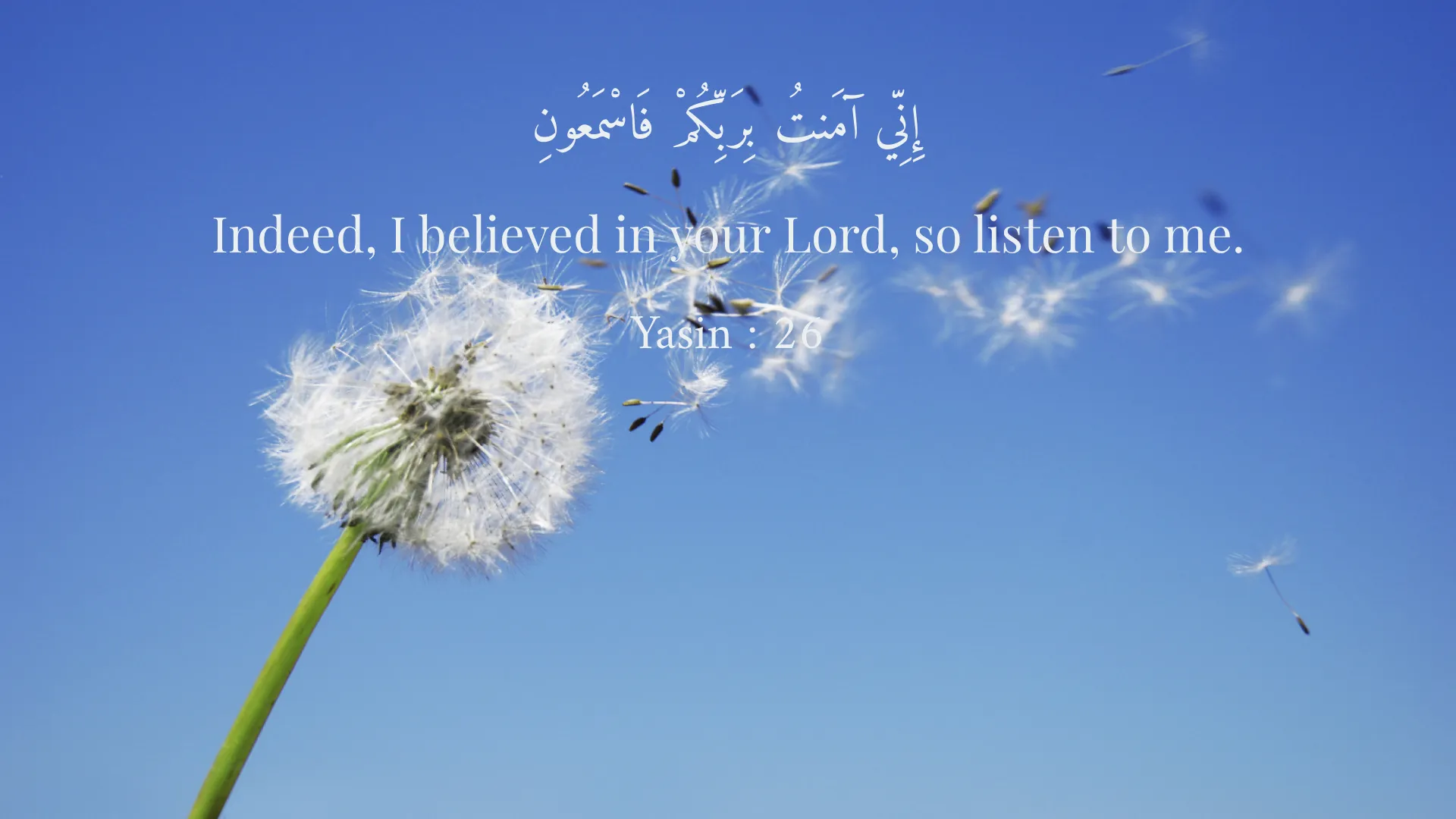
إِنِّي آمَنتُ بِرَبِّكُمْ فَاسْمَعُونِ
Indeed, I believed in your Lord, so listen to me.
Yasin : 26
وَلا تَحْسَبَنَّ الَّذِينَ قُتِلُوا فِي سَبيلِ اللَّهِ أمواتًا بَلْ أَحْيَاءٌ عِندَ رَبِّهِمْ يُرْزَقُونَ
And do not think that those who have died in the cause of Allah are dead; rather, they are alive with their Lord, receiving provision.
Al-Imran : 169
ليس البر أن تولوا وجوهكم قبل المشرك والمغرب ولكن البر من آمن بالله واليوم الآخر والملائكة والكتاب والنبيين
Righteousness is not that you turn your faces toward the east or the west, but [true] righteousness is in one who believes in Allah, the Last Day, the Angels, the Book, and the Prophets.
Al-Baqarah : 177
Short Story
One day, a young man named Amir was searching for the true meaning of his life. He recalled the Quranic verses and decided to make his life purposeful. Through reciting the verses, he found inner peace and understood that love for God and serving others were the keys to success. From that day on, Amir strived to adhere to these principles in his life and felt better every day.