Quranic Answer
Having hope for an unknown tomorrow is one of humanity's greatest life challenges. In a world full of change and uncertainty, anxiety about the future is natural. However, Islam, as a comprehensive guide for life, offers profound and comforting solutions for confronting these uncertainties. These solutions not only help alleviate anxiety but also empower individuals with immense strength to move forward with hope and reliance on God. The core of these solutions is the deep concept of 'Tawakkul' (reliance upon Allah). Tawakkul means complete trust in God and entrusting matters to Him, while still making efforts and planning. This does not imply idleness or passive waiting; rather, it means exerting one's maximum effort and then submitting the outcome to Allah, the Almighty. The Holy Quran repeatedly emphasizes this principle. For instance, in Surah At-Talaq, verse 3, Allah says: "Waman yatawakkal AAala Allahi fahuwa hasbuh" which means, "And whoever relies upon Allah, then He is sufficient for him." This verse builds a strong sanctuary for hearts worried about the future. Knowing that the Creator of the entire universe and the Administrator of all affairs is your guardian and supporter brings an indescribable peace. Another key concept presented in the Quran for dealing with future uncertainties is 'Sabr' (patience). Patience is not merely enduring hardships but also includes steadfastness on the path of truth and resilience in the face of adversities. Allah repeatedly calls believers to patience in the Holy Quran and promises to be with the patient. In Surah Al-Baqarah, verse 153, He states: "Ya ayyuha allatheena amanoo istaAAeenoo bialssabri waalssalati inna Allaha maAAa alssabireen" meaning, "O you who have believed, seek help through patience and prayer. Indeed, Allah is with the patient." This verse teaches us that patience and prayer are two powerful tools for overcoming difficulties and maintaining hope in the face of an ambiguous future. Prayer, as the pillar of faith and the ascent of the believer, provides a direct connection with Allah and is an endless source of tranquility and positive energy. Through prayer, one feels that they are not alone and are always connected to an infinite power. In addition to Tawakkul and Sabr, 'Rida bi Qada'illah' (contentment with Allah's decree) plays a vital role in fostering hope for the future. This concept means accepting that whatever Allah decrees is ultimately for one's good and benefit, even if it appears undesirable on the surface. Believing in the truth that Allah, the Almighty, is the Most Wise and Most Merciful, and never wrongs His servants, eradicates worries. Surah Yusuf, verse 87, states: "Wa la tay’asoo min rawhi Allahi innahu la yay’asu min rawhi Allahi illa alqawmu alkaafiroon" meaning, "And do not despair of the relief from Allah. Indeed, no one despairs of relief from Allah except the disbelieving people." This verse explicitly identifies despair as a sign of disbelief and invites believers to hope in Allah's mercy. A believer, even in the most difficult circumstances, keeps the light of hope alive in their heart, knowing that after every hardship, there will be ease and relief. This perspective transforms potential fear into a proactive approach, encouraging effort while leaving the ultimate outcome to Divine wisdom. 'Dhikrullah' (remembrance of Allah) and keeping Him in mind are also among the most effective ways to gain peace and hope for the future. In Surah Ar-Ra'd, verse 28, the Holy Quran states: "Allatheena amanoo watatma-innu quloobuhum bidhikri Allahi ala bidhikri Allahi tatma-innu alquloobu" meaning, "Those who have believed and whose hearts are assured by the remembrance of Allah. Unquestionably, by the remembrance of Allah hearts are assured." When one's heart is reassured by the remembrance of Allah, the fear of an unknown future vanishes. Dhikr, whether through reciting the Quran, supplication (Du'a), glorification (Tasbeeh), or pondering over divine signs, establishes a deep connection with the Creator and assures the soul that it is under His protection and grace. This inner certainty is the greatest source of hope, enabling individuals to face life's uncertainties with a calm heart and a hopeful spirit. Therefore, to have hope for an unknown tomorrow, we must integrate these Quranic principles into our lives: complete reliance on Allah (Tawakkul), patience and steadfastness in the face of challenges (Sabr), contentment with Allah's decree (Rida), and continuous remembrance of Him (Dhikr). By acting upon these teachings, we not only free ourselves from future anxieties but also live each day with enthusiasm and vitality, knowing that whatever destiny Allah ordains for us is the best, both in this world and the Hereafter. This profound insight allows us to confront whatever comes our way with a reassured heart and a hopeful spirit, understanding that Allah the Almighty always ordains the best for His believing servants. This path is one of peace, contentment, and enduring hope, imbuing human life with deep and eternal meaning.
Related Verses
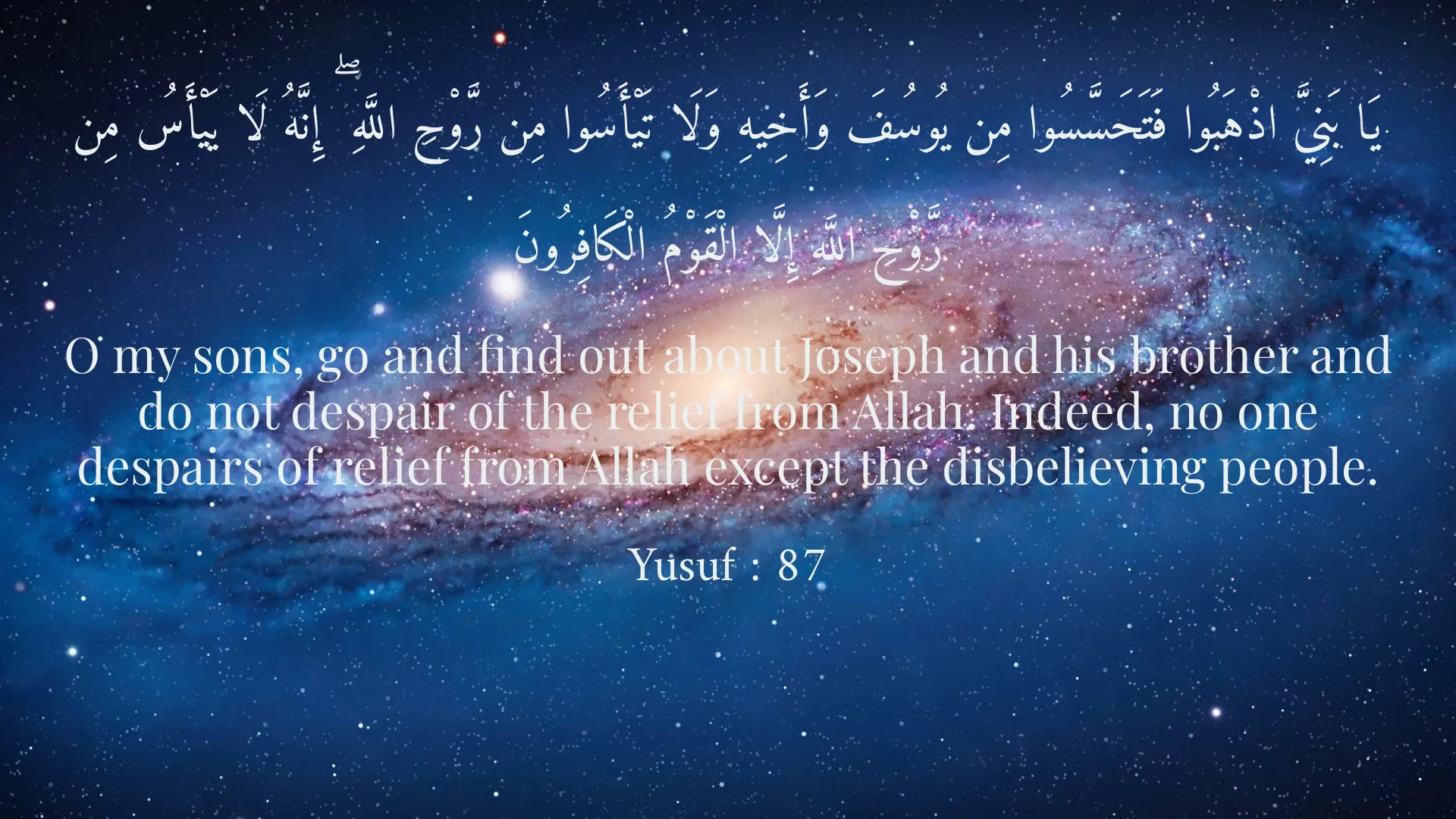
يَا بَنِيَّ اذْهَبُوا فَتَحَسَّسُوا مِن يُوسُفَ وَأَخِيهِ وَلَا تَيْأَسُوا مِن رَّوْحِ اللَّهِ ۖ إِنَّهُ لَا يَيْأَسُ مِن رَّوْحِ اللَّهِ إِلَّا الْقَوْمُ الْكَافِرُونَ
O my sons, go and find out about Joseph and his brother and do not despair of the relief from Allah. Indeed, no one despairs of relief from Allah except the disbelieving people.
Yusuf : 87
وَيَرْزُقْهُ مِنْ حَيْثُ لَا يَحْتَسِبُ ۚ وَمَن يَتَوَكَّلْ عَلَى اللَّهِ فَهُوَ حَسْبُهُ ۚ إِنَّ اللَّهَ بَالِغُ أَمْرِهِ ۚ قَدْ جَعَلَ اللَّهُ لِكُلِّ شَيْءٍ قَدْرًا
And will provide for him from where he does not expect. And whoever relies upon Allah - then He is sufficient for him. Indeed, Allah will accomplish His purpose. Allah has already set for everything a [decreed] extent.
At-Talaq : 3
الَّذِينَ آمَنُوا وَتَطْمَئِنُّ قُلُوبُهُم بِذِكْرِ اللَّهِ ۗ أَلَا بِذِكْرِ اللَّهِ تَطْمَئِنُّ الْقُلُوبُ
Those who have believed and whose hearts are assured by the remembrance of Allah. Unquestionably, by the remembrance of Allah hearts are assured.
Ar-Ra'd : 28
Short Story
It is narrated that in ancient times, there was a weary dervish, exhausted from travel and without any food. In a dry desert, under the scorching sun, he had lost all hope. Yet, in his heart, he whispered, "Oh my Lord, You are the Provider, and You do not disappoint those who rely on You." With this glimmer of hope, he took a step forward. Suddenly, he spotted a caravan appearing in the distance. The caravan leader, seeing the dervish in such a state, felt compassion and provided him with water and food. The dervish, with a hopeful smile, said, "Truly, there is no despair in Allah's work, and whoever relies on Him, their need shall be fulfilled."