Quranic Answer
Quranic supplications are not merely beautiful words to recite; they are profound pathways to forge a deeper, more meaningful connection with Allah in every facet of daily life. Integrating these blessed prayers into our routine means that every activity, every challenge, and every moment of joy can be imbued with the remembrance and presence of Allah, serving as an immense source of tranquility, strength, and divine guidance. The Holy Quran, a book of guidance and light, teaches us how to remain in constant communion with our Creator, seeking His aid and blessings at all times and under all circumstances. This continuous and sincere connection not only brings forth numerous spiritual benefits but also helps us face life's challenges with a stronger spirit and a calmer heart. One of the most fundamental concepts in the Quran is the command to engage in "Dua" (supplication). Allah (SWT) declares in Surah Ghafir, verse 60: «وَقَالَ رَبُّكُمُ ادْعُونِي أَسْتَجِبْ لَكُمْ ۚ», which translates to: "And your Lord says, 'Call upon Me; I will respond to you.'" This verse unequivocally shows that Dua is not just a request but an act of worship that Allah Himself has commanded and promised to answer. This divine injunction encourages us to extend our hands towards Him in every difficulty, every need, and even in moments of gratitude and happiness. Incorporating this concept into daily life implies that with every decision, every small step we take, and every moment of uncertainty, we should remember that we can and must seek Allah's help. This fundamental belief forms the backbone of our connection to the unseen world and assures us that no problem is too great to be beyond Allah's power. To practically implement this, the first step is "awareness." Awareness that Allah is always near and hears our every call. Surah Al-Baqarah, verse 186, emphasizes this truth: «وَإِذَا سَأَلَكَ عِبَادِي عَنِّي فَإِنِّي قَرِيبٌ ۖ أُجِيبُ دَعْوَةَ الدَّاعِ إِذَا دَعَانِ ۖ فَلْيَسْتَجِيبُوا لِي وَلْيُؤْمِنُوا بِي لَعَلَّهُمْ يَرْشُدُونَ», meaning: "And when My servants ask you concerning Me, then [answer them], I am indeed near. I respond to the invocation of the supplicant when he calls upon Me. So let them respond to Me [by obedience] and believe in Me that they may be guided." This verse whispers that Allah is closer to us than our jugular vein, hearing every word that emanates from our hearts. Therefore, to integrate Quranic supplications into life, this belief must first be firmly established in our hearts: that connection with Allah is instantaneous and requires no intermediary. This proximity gives us the assurance that at any moment, we can call upon Him, and He will respond to us. The second step is "selecting appropriate supplications" for different situations. The Holy Quran is a treasure trove of comprehensive and profound prayers articulated by prophets and righteous servants. For instance, the supplication «رَبَّنَا آتِنَا فِي الدُّنْيَا حَسَنَةً وَفِي الْآخِرَةِ حَسَنَةً وَقِنَا عَذَابَ النَّارِ» (Surah Al-Baqarah, verse 201) is an all-encompassing prayer for goodness in this world and the hereafter. This Dua can be recited at the start of the day, during work, or before sleep to attract goodness and blessings into all aspects of our lives. Or the supplication of Prophet Musa (Moses), peace be upon him: «رَبِّ اشْرَحْ لِي صَدْرِي وَيَسِّرْ لِي أَمْرِي وَاحْلُلْ عُقْدَةً مِّن لِّسَانِي يَفْقَهُوا قَوْلِي» (Surah Taha, verses 25-28), which is highly practical for easing affairs and enhancing eloquence. We can recite this Dua before a speech, an important meeting, or even when we want to communicate with someone and are concerned about being clearly understood. Also, the Dua "Rabbī Zidnī Ilmā" (My Lord, increase me in knowledge) from Surah Taha, verse 114, can be whispered daily while studying or learning something new. Choosing Duas appropriate to the need and situation adds more depth to the act and elevates it beyond mere repetition. The third step is "understanding and reflecting on the meaning" of the supplication. Merely reciting words without comprehending their meanings is like sowing seeds in barren soil. When we grasp the meaning of a Dua, we feel it with our entire being, transforming it from a dry whisper into a lively and passionate invocation. Reflection on the meanings of the words takes us deeper into the Dua and multiplies its effect on our heart and soul. For example, when we say «رَبَّنَا لَا تُزِغْ قُلُوبَنَا بَعْدَ إِذْ هَدَيْتَنَا وَهَبْ لَنَا مِن لَّدُنكَ رَحْمَةً ۚ إِنَّكَ أَنتَ الْوَهَّابُ» (Surah Al-Imran, verse 8), we are literally asking Allah to protect our hearts from deviation after He has guided us and to grant us mercy from His presence, and this heartfelt request will have a profound impact on our steadfastness on the path of truth. The fourth step is "consistency and perseverance" in supplication. Dua should not be confined only to times of difficulty and hardship. The Quran teaches us to remember Allah always. «فَاذْكُرُونِي أَذْكُرْكُمْ وَاشْكُرُوا لِي وَلَا تَكْفُرُونِ» (Surah Al-Baqarah, verse 152) means: "So remember Me; I will remember you. And be grateful to Me and do not deny Me." This verse underscores the importance of constant remembrance of Allah. We can establish this consistency by setting specific times for Dua throughout the day, such as upon waking, before starting work, during breaks, and before sleeping. Even brief moments of waiting in line or in traffic offer golden opportunities to whisper a short Quranic Dua. Continuous supplication transforms it into an inseparable part of our identity. The fifth step is "sincerity and certainty" in supplication. Allah answers the prayer of one who supplicates with a pure heart and complete certainty in His power and mercy. The Quran repeatedly emphasizes that believers should place their trust in Allah. When we make Dua, we must believe with all our heart that Allah is All-Powerful and will respond to us in the best possible way, even if His response is not immediate or exactly as we desire. This is because sometimes the answer to a prayer might be in protecting us from an unknown harm, or its delay might be for a greater good that divine wisdom necessitates. This certainty in divine wisdom and mercy brings peace back to our hearts, even if our apparent desire is not immediately fulfilled. Ultimately, integrating Quranic supplications into daily life means "transforming life into worship." Every breath we take, every step we make, and every action we perform can, with pure intention and the remembrance of Allah, become an act of worship that purifies our soul and body. This continuous connection with Allah not only grants us spiritual tranquility but also makes us more resilient against temptations and hardships, illuminating our path towards prosperity in this world and the hereafter. Through Dua, we not only ask from Allah but also draw ourselves closer to Him, allowing our lives to take on a divine essence. This approach elevates our daily routines beyond mechanical activities, transforming them into a spiritual and meaningful journey where every moment is an opportunity for growth and proximity to the Creator of the universe. With consistency and sincerity, we will witness how Quranic supplications transform the very fabric of our lives, filling them with divine light and blessings. This path leads to eternal peace and divine satisfaction, truly making our lives heavenly.
Related Verses
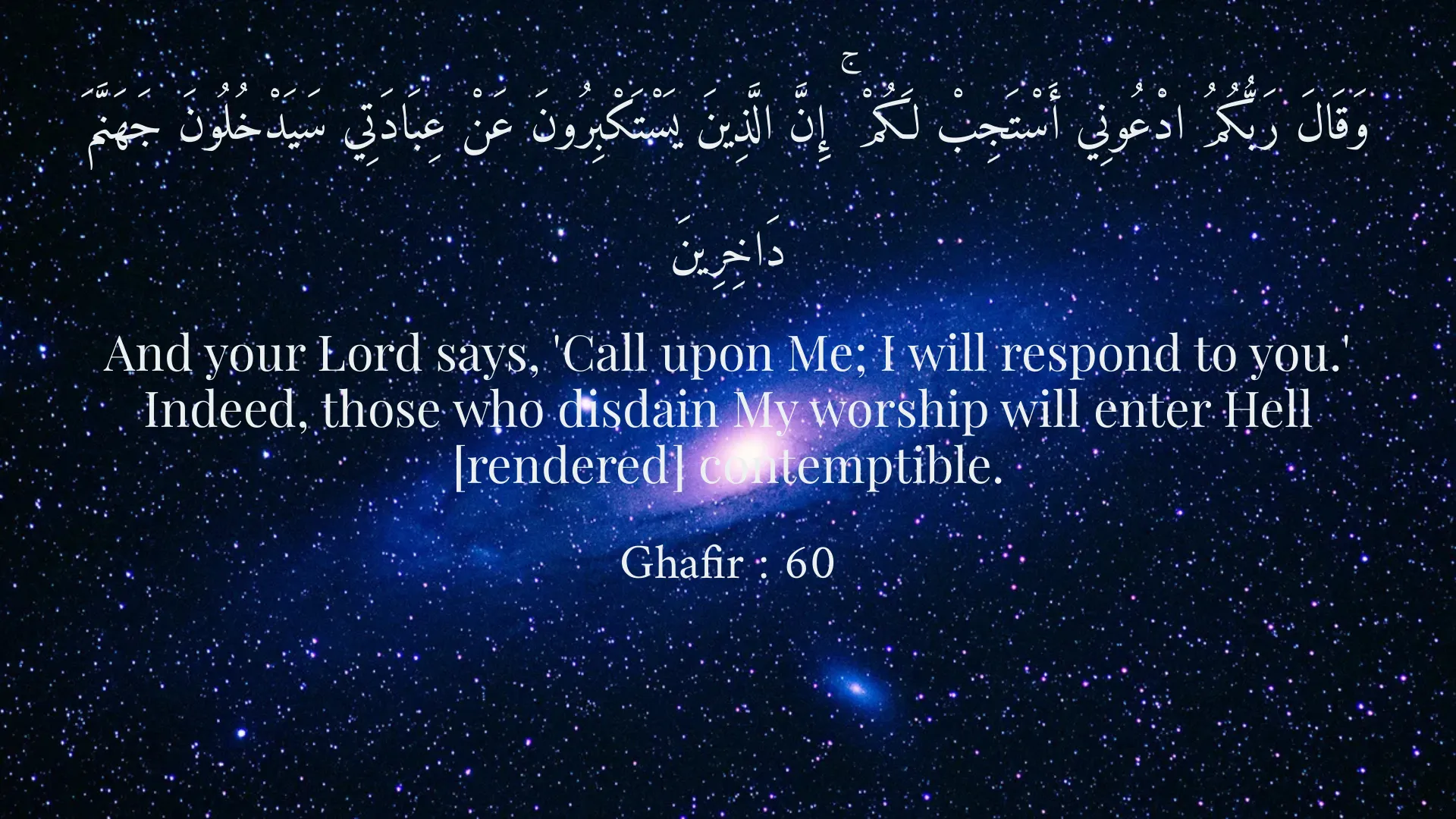
وَقَالَ رَبُّكُمُ ادْعُونِي أَسْتَجِبْ لَكُمْ ۚ إِنَّ الَّذِينَ يَسْتَكْبِرُونَ عَنْ عِبَادَتِي سَيَدْخُلُونَ جَهَنَّمَ دَاخِرِينَ
And your Lord says, 'Call upon Me; I will respond to you.' Indeed, those who disdain My worship will enter Hell [rendered] contemptible.
Ghafir : 60
وَإِذَا سَأَلَكَ عِبَادِي عَنِّي فَإِنِّي قَرِيبٌ ۖ أُجِيبُ دَعْوَةَ الدَّاعِ إِذَا دَعَانِ ۖ فَلْيَسْتَجِيبُوا لِي وَلْيُؤْمِنُوا بِي لَعَلَّهُمْ يَرْشُدُونَ
And when My servants ask you concerning Me, then [answer them], I am indeed near. I respond to the invocation of the supplicant when he calls upon Me. So let them respond to Me [by obedience] and believe in Me that they may be guided.
Al-Baqarah : 186
وَمِنْهُم مَّن يَقُولُ رَبَّنَا آتِنَا فِي الدُّنْيَا حَسَنَةً وَفِي الْآخِرَةِ حَسَنَةً وَقِنَا عَذَابَ النَّارِ
But among them is he who says, "Our Lord, give us in this world [that which is] good and in the Hereafter [that which is] good and protect us from the punishment of the Fire."
Al-Baqarah : 201
Short Story
It is narrated that in the city of Shiraz, there lived a wealthy merchant who, every morning and evening, recited loud and elaborate prayers, but his heart was solely preoccupied with accumulating more wealth. In the same city lived a simple-hearted dervish, whose daily sustenance was barely met. This dervish, every morning, with a heart full of hope and simplicity, would merely whisper: 'My Lord, suffice me and fill my heart with contentment.' One day, the merchant, hearing his prayers, sneered, 'How do you expect your prayers, being so brief, to be answered?' The dervish replied with a kind smile, 'I only ask according to my need, and I know that Allah grants according to my heart, not the length of my words.' It was not long before a misfortune befell the merchant, and he lost all his wealth. But the dervish, with his simple prayer and contented heart, maintained his peace, and people from all directions came to his aid. Thus, the merchant learned that the value of prayer lies in sincerity, not in the length of words or outward grandeur.