Quranic Answer
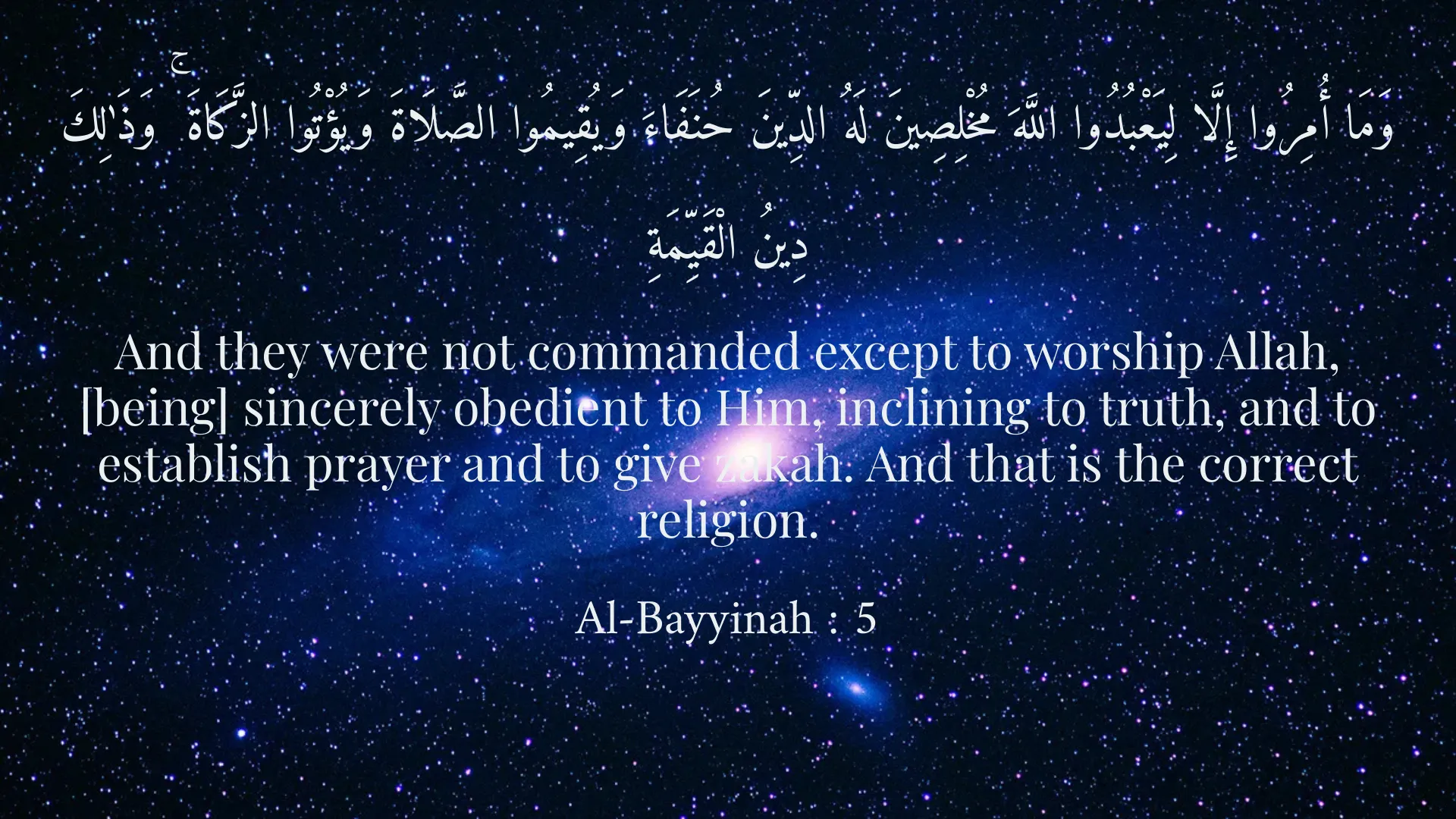
Purity of intention and sincerity in actions are among the most crucial concepts and principles in the teachings of the Holy Quran. The Quran repeatedly emphasizes the importance of sincere intentions and the avoidance of any form of selfishness or hypocrisy (riya') in worship and all aspects of life. Selfishness (ananiyah) means that a person performs actions not for the pleasure of God, but for personal gain, the praise of others, or to achieve worldly status. In contrast, purity of intention (ikhlas) means performing every action solely for Allah, with the sole purpose of gaining His pleasure, without any partner or intention other than Him. One of the fundamental bases for keeping intentions pure from selfishness is the concept of Tawhid, the Oneness of God. Tawhid signifies the singularity and uniqueness of Allah, and that only He is worthy of worship and obedience. When a person directs all their thoughts, actions, and aspirations solely towards Almighty Allah, there is no room left for selfishness or worldly intentions. The Holy Quran repeatedly stresses this principle that humans should worship only God and associate no partners with Him. This "shirk" (associating partners with God) can occur not only in explicit worship but also in inner intentions; that is, when a person performs an action for the approval of people, to gain praise, or for material benefits, instead of doing it purely for God. This subtle form of shirk contaminates intentions with selfishness. Surah Al-Bayyinah, verse 5, explicitly states: "And they were not commanded except to worship Allah, [being] sincerely obedient to Him, inclining to truth, and to establish prayer and to give zakah. And that is the correct religion." This verse clearly demonstrates the connection between sincerity (ikhlas) and religion and worship. The concept of "Lillah" (for the sake of Allah) is another pillar of pure intention. In many Quranic verses, believers are asked to perform their actions "li-Wajhillah" (for the countenance of Allah). This includes charity, helping the needy, jihad, and even daily tasks. When a person performs an act solely for the pleasure of God, they no longer expect reward from people, fame, or worldly gain. In Surah Al-Insan, verse 9, Allah says through the words of the righteous (al-Abrar): "Indeed, We feed you only for the countenance of Allah. We wish not from you reward or [even] gratitude." This verse illustrates the pinnacle of sincerity, where one is freed even from the expectation of thanks or appreciation. To keep intentions pure, we must constantly remind ourselves that the only true Observer and the only true Rewarder is Allah, and therefore, only His pleasure matters. This perspective eliminates any inclination towards showing off or self-admiration. One of the greatest dangers to pure intention is Riya' (hypocrisy or showing off). Riya' means ostentation and showing off in performing good deeds to gain status in the eyes of people. The Holy Quran strongly condemns Riya' and considers actions mixed with it to be worthless. In Surah Al-Baqarah, verse 264, Allah states: "O you who have believed, do not invalidate your charities with reminders or injury like one who spends his wealth [only] to be seen by the people and does not believe in Allah and the Last Day." This verse clearly shows how Riya' can destroy the value of good deeds and even equate it with disbelief in God. To combat Riya', one must always remember that Allah is aware of the most hidden intentions, and no action is concealed from His sight. Focusing on Allah's pleasure and disregarding people's judgment is an effective way to escape the trap of Riya' and selfishness. Focusing on the Hereafter (Akhirah) and its rewards is another effective way to purify intentions from selfishness. When a person understands that this world is fleeting and that the true, lasting life is in the Hereafter, they will no longer pursue ephemeral worldly gains. Every good deed performed with pure intention for Allah will be a provision for the Hereafter. This perspective helps a person detach from material desires and fame-seeking, which often stem from selfishness, and perform their actions with the goal of gaining eternal reward from Allah. The Quran in Surah Al-Alaq beautifully states that to your Lord is the return, a constant reminder that helps one base their actions on His pleasure. This profound understanding shifts one's entire paradigm, making every effort, big or small, a means to a greater, eternal purpose, far beyond the transient praises or benefits of this world. Taqwa (God-consciousness or fear of Allah) and Muhasabah (self-accountability) are also crucial tools for purifying intentions. Taqwa means having constant vigilance and guarding oneself against committing sins and neglecting religious duties, and this includes guarding one's intentions. A person with Taqwa always strives to perform every action with pure intention. Muhasabah means that a person regularly reviews their actions and intentions to see if they were sincere or not. This continuous self-assessment helps in identifying and correcting impure intentions. The Quran invites believers to self-reflection (muraqabah) and Taqwa, both of which strengthen the purity of intention. It is through this constant self-examination that one can discern the subtle whispers of ego and worldly desires, steering the heart back towards divine pleasure. In practice, to keep intentions pure, several steps can be taken: 1. Constant remembrance of Tawhid: Before starting any action, remind yourself that you are doing it for the pleasure of Allah. 2. Supplication to Allah: Ask Allah to help you purify your intentions and keep you away from Riya' and selfishness. Prophet Muhammad (PBUH) also made such supplications. 3. Concealing good deeds: As much as possible, perform good deeds secretly to reduce the temptation of Riya'. 4. Reflecting on the consequences of selfishness: Remember how selfishness can harm a person both in this world and the Hereafter, and how it can invalidate their actions. 5. Associating with sincere people: Socializing with those who value sincerity can be inspiring and help maintain one's own purity of intention. In conclusion, keeping intentions pure from selfishness is a continuous process requiring inner effort, rooted in a correct understanding of Allah and the purpose of creation. The Quran, by emphasizing Tawhid, the concept of "Lillah," the prohibition of Riya', the importance of the Hereafter, and the invitation to Taqwa and self-accountability, provides comprehensive solutions for achieving this vital goal. When intentions become pure, all of one's actions, even the most mundane, transform into acts of worship and acquire infinite value in the sight of the Lord. This sincerity makes life meaningful and blessed, paving the way for eternal felicity. This process not only contributes to the individual's spiritual elevation but also improves their relationships with others and society, as actions stemming from pure intentions will always be accompanied by goodness and blessings. Pure intention is the key to the acceptance of deeds and the cornerstone of spiritual growth, and the Quran guides us towards this inner purity to attain closeness to Allah and free ourselves from all attachments and impure motives.
Related Verses
وَمَا أُمِرُوا إِلَّا لِيَعْبُدُوا اللَّهَ مُخْلِصِينَ لَهُ الدِّينَ حُنَفَاءَ وَيُقِيمُوا الصَّلَاةَ وَيُؤْتُوا الزَّكَاةَ ۚ وَذَٰلِكَ دِينُ الْقَيِّمَةِ
And they were not commanded except to worship Allah, [being] sincerely obedient to Him, inclining to truth, and to establish prayer and to give zakah. And that is the correct religion.
Al-Bayyinah : 5
إِنَّمَا نُطْعِمُكُمْ لِوَجْهِ اللَّهِ لَا نُرِيدُ مِنكُمْ جَزَاءً وَلَا شُكُورًا
[Saying], 'We feed you only for the countenance of Allah. We wish not from you reward or [even] gratitude.'
Al-Insan : 9
يَا أَيُّهَا الَّذِينَ آمَنُوا لَا تُبْطِلُوا صَدَقَاتِكُم بِالْمَنِّ وَالْأَذَىٰ كَالَّذِي يُنفِقُ مَالَهُ رِئَاءَ النَّاسِ وَلَا يُؤْمِنُ بِاللَّهِ وَالْيَوْمِ الْآخِرِ ۖ
O you who have believed, do not invalidate your charities with reminders or injury like one who spends his wealth [only] to be seen by the people and does not believe in Allah and the Last Day.
Al-Baqarah : 264
Short Story
It is recounted in Sa'di's Gulistan that a wise king was on a journey with his astute vizier. They arrived at a caravanserai and saw two men: one was loudly performing dhikr (remembrance of God) and displaying his piety, while the other sat quietly and humbly in a corner, serving the people. The king asked the vizier, "Which of these two is superior in the sight of God?" The vizier replied, "O virtuous king, the one who is silent and sincerely serves God's creatures has a heart closer to God than the one who, through pretense and showing off, wishes to appear great in the eyes of people. For a pure intention is more valuable than a loud voice and a hypocritical shout." The king took heed of the vizier's words and understood that the worth of an action lies in the sincerity of its intention, not in its outward appearance. My dear friend, purify your intentions so that your deeds may be accepted, for even a mountain of gold, if tainted with hypocrisy, is worth nothing.