Quranic Answer
Understanding whether God is pleased with us or not is one of the deepest and most fundamental concerns of every believing human. This divine pleasure is not a fleeting feeling or a superficial material reward, but a profound inner state, a spiritual journey, and evident signs in an individual's life and society, clearly indicated in the Holy Quran. In numerous verses, Allah Almighty introduces ways to achieve this pleasure, as well as its signs. In essence, God's pleasure is attained through piety (Taqwa), genuine faith (Iman), righteous deeds (Amal Salih), patience (Sabr), gratitude (Shukr), and continuous repentance (Tawbah), each having vast dimensions and tangible impacts on a person's life. The first and perhaps most essential pillar for attracting divine pleasure is 'Taqwa,' which means God-consciousness and piety. Taqwa implies guarding oneself against sins and fulfilling divine obligations. The Quran repeatedly emphasizes the importance of Taqwa and declares the pious as beloved by Allah. In Surah Aal-Imran, verse 134, it states: "And Allah loves the doers of good." It then describes the characteristics of the pious: those who spend in ease and hardship, control their anger, and forgive people. This verse demonstrates that Taqwa is not limited to individual acts of worship but also encompasses benevolent social behaviors and self-control. When a person reaches this level of Taqwa, where they are mindful of God's pleasure in all aspects of life, an inner peace and blessing flow into their life, which itself is a sign of divine pleasure. The second pillar is 'genuine faith and righteous deeds.' The Quran frequently pairs faith (Iman) with righteous deeds (Amal Salih). Mere verbal profession of faith is insufficient; faith must manifest in actions and conduct. In Surah Al-Bayyinah, verses 7 and 8, it says: "Indeed, they who have believed and done righteous deeds - those are the best of creatures. Their reward with their Lord will be gardens of perpetual residence beneath which rivers flow, wherein they will abide forever, Allah being pleased with them and they with Him. That is for whoever has feared his Lord." These verses explicitly state that Allah is pleased with those who believe and perform righteous deeds, and this pleasure is a reward greater than Paradise itself. Righteous deeds include every good act performed with sincere intention for Allah, ranging from prayer and fasting to helping the needy, truthfulness, trustworthiness, upholding justice, and good character. When one finds that Allah grants them success in performing good deeds and their heart inclines towards goodness, this itself can be a sign of divine pleasure. The inner good feeling after performing a virtuous act and the sense of closeness to Allah are among the fruits of this pleasure. 'Patience and steadfastness' in the face of difficulties and divine trials are also signs of God's pleasure. Worldly life is full of ups and downs, and Allah tests His servants with hardships. Those who endure these tests with patience and do not deviate from the path of truth, in fact, draw closer to divine pleasure. In Surah Al-Baqarah, verse 153, we read: "O you who have believed, seek help through patience and prayer. Indeed, Allah is with the patient." Allah's companionship with the patient is the highest sign of His pleasure and love. When you face challenges and, instead of despairing or complaining, rely on Allah and remain steadfast in the path of truth with patience, this inner state and perseverance are signs of His grace and pleasure. 'Gratitude' for God's blessings, both big and small, is also a way to attract His pleasure. Allah says in Surah Ibrahim, verse 7: "If you are grateful, I will surely increase you [in favor]; but if you deny, indeed, My punishment is severe." An increase in blessings, whether material or spiritual, can be a sign of God's pleasure. When a person is grateful for divine blessings and uses them in a way that pleases Him, Allah also becomes pleased with them and bestows more blessings upon them. A feeling of inner peace and contentment in life, even amidst shortcomings, can itself be a sign of divine pleasure, for Allah fills the heart of His servant with tranquility. Finally, 'continuous repentance and seeking forgiveness' for sins and returning to Allah is another crucial factor for attaining divine pleasure. No human is infallible, and everyone may make mistakes and commit sins. But what is important is remorse for sin and striving to rectify it. Allah says in Surah Al-Baqarah, verse 222: "Indeed, Allah loves those who repent and loves those who purify themselves." This love of Allah for repentant ones is itself the highest sign of His pleasure. When a person realizes their mistake, truly regrets it from the heart, and resolves to make amends, this feeling of purity and closeness to Allah is a sign of His acceptance of their repentance and divine pleasure. The success of repentance itself is a blessing that comes from Allah and is a sign that He does not want His servant to remain sinful and grants them an opportunity to return. In general, God's pleasure manifests in 'inner peace,' 'success in performing good deeds,' 'blessings in life,' 'a sense of closeness to God,' and 'avoidance of sins.' When a person finds that their inclination to do good deeds increases, they avoid sins, they face difficulties with patience and reliance on God, and they have a deep inner peace regarding divine decree, they can hope that they are on the path of divine pleasure. This is a continuous process that requires constant self-assessment and striving to be better at every moment. God's pleasure is ranked highest in Paradise, for it is superior to all other blessings, as stated in Surah At-Tawbah, verse 72: "And approval from Allah is greater. That is the great attainment." This verse explicitly shows that the greatest reward and tremendous success is indeed divine pleasure, which surpasses every blessing of Paradise. Therefore, striving for divine pleasure is the ultimate aspiration of every believer, and its signs should be observed within oneself and in the impact of one's actions on the world.
Related Verses
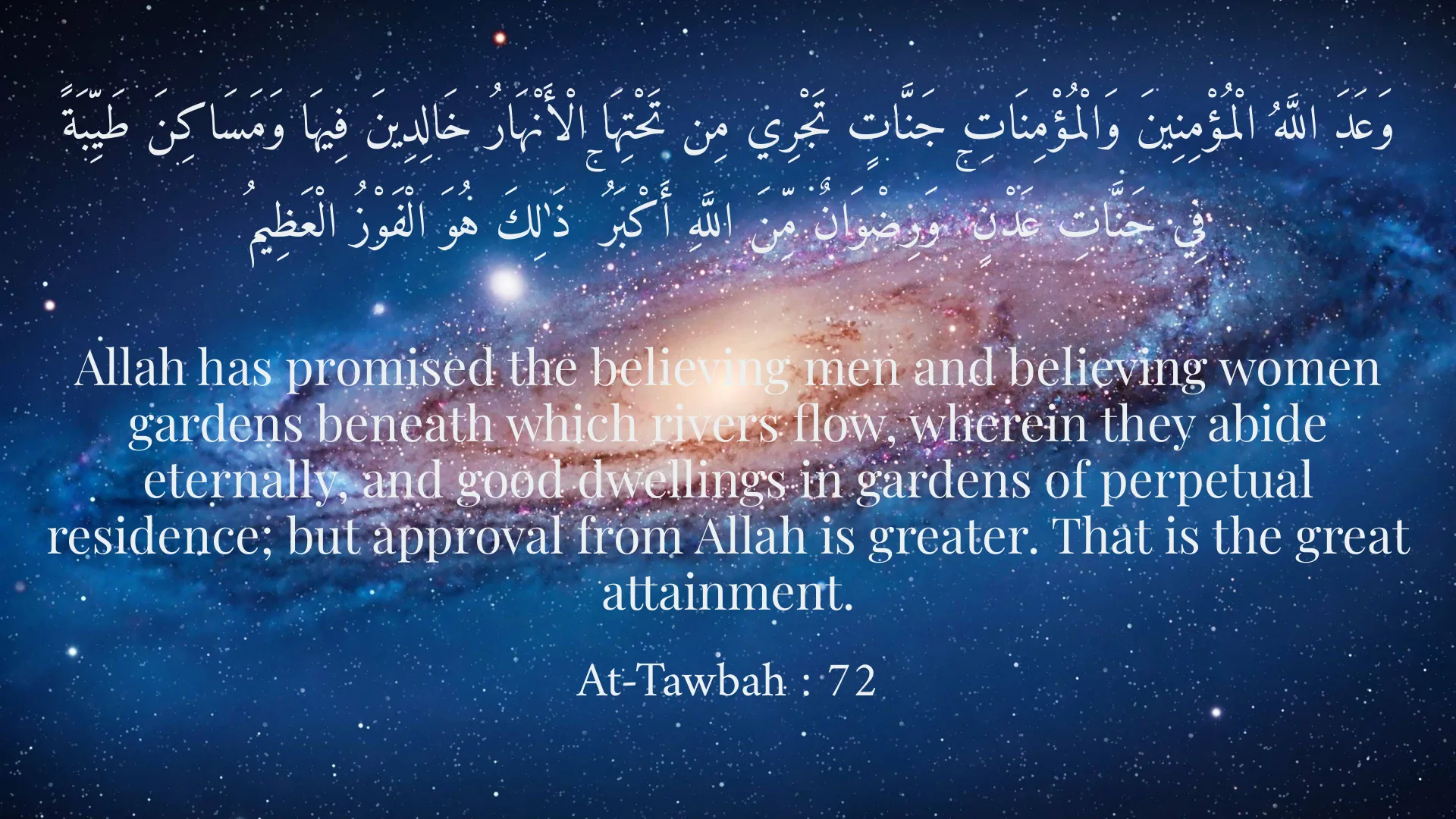
وَعَدَ اللَّهُ الْمُؤْمِنِينَ وَالْمُؤْمِنَاتِ جَنَّاتٍ تَجْرِي مِن تَحْتِهَا الْأَنْهَارُ خَالِدِينَ فِيهَا وَمَسَاكِنَ طَيِّبَةً فِي جَنَّاتِ عَدْنٍ ۚ وَرِضْوَانٌ مِّنَ اللَّهِ أَكْبَرُ ۚ ذَٰلِكَ هُوَ الْفَوْزُ الْعَظِيمُ
Allah has promised the believing men and believing women gardens beneath which rivers flow, wherein they abide eternally, and good dwellings in gardens of perpetual residence; but approval from Allah is greater. That is the great attainment.
At-Tawbah : 72
إِنَّ الَّذِينَ آمَنُوا وَعَمِلُوا الصَّالِحَاتِ أُولَٰئِكَ هُمْ خَيْرُ الْبَرِيَّةِ
Indeed, they who have believed and done righteous deeds - those are the best of creatures.
Al-Bayyinah : 7
جَزَاؤُهُمْ عِندَ رَبِّهِمْ جَنَّاتُ عَدْنٍ تَجْرِي مِن تَحْتِهَا الْأَنْهَارُ خَالِدِينَ فِيهَا أَبَدًا ۖ رَّضِيَ اللَّهُ عَنْهُمْ وَرَضُوا عَنْهُ ۚ ذَٰلِكَ لِمَن خَشِيَ رَبَّهُ
Their reward with their Lord will be gardens of perpetual residence beneath which rivers flow, wherein they will abide forever, Allah being pleased with them and they with Him. That is for whoever has feared his Lord.
Al-Bayyinah : 8
Short Story
It is narrated that in ancient times, there lived a pious and benevolent man named 'Hakim' (the Wise), who was always seeking the pleasure of the Lord. People loved him because Hakim treated everyone with kindness, helped the poor, and never harbored resentment towards anyone. One day, a friend, seeing his constant peace and contentment, asked him, "O Hakim, with all this effort and hardship, how are you always so calm and joyful? Are you never worried that God might be displeased with you?" Hakim smiled and said, "My dear friend, I always strive to do what God has commanded and avoid what He has forbidden. Then, with a confident heart, I hope for His grace and pleasure. My peace comes from knowing that He never leaves His servant's efforts unrewarded, and my love for Him is a response to His endless love. When I perform good deeds and find inner peace, I understand that I have taken a step on the path to His pleasure, and that is sufficient for me." And thus, Hakim, with sincere heart and righteous deeds, was always immersed in divine pleasure.