Quranic Answer
In the journey of life, every human being encounters ups and downs, moments of joy and sorrow, and sometimes periods of deep darkness and despair. This darkness might stem from personal crises, economic hardships, illness, or even general societal conditions. In such times, maintaining hope is not merely a spiritual need but a fundamental prerequisite for survival and progress. The Holy Quran, as a divine guide, offers profound and effective strategies for preserving hope amidst darkness. These strategies are not only comforting but also empower individuals to face challenges with steadfastness. The first and most crucial principle is complete reliance upon Allah (Tawakkul). When a person finds themselves in a dead end, and earthly paths seem closed, trusting in an infinite power greater than any obstacle opens a door of hope. In Surah At-Talaq, verse 3, the Quran states: “And whoever relies upon Allah – then He is sufficient for him.” This verse assures us that if we entrust our affairs to Allah and have confidence in His planning, He will suffice us. This reliance does not mean abandoning effort; rather, it implies striving while maintaining inner certainty that the ultimate outcome rests with Allah, and He desires what is best for us. Indeed, Tawakkul lifts the heavy burden of worries from a person's shoulders, granting them a calm spirit and a reassured heart, for they know they are under the protection of one whose power is limitless and whose knowledge is boundless. In the heart of darkness, this certainty in divine guardianship and planning illuminates the path like a bright lantern, preventing despair from taking root. The belief that Allah never abandons His servants and always decrees what is best for them is the greatest source of hope. The second essential pillar is patience (Sabr) and steadfastness. The Quran repeatedly emphasizes the importance of patience, considering it the key to overcoming many difficulties. In Surah Al-Baqarah, verse 153, we read: “O you who have believed, seek help through patience and prayer. Indeed, Allah is with the patient.” Patience here does not merely imply passive endurance; rather, it encompasses active resistance, perseverance in the face of hardships, and self-restraint when confronted with adversity. This patience is accompanied by hope and expectation of relief. Allah has promised to be with the patient, and this companionship signifies His support and aid. Every hardship is a test of one's faith and patience. By passing these tests, a person becomes stronger and more insightful. The history of prophets and divine saints is also replete with stories of patience that led to victory and relief. Knowing that every difficulty has an end and every darkness will eventually give way to light enables a person to endure and emerge from that darkness with patience. Patience broadens one's perspective, guiding them from focusing on the current difficult moment towards a brighter future. The third vital factor is the remembrance of Allah (Dhikr) and the establishment of prayer (Salat). The Quran states: “Unquestionably, by the remembrance of Allah hearts are assured” (Surah Ar-Ra'd, verse 28). In moments of extreme distress and spiritual pressure, remembering Allah and establishing a connection with Him through prayer and supplication is soothing and hope-giving. Prayer, as the pillar of faith, is not merely an obligation but a safe haven where one can distance themselves from the commotion of the world and communicate intimately with their Creator. This direct connection with the source of peace and power infuses light into the heart and vitality into the soul. Reciting divine names, reciting the Quran, and making supplications are all tools that connect a person to the endless source of hope. When a person feels utterly alone, the remembrance of Allah reminds them that Allah is always present and attentive, and He hears their voice. This sense of divine presence is the greatest support against despair and hopelessness, helping the individual to shift their focus from problems towards Allah's infinite power. The fourth important point is the Quran's explicit prohibition of despairing from Allah's mercy. Despairing of Allah's mercy is considered a major sin because it indicates a lack of proper understanding of Allah's perfect attributes, including His boundless forgiveness and mercy. In Surah Az-Zumar, verse 53, Allah says: “Say, 'O My servants who have transgressed against themselves [by sinning], do not despair of the mercy of Allah. Indeed, Allah forgives all sins. Indeed, it is He who is the Forgiving, the Merciful.'” This verse demonstrates that even those who have committed great sins should not despair of Allah's mercy, let alone those who are facing worldly problems. Allah's mercy is vast, and there is always a way for relief and salvation. A positive outlook and hope for the future stem from the certainty that Allah does not change the condition of a people until they change what is in themselves. This hope is a motivator for striving and seeking solutions. Finally, the divine promise, “For indeed, with hardship [will be] ease. Indeed, with hardship [will be] ease” (Surah Ash-Sharh, verses 5 and 6), is the greatest glad tidings and a crucial factor in maintaining hope. This verse, repeated twice for emphasis, is a categorical affirmation that difficulties are temporary and ease will surely follow. This promise assures people that their current difficult situation is not permanent and relief is on its way. It is in the darkest nights that the dawn approaches. This perspective not only keeps hope alive in the heart but also helps individuals move forward with a positive outlook and stronger motivation to resolve their problems. Through reliance on Allah, patience, remembrance, and faith in divine promises, one can find a light of hope even in the deepest darkness and move towards illumination. These strategies, working not only individually but also synergistically, provide a robust network of spiritual support for a person in facing difficulties.
Related Verses
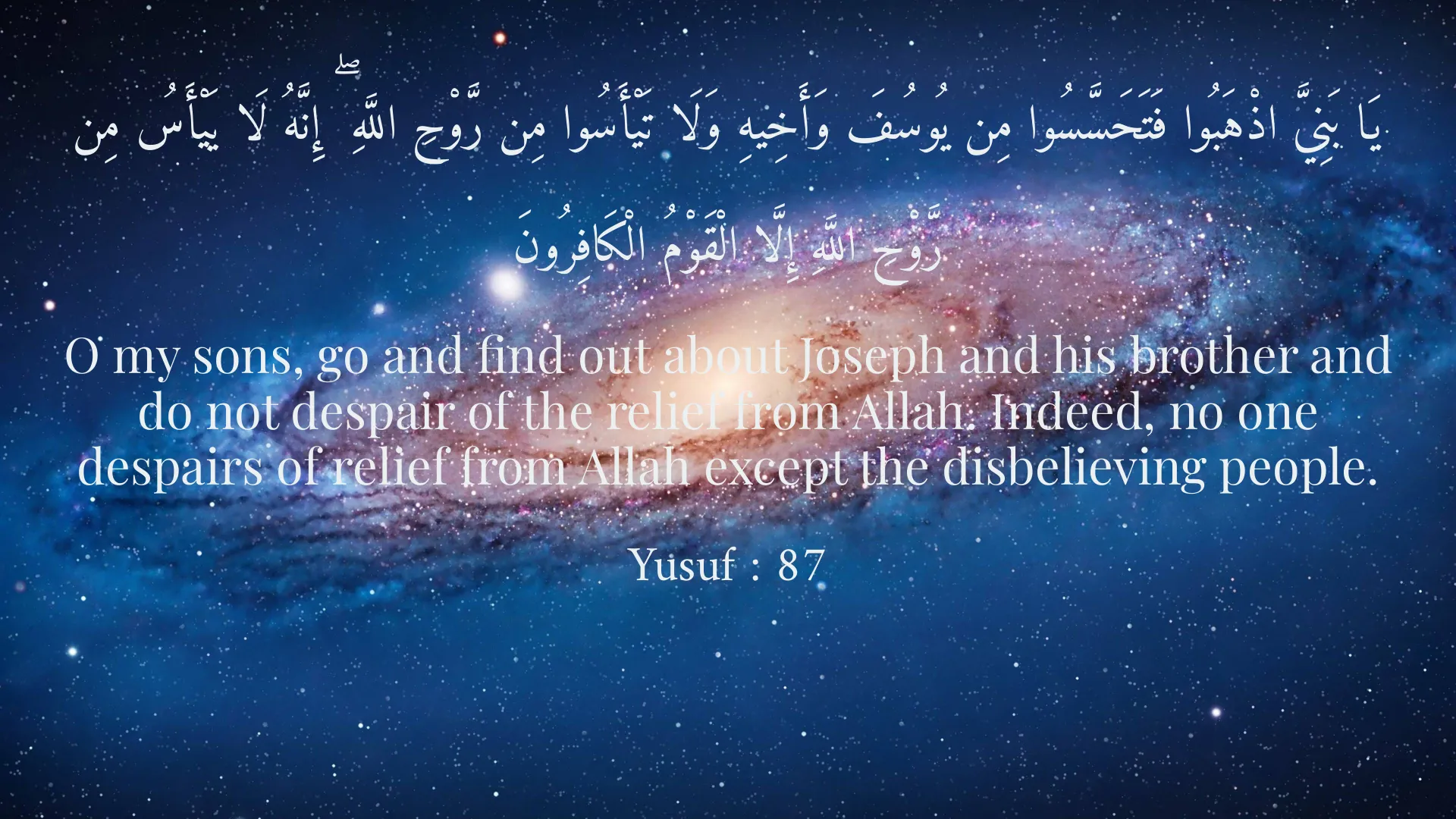
يَا بَنِيَّ اذْهَبُوا فَتَحَسَّسُوا مِن يُوسُفَ وَأَخِيهِ وَلَا تَيْأَسُوا مِن رَّوْحِ اللَّهِ ۖ إِنَّهُ لَا يَيْأَسُ مِن رَّوْحِ اللَّهِ إِلَّا الْقَوْمُ الْكَافِرُونَ
O my sons, go and find out about Joseph and his brother and do not despair of the relief from Allah. Indeed, no one despairs of relief from Allah except the disbelieving people.
Yusuf : 87
فَإِنَّ مَعَ الْعُسْرِ يُسْرًا
For indeed, with hardship [will be] ease.
Ash-Sharh : 5
إِنَّ مَعَ الْعُسْرِ يُسْرًا
Indeed, with hardship [will be] ease.
Ash-Sharh : 6
يَا أَيُّهَا الَّذِينَ آمَنُوا اسْتَعِينُوا بِالصَّبْرِ وَالصَّلَاةِ ۚ إِنَّ اللَّهَ مَعَ الصَّابِرِينَ
O you who have believed, seek help through patience and prayer. Indeed, Allah is with the patient.
Al-Baqarah : 153
Short Story
In a harsh winter, a dervish lost his way in a barren desert. The night was dark and cold, and despair, like a creeping serpent, coiled around his heart. Overcome by hunger and thirst, he had no strength left and thought to himself, 'This is my end.' Suddenly, he recalled the words of an elder who once said, 'Even in the darkest nights, look to the stars, for they are signs of a greater light.' The dervish fixed his gaze upon the sky. Dark clouds obscured most of the stars, but through a small break, a faint star, however dim, glimmered. At that very moment, a subtle scent of water reached his nostrils, carried by a gentle breeze. With renewed vigor, he followed the scent and soon arrived at a small oasis. He realized that hope is not the absence of darkness, but the ability to perceive the smallest glimmer of light within it; a light that ultimately guides one to safety.