Quranic Answer
The question of "how to navigate through a cluttered mind" is a profound human concern that many of us face in modern life. The Holy Quran, although it does not explicitly use the term "cluttered mind," offers comprehensive and fundamental guidance for achieving inner peace, mental clarity, and managing psychological challenges, which directly relate to freeing oneself from this mental turmoil. The Quranic answer to this issue is rooted in foundational beliefs and practices that help individuals transcend intellectual turbulence and internal temptations, leading them to a shore of tranquility. The first and most important Quranic remedy for a cluttered mind is "Dhikr Allah," or the remembrance of God. Allah (SWT) states in Surah Ar-Ra'd, verse 28: "Those who have believed and whose hearts are assured by the remembrance of Allah. Unquestionably, by the remembrance of Allah hearts are assured." This verse presents the core solution. A cluttered mind often results from scattered thoughts, worries, fears about the future, regrets about the past, and relentless material preoccupations. The remembrance of God, whether through the heart or tongue (such as reciting the Quran, uttering supplications, performing prayers), redirects focus from these distractions towards a divine focal point. When the heart and mind are engaged in the remembrance of God, satanic whispers, negative thoughts, and worldly anxieties gradually give way to peace, hope, and certainty. Dhikr acts like a filter, separating superfluous and destructive thoughts from the mind and retaining only what is necessary for spiritual growth and tranquility. This focus on the Creator helps individuals gain a deeper understanding of their place in the universe and realize that all matters are under His control. This knowledge is a vast source of comfort and solace. Dhikr is not merely uttering a few words; it is a presence of the heart, a constant reminder that Allah is All-Seeing and All-Knowing, the Provider and the Helper. This continuous remembrance lifts the heavy burden of responsibilities from a person's shoulders and invites them to rely on the inexhaustible power of the Divine. The second key principle is "Tawakkul upon Allah," or reliance on God. Many agitated thoughts stem from anxieties about the future, uncertainty about outcomes, and fear of failure. The Quran strongly emphasizes complete reliance on Allah. In Surah At-Talaq, verse 3, we read: "And whoever relies upon Allah – then He is sufficient for him." This reliance does not mean abandoning effort; rather, it means exerting the best possible effort and then entrusting the outcome to Allah. When one understands that Allah is the Planner and Administrator of all affairs, and that not a single leaf falls without His permission, many worries and stresses dissipate. Tawakkul allows individuals to be free from the heavy burden of trying to control everything and to trust in the superior and merciful power of Allah. This trust enables the mind to break free from the endless cycle of "what if..." and "if only..." and achieve the tranquility that comes from contentment and submission to Divine will. Tawakkul also involves accepting Allah's decree. When a person accepts that some matters are beyond their control and that Allah ordains what is best for them, they can face adversities with greater serenity and avoid rumination over the past or future. The third remedy is "Patience and Prayer." In Surah Al-Baqarah, verse 153, it states: "O you who have believed, seek help through patience and prayer. Indeed, Allah is with the patient." Prayer (Salat) is a direct and regular connection with the Creator, providing an individual with the opportunity to distance themselves from the commotion of the world multiple times a day, focus their mind, and share their needs and concerns with God. Prayer is a divine meditation that invites both body and mind to tranquility. Ablution, movements, recitations, and supplications in prayer all contribute to mental focus and purification. Patience (Sabr) means steadfastness and resilience in the face of difficulties and avoiding haste in decision-making. A cluttered mind often results from an inability to endure tough situations or a rush to solve problems. Patience teaches individuals to maintain their composure during challenges, act with wisdom and deliberation, and avoid emotional reactions that lead to further mental turmoil. Patience is a virtue that bestows endurance and resilience, preventing one from drowning in negative thoughts. The fourth Quranic approach is "Recitation and Reflection on the Quran." The Quran is not merely the word of God; it is also a healing and mercy for believers (Surah Al-Isra, verse 82). When one recites the Quran, especially while pondering its meanings, it is as if they immerse themselves in a space of divine light and wisdom. This practice guides the mind from scattered thoughts towards deep and insightful concepts. The verses of the Quran provide insight, clarify solutions, and change one's perspective on life and its problems. Many mental disturbances arise from a lack of clarity in goals, values, and life's path. The Quran provides this clarity and offers a roadmap for achieving happiness and tranquility. Reflection on the stories of the prophets, moral lessons, and divine laws helps the mind move out of a state of confusion and towards constructive, guided thinking. Regular Quran recitation can act as a mental program that continually reconstructs thoughts, guiding them towards positivity and divinity. Fifth, "Contentment with Divine Decree and avoiding excessive worldly attachments." The Quran repeatedly emphasizes the fleeting nature of this world and the importance of the afterlife. In Surah Al-Hadid, verse 20, we read: "Know that the life of this world is only play and amusement, pomp and mutual boasting among you, and rivalry in respect of wealth and children..." Many mental disturbances arise from strong attachments to wealth, status, fame, and the fear of losing them. When one understands that this world is temporary and the main goal is preparation for the afterlife, many of these worries become meaningless. This understanding helps the mind free itself from the heavy burden of greed, envy, and useless competitions, leading to the tranquility of contentment and satisfaction. Detaching from these attachments does not mean abandoning the world, but rather looking at it realistically and not allowing it to control one's mind and heart. Sixth, "Istighfar (seeking forgiveness) and Tawbah (repentance)." Sometimes, the burden of sins and shortcomings weighs heavily on a person's mind and conscience, leading to mental turmoil. The Quran frequently refers to the importance of seeking forgiveness and returning to God. (Surah Hud, verse 3: "And O my people, ask forgiveness of your Lord and then repent to Him. He will send [rain from] the sky upon you in showers and add strength to your strength..."). Purifying the inner self from the burden of sins brings peace to the mind and allows divine light to flow into it. Feelings of guilt and regret can constantly occupy the mind, but sincere repentance and seeking forgiveness break these chains and open the way for inner peace. Finally, "Good thoughts of Allah" and "Gratitude." The Quran encourages believers to have good thoughts of Allah and to be grateful for His blessings. (Surah Ibrahim, verse 7: "And [remember] when your Lord proclaimed, 'If you are grateful, I will surely increase you [in favor]...'"). Focusing on what one has and on blessings, instead of on deficiencies and problems, diverts the mind from negativity and destructive thoughts. Gratitude makes one's perspective positive and helps them see the beauty and divine favors in their life. This shift in perspective automatically reduces the volume of clutter and negative thoughts in the mind, replacing them with contentment and tranquility. Therefore, the Quranic solution for navigating a cluttered mind is a comprehensive and spiritual path built on a deep connection with the Creator. This solution includes continuous remembrance of God, complete reliance on Him, steadfastness in the face of difficulties with the help of patience and prayer, reflection on divine verses, detachment from worldly concerns, purification of the soul from sins, and finally, gratitude and good thoughts towards the Lord. These principles not only free the mind from clutter but also give meaning and direction to one's life, guiding them towards happiness in this world and the hereafter. Each of these teachings, both individually and in combination, can significantly contribute to creating a calm, focused, and productive mind. This approach is not a temporary cure but a lifestyle that continuously nourishes the soul and purifies the mind. By acting upon these teachings, one can break the walls of mental turmoil and reach the peaceful garden within themselves.
Related Verses
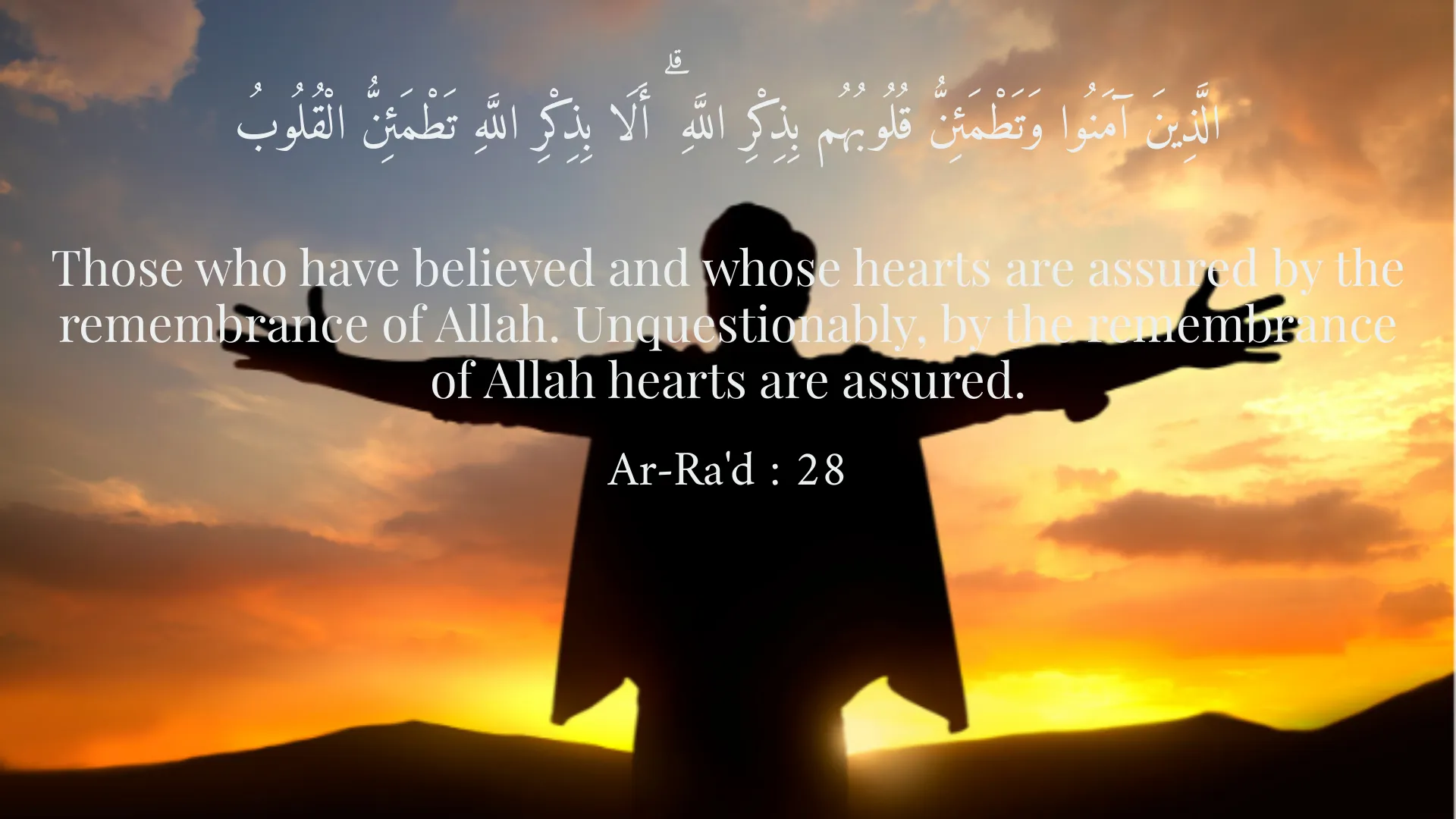
الَّذِينَ آمَنُوا وَتَطْمَئِنُّ قُلُوبُهُم بِذِكْرِ اللَّهِ ۗ أَلَا بِذِكْرِ اللَّهِ تَطْمَئِنُّ الْقُلُوبُ
Those who have believed and whose hearts are assured by the remembrance of Allah. Unquestionably, by the remembrance of Allah hearts are assured.
Ar-Ra'd : 28
يَا أَيُّهَا الَّذِينَ آمَنُوا اسْتَعِينُوا بِالصَّبْرِ وَالصَّلَاةِ ۚ إِنَّ اللَّهَ مَعَ الصَّابِرِينَ
O you who have believed, seek help through patience and prayer. Indeed, Allah is with the patient.
Al-Baqarah : 153
وَمَن يَتَوَكَّلْ عَلَى اللَّهِ فَهُوَ حَسْبُهُ ۚ
And whoever relies upon Allah – then He is sufficient for him.
At-Talaq : 3
وَنُنَزِّلُ مِنَ الْقُرْآنِ مَا هُوَ شِفَاءٌ وَرَحْمَةٌ لِّلْمُؤْمِنِينَ ۙ
And We send down from the Qur'an that which is a healing and a mercy for the believers...
Al-Isra : 82
Short Story
In Saadi's Golestan, it is narrated that a certain king was constantly restless and anxious, despite possessing immense servants, wealth, and dominion. One day, he said to a wise man: "O wise one, teach me a way to be free from this distress and find peace in my heart." The wise man replied: "The peace of heart is not in the abundance of wealth and status, but in contentment and submission to divine decree." Then the wise man gave an example: "On the path, I saw a dervish sleeping on the ground, his head resting on a stone pillow. I asked him: 'O dervish, how can you find peace in this cold weather and without shelter?' The dervish raised his head, smiled, and said: 'My brother, this comfort comes from having no wealth to worry about thieves, no house to fear burning, and no status to dread losing. What I have is this very moment, and what I do not have, Allah suffices for it.' The king was moved by these words and understood that his cluttered mind stemmed from excessive worldly attachments and the fear of losing them. He realized that the path to peace was to let go of these attachments and rely on God. After that, the king tried to free his heart from these scattered thoughts and turned to contentment and the remembrance of God, and gradually, peace returned to his heart.