Quranic Answer
To truly allow the Quran to flow through the fabric of our lives, guiding us towards perfection and happiness, we need an approach that transcends mere recitation. The Holy Quran is a comprehensive manual for life, not just a sacred book for blessings or specific rituals. The primary purpose of the Quran's revelation is to guide humanity towards the straight path and a life that pleases the Almighty. To achieve this, there are several fundamental steps, each supporting the other, collectively forming a practical guide for a "Quranic life." Step One: Deep Understanding and Contemplation of Verses (Knowing, Not Just Reading) The first and perhaps most crucial step to living with the Quran is to understand its verses precisely and profoundly. Reciting the Quran with beautiful melody and adhering to Tajweed rules is certainly meritorious and holds immense virtue, but if this recitation is not accompanied by an understanding of its meaning, its impact on life will be limited. Allah states in Surah Sad (38:29): "A blessed Book We have sent down to you, that they may reflect upon its verses and that those of understanding would be reminded." Contemplation (Tadabbur) means looking deeply and pondering over every word, every sentence, and every Quranic concept. This contemplation involves referring to authentic commentaries (Tafsir), understanding the reasons for revelation (Asbab al-Nuzul), and comprehending the historical and cultural context of their revelation. Without proper understanding, we cannot expect the divine word to illuminate our path in life. When we read "Indeed, Allah orders justice and good conduct" (An-Nahl: 90), we must understand the precise meaning of justice and good conduct to implement them in our lives. This deep understanding is the foundation for any real action and change. Step Two: Reflection and Personal Connection with Verses (Internalizing the Message) After initial understanding, the next stage is reflection and personal connection with the verses. Every verse of the Quran is like a mirror that can reveal different aspects of our being and our behaviors. We should ask ourselves: "What message does this verse hold for me, at this moment in my life?" "How can this Quranic concept solve my current problems or offer a way to improve my relationships with others?" This reflection goes beyond mere intellectual study; it is an inner dialogue with the word of God. When we come across verses about patience, gratitude, reliance on God (Tawakkul), or forgiveness, we should examine our own spiritual and mental state and see if we possess these qualities and how we can strengthen them. This process transforms the Quran from an external text into an internal guide that is present in every moment of our lives. This internalization connects our hearts and souls with the divine message, making us living, dynamic beings based on Quranic values. Step Three: Action and Practical Implementation (Embodying the Quran in Behavior) The most important stage for "living" the Quran is to act upon its teachings. Understanding and reflection, without action, are like knowledge that bears no fruit. The Quran is not merely a theoretical book; it is a book for action. "You will not attain righteousness until you spend [in the way of Allah ] from that which you love" (Ali 'Imran: 92); this verse encourages us to spend from what we love, not just to know the virtue of spending. Acting upon the Quran means: * In the individual sphere: Adherence to prayers and worship, abstaining from major and minor sins, controlling the tongue (backbiting, lying, slander), honesty in speech and deeds, avoiding extravagance, cleanliness, and order. * In the social sphere: Respecting the rights of parents, spouses, and children, kindness to neighbors, upholding trusts, justice in economic and social interactions, helping the needy, enjoining good and forbidding evil with wisdom and beautiful admonition, forgiveness, and pardon in the face of mistakes. * In the economic sphere: Earning lawful sustenance, avoiding usury and hoarding, fairness in transactions. * In the ethical sphere: Patience in the face of difficulties, gratitude for blessings, humility towards people, kindness, courage in upholding truth, avoiding arrogance and pride. Prophet Muhammad (PBUH) was the perfect embodiment of a "Quranic human." When Aisha (RA) was asked about the Prophet's character, she replied: "His character was the Quran." This statement illustrates the ultimate manifestation of the Quran in a person's behavior and speech. We, too, should strive to transform everything we read into our disposition, character, and actions. This means that every decision we make, every word we utter, and every action we perform should be weighed against Quranic principles and values. Living with the Quran means continuously striving to align our will and actions with the divine will and commands. Step Four: Consistency and Steadfastness (A Lifelong Journey) Living the Quran is not a temporary project but a lifelong journey. It requires consistency and steadfastness. Every day, we must renew our covenant with the Quran, even if it is just by reading and contemplating a few verses. This continuity nourishes our souls and prevents heedlessness and forgetfulness. Just as the body needs daily food, the soul needs Quranic nourishment. We may face challenges on this path, but what is important is not to despair and always aim to return to the Quran. This consistency ensures that the Quran gradually becomes an inseparable part of our identity and personality, and its light of guidance always illuminates our path. Step Five: Teaching and Dissemination (Spreading the Light of the Quran) Part of living the Quran is striving to convey its message to others. Once we have learned something and implemented it in our lives, we have a responsibility to share it with others. This can be done through speech, exemplary behavior, or direct teaching. Calling to goodness and enjoining what is right are fundamental principles of the Quran. "And let there be [arising] from you a nation inviting to [all that is] good, enjoining what is right and forbidding what is wrong, and those will be the successful" (Ali 'Imran: 104). Of course, this dissemination must be done with wisdom and beautiful admonition, not with compulsion or force. The goal is to enlighten hearts with the light of the Quran. Ultimately, living the Quran means transforming the revealed word into a practical program for every moment of our existence. It means the Quran is present not just on our bookshelf, but in our hearts, minds, hands, and feet. It means drawing a lesson for action from every verse and measuring ourselves daily against the standards of Quranic teachings. This continuous effort will lead us to divine pleasure, inner peace, and true happiness in this world and the hereafter. The Quran is our guide; let us implement this guide in our lives in the best possible way and benefit from its light of guidance. This path requires sincerity, effort, and reliance on Allah. With every verse, we illuminate a part of our being and take a step towards perfection.
Related Verses
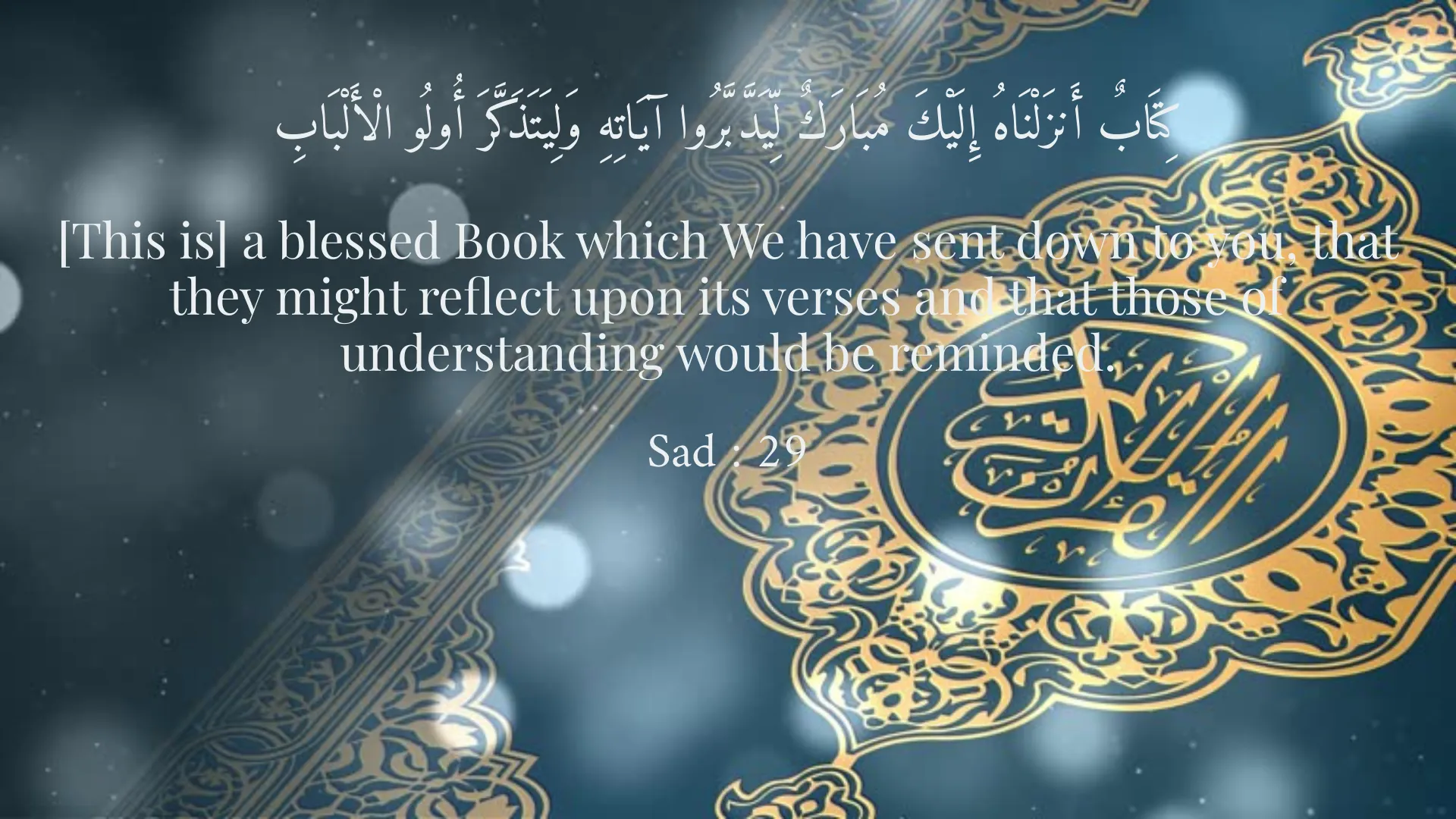
كِتَابٌ أَنزَلْنَاهُ إِلَيْكَ مُبَارَكٌ لِّيَدَّبَّرُوا آيَاتِهِ وَلِيَتَذَكَّرَ أُولُو الْأَلْبَابِ
[This is] a blessed Book which We have sent down to you, that they might reflect upon its verses and that those of understanding would be reminded.
Sad : 29
لَن تَنَالُوا الْبِرَّ حَتَّىٰ تُنفِقُوا مِمَّا تُحِبُّونَ ۚ وَمَا تُنفِقُوا مِن شَيْءٍ فَإِنَّ اللَّهَ بِهِ عَلِيمٌ
You will not attain righteousness until you spend [in the way of Allah ] from that which you love. And whatever you spend of thing – indeed, Allah is Knowing of it.
Al-Imran : 92
إِنَّ اللَّهَ يَأْمُرُ بِالْعَدْلِ وَالْإِحْسَانِ وَإِيتَاءِ ذِي الْقُرْبَىٰ وَيَنْهَىٰ عَنِ الْفَحْشَاءِ وَالْمُنكَرِ وَالْبَغْيِ ۚ يَعِظُكُمْ لَعَلَّكُمْ تَذَكَّرُونَ
Indeed, Allah orders justice and good conduct and giving to relatives and forbids immorality and wrongdoing and oppression. He admonishes you that perhaps you will be reminded.
An-Nahl : 90
Short Story
One day, in a beautiful garden, a reciter (qari) recited the Quran with a heavenly voice, captivating everyone with the sweetness of his melody. People praised him profusely, saying, "How wonderfully he recites the verses!" Yet, in the same garden, there was a simple-hearted and less educated man who perhaps knew only a few surahs by heart, but whenever he found an opportunity, he would immediately rush to help the needy, or reconcile two disputing parties, or cheer up the disheartened with a kind word. One day, a wise man who observed both, told the people: "O friends, that reciter brought the verses to his tongue and made them pleasing to the ear, but this simple man brought the verses to life within his being and manifested them in his actions. For the Quran was not revealed merely to adorn throats, but to be a lamp for life and action. A beautiful voice is pleasing to the heart, but righteous deeds are the path to Paradise and truly living with the Divine Word."