Quranic Answer
Showing off in worship is a multifaceted challenge that many believers encounter in their religious journey. This sensitive issue centers around the sincerity of one’s intention while engaging in acts of worship. The Holy Quran, as the ultimate guide for Muslims, addresses this concern explicitly, establishing clear guidelines to help maintain the purity of one’s actions. In this article, we will delve into the implications of performing acts of worship with the wrong intentions, the Quranic teachings regarding sincerity, and practical strategies to ensure that worship remains a genuine expression of faith. One pivotal text that discusses the dangers of showing off in worship is found in Surah Al-Baqarah, verse 264. This verse states: 'O you who have believed, do not invalidate your charities with reminders or injury, like one who spends his wealth for show to the people.' Here, Allah juxtaposes the authentic giver, who is motivated purely by altruism, with the ostentatious spender, who seeks public recognition and validation for his deeds. The message is clear: acts of worship, including charity, should be performed solely for the purpose of pleasing Allah. If these acts are contaminated by the desire for recognition among peers, the validity of that worship becomes compromised. Showiness or 'Riyaa', a term often used in Islamic theology, manifests in two primary forms. The first is the overt performance of worshipful acts in a way that draws the attention of others. For example, a believer may choose to pray in a public space where they are likely to be observed, intentionally adopting certain gestures or behaviors that emphasize their devotion, not primarily for Allah’s sake, but to appear righteous in the eyes of others. The second form occurs when individuals discuss their religious observances and good deeds, perhaps boasting about their attendance at religious services or the extent of their charitable contributions. In both scenarios, the underlying issue is the same: the individual is more concerned about how they are perceived by others than their relationship with Allah. In Surah Al-Ma'idah, verse 54, Allah advises believers to be wary of those who doubt their faith and engage in acts simply for show. This verse stresses the importance of surrounding ourselves with individuals who share a sincere, humble approach to worship and discourage the idea of seeking admiration through our religious practices. The Quran frequently emphasizes the notion that companionship matters greatly in the pursuit of righteousness. When one is surrounded by sincere believers, it becomes easier to cultivate a genuine intention in worship and avoid the pitfalls of vanity. The consistent examination of our intentions is crucial in our faith journey. As believers, we should strive to perform acts of worship purely for the pleasure of Allah. Introspection becomes a valuable tool in this regard. By frequently assessing why we engage in certain acts, we can weed out motivations that are less than pure, thereby ensuring that our worship aligns with the requirements set forth in the Quran. It is essential to remember that worship should not only be an external practice; it must be underpinned by a sincere heart and genuine devotion. One practical approach to counteract the tendency to show off is practicing acts of worship in private. For instance, when giving charity, it is commendable to do so anonymously. This not only fosters a deeper connection with Allah but also helps to distance oneself from the influence of Satan, who may whisper thoughts of vanity and self-importance into the heart of the believer. It is often said that the true essence of worship lies in its discretion, emphasizing that the most meaningful acts of worship often go unnoticed by society. Furthermore, believers should incorporate the remembrance of Allah into their daily lives. Constant acknowledgment of Allah’s awareness of our actions serves as a powerful deterrent to showing off. When one understands that Allah sees every intention and action, it compels them to act with sincerity and purity of heart. Establishing daily reminders—be it through engaging in Dhikr (remembrance of Allah), reading Quran, or reflecting on His attributes—can significantly assist in nurturing an attitude of humility and transparency in worship. The struggle against showing off in worship is not merely an external battle, but an internal one. It requires continuous self-reflection, honest evaluations, and relentless efforts to purify one’s intentions. Our acts of worship should be rooted in the desire to please Allah alone, rather than a quest for validation from our peers. This sincere devotion ultimately fosters a deep and meaningful relationship with Allah, wherein a believer finds solace, guidance, and strength. Moreover, the importance of community cannot be overstated in this regard. Engaging with like-minded individuals—believers who embody sincerity in their worship—creates an atmosphere conducive to faith and worship. This supportive environment can help us resist temptations of ego and vanity, reinforcing a collective desire to seek Allah’s pleasure above all else. The companionship of those who remind us of Allah transforms the act of worship into a shared journey, thus enhancing our collective devotion. In conclusion, showing off during worship poses a significant challenge for believers, yet it is one that can be navigated effectively through the teachings of Islam. The Holy Quran provides wisdom on the importance of sincere intention and emphasizes actions performed purely for Allah’s sake. By being vigilant in our intentions, seeking privacy in worship, and surrounding ourselves with faithful companions, we pave the way toward a more profound and genuine relationship with our Creator. Ultimately, the path to sincere worship is one of humility, reflection, and unwavering dedication to nurturing a heart that seeks to please Allah above all else.
Related Verses
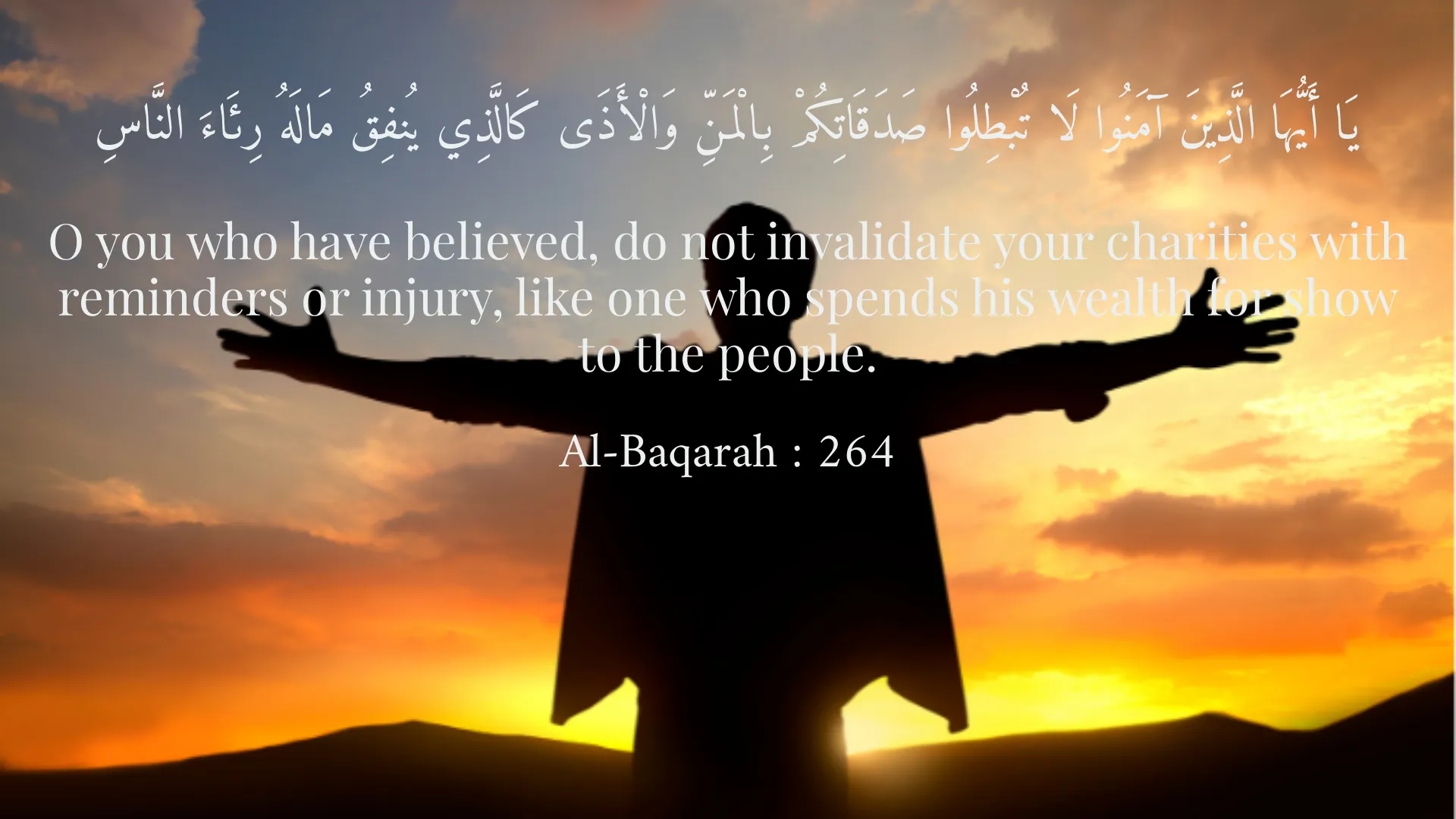
يَا أَيُّهَا الَّذِينَ آمَنُوا لَا تُبْطِلُوا صَدَقَاتِكُمْ بِالْمَنِّ وَالْأَذَى كَالَّذِي يُنفِقُ مَالَهُ رِئَاءَ النَّاسِ
O you who have believed, do not invalidate your charities with reminders or injury, like one who spends his wealth for show to the people.
Al-Baqarah : 264
يَا أَيُّهَا الَّذِينَ آمَنُوا مَن يَرْتَدَّ مِنكُمْ عَنْ دِينِهِ فَسَوْفَ يَأْتِي اللَّهُ بِقَوْمٍ يُحِبُّهُمْ وَيُحِبُّونَهُ أَذِلَّةٍ عَلَى الْمُؤْمِنِينَ أَعِزَّةٍ عَلَى الْكَافِرِينَ
O you who have believed, whoever of you should revert from his religion - Allah will bring forth [for] a people He will love and who will love Him, humble toward the believers, powerful against the disbelievers.
Al-Ma'idah : 54
Short Story
One day, a man was sitting by a stream, contemplating his worship. When he noticed that people were watching him, he felt that his worship was affected and decided to worship privately. He then concluded that his acts of worship should be for Allah alone, and not for attracting others' attention. This decision transformed his spirit and helped him establish a deeper connection with Allah.