Quranic Answer
Progressing without comparing yourself to others is a profoundly spiritual and psychological journey, extensively addressed in the Holy Quran. From a Quranic perspective, every human being's life is a unique path ordained by Allah (God). This outlook forms the basis for freeing oneself from the trap of comparison, as each individual is tested and measured based on their specific abilities, challenges, and blessings. The Quran teaches us that every soul is responsible for its own deeds and will not bear the burden of another (Surah Fatir, verse 18). This verse lays the foundation for the belief that our path to progress is intrinsically linked to our internal efforts and transformations, rather than being dependent on the external achievements of others. Comparison often leads to envy, dissatisfaction, and an overlooking of divine blessings, hindering genuine and meaningful growth. Indeed, much human discontent stems from observing others' possessions and neglecting one's own bounties. Allah explicitly states in Surah An-Nisa, verse 32: “And do not covet that by which Allah has preferred some of you over others.” This verse directly prohibits us from yearning for or fixating on the possessions or superiorities of others. This prohibition is not merely about avoiding envy; it is a profound guidance to focus on oneself and what has been ordained for us. Every individual is endowed with different provisions and capabilities, within which lies divine wisdom. Accepting these differences is key to inner peace and moving forward without the need for external validation or competition. True progress, from a Quranic standpoint, is that which aligns with seeking closeness to Allah and purifying the self (Tazkiyah al-Nafs). This self-purification involves cleansing the inner being from moral vices like envy, arrogance, and hypocrisy, and adorning it with virtues such as patience, gratitude, reliance on Allah (Tawakkul), and humility. The Quran in Surah Ar-Ra'd, verse 11 states: “Indeed, Allah will not change the condition of a people until they change what is in themselves.” This verse places the responsibility and possibility of change entirely on the individual. Progress, in this sense, is an internal process that begins with one's will and effort to reform oneself. If our goal is Allah's pleasure, then the outcomes and possessions of others become irrelevant, and our sole criterion will be the extent of our sincerity, righteous deeds, and piety. Instead of comparing material possessions or social statuses, we should focus on comparing ourselves with 'yesterday's self'. Have we been better today in our worship, morals, helping others, and piety than we were yesterday? This question encapsulates the essence of progress without comparison. Gratitude (Shukr) is one of the most powerful tools the Quran offers for escaping the trap of comparison. In Surah Ibrahim, verse 7, it is stated: “If you are grateful, I will surely increase you [in favor].” When our focus is on being thankful for the blessings Allah has bestowed upon us, our minds shift away from deficiencies and comparisons towards abundance and contentment. This gratitude not only leads to an increase in material and spiritual blessings but also purifies the heart from envy and greed, paving the way for true growth and progress. Furthermore, the Quran emphasizes that this worldly life is transient and fleeting, and what endures are righteous deeds and God-consciousness. In Surah Al-Kahf, verse 46, we read: “Wealth and children are [but] adornment of the worldly life. But the enduring good deeds are better to your Lord for reward and better for [one's] hope.” This perspective shifts human ambition from futile worldly competitions towards investing for the Hereafter. When the primary goal is to attain Allah's pleasure and accumulate provisions for the afterlife, comparing oneself to others who might only have apparent worldly superiority becomes meaningless. Therefore, to progress without comparing oneself to others, three essential steps must be taken: Firstly, a deep understanding that every human being has a unique path and unique trials, and the primary goal is internal and spiritual growth, not external competition. Secondly, focusing on changing and improving 'oneself' through consistent effort to purify the soul and increase righteous deeds. And thirdly, cultivating a spirit of gratitude for Allah's blessings and trusting in Him in all matters. This Quranic approach not only helps individuals free themselves from envy and despair but also places them on a path of sustainable and satisfying progress, whose source is inner peace and a profound connection with the Creator.
Related Verses
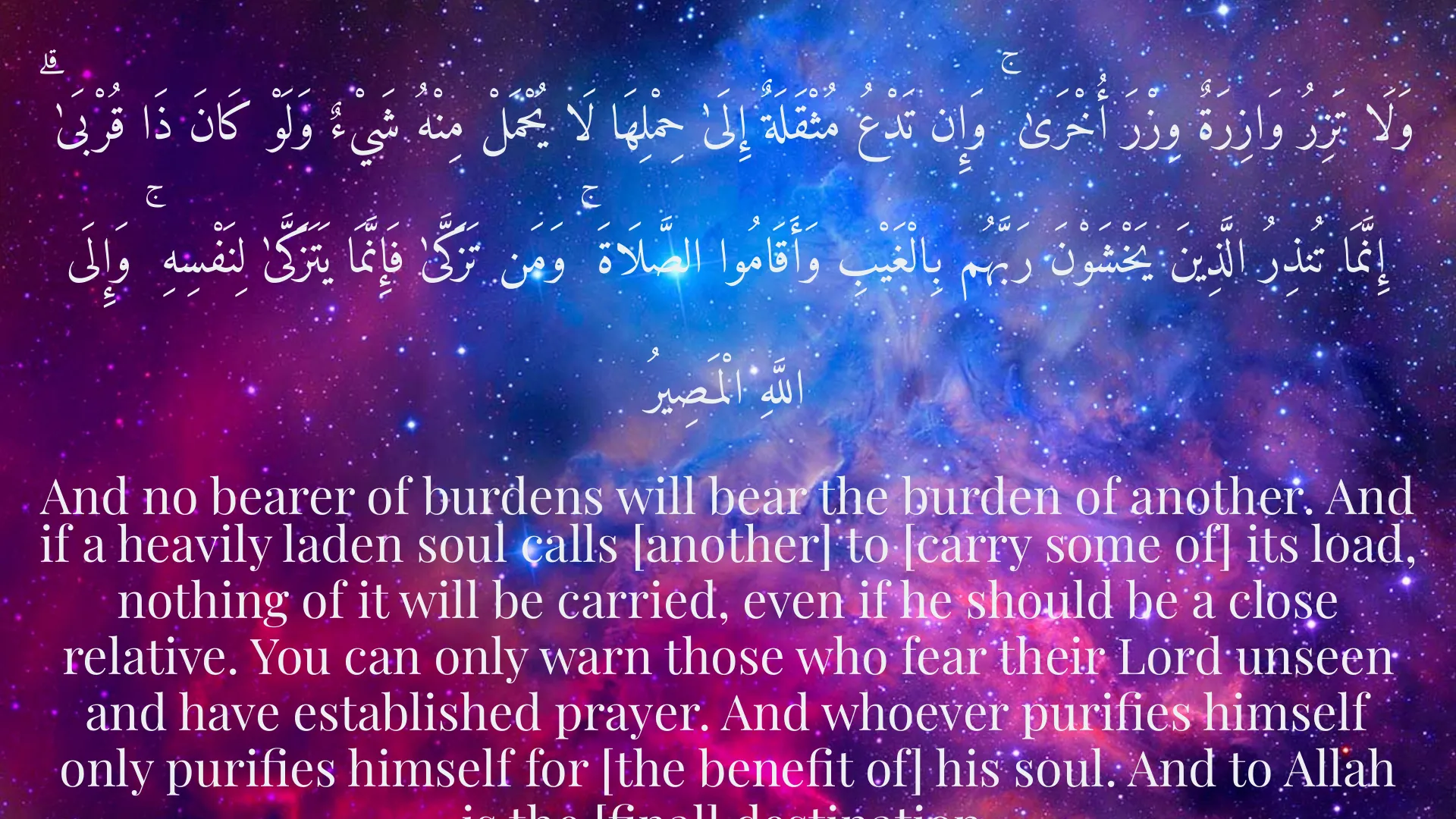
وَلَا تَزِرُ وَازِرَةٌ وِزْرَ أُخْرَىٰ ۚ وَإِن تَدْعُ مُثْقَلَةٌ إِلَىٰ حِمْلِهَا لَا يُحْمَلْ مِنْهُ شَيْءٌ وَلَوْ كَانَ ذَا قُرْبَىٰ ۗ إِنَّمَا تُنذِرُ الَّذِينَ يَخْشَوْنَ رَبَّهُم بِالْغَيْبِ وَأَقَامُوا الصَّلَاةَ ۚ وَمَن تَزَكَّىٰ فَإِنَّمَا يَتَزَكَّىٰ لِنَفْسِهِ ۚ وَإِلَى اللَّهِ الْمَصِيرُ
And no bearer of burdens will bear the burden of another. And if a heavily laden soul calls [another] to [carry some of] its load, nothing of it will be carried, even if he should be a close relative. You can only warn those who fear their Lord unseen and have established prayer. And whoever purifies himself only purifies himself for [the benefit of] his soul. And to Allah is the [final] destination.
Fatir : 18
وَلَا تَتَمَنَّوْا مَا فَضَّلَ اللَّهُ بِهِ بَعْضَكُمْ عَلَىٰ بَعْضٍ ۚ لِّلرِّجَالِ نَصِيبٌ مِّمَّا اكْتَسَبُوا ۖ وَلِلنِّسَاءِ نَصِيبٌ مِّمَّا اكْتَسَبْنَ ۚ وَاسْأَلُوا اللَّهَ مِن فَضْلِهِ ۗ إِنَّ اللَّهَ كَانَ بِكُلِّ شَيْءٍ عَلِيمًا
And do not covet that by which Allah has preferred some of you over others. For men is a share of what they have earned, and for women is a share of what they have earned. And ask Allah of His bounty. Indeed, Allah is ever, of all things, Knowing.
An-Nisa : 32
لَهُ مُعَقِّبَاتٌ مِّن بَيْنِ يَدَيْهِ وَمِنْ خَلْفِهِ يَحْفَظُونَهُ مِنْ أَمْرِ اللَّهِ ۗ إِنَّ اللَّهَ لَا يُغَيِّرُ مَا بِقَوْمٍ حَتَّىٰ يُغَيِّرُوا مَا بِأَنفُسِهِمْ ۗ وَإِذَا أَرَادَ اللَّهُ بِقَوْمٍ سُوءًا فَلَا مَرَدَّ لَهُ ۚ وَمَا لَهُم مِّن دُونِهِ مِن وَالٍ
For him are successive [angels] before him and behind him who protect him by the decree of Allah. Indeed, Allah will not change the condition of a people until they change what is in themselves. And when Allah intends for a people ill, there is no repelling it. And there is not for them besides Him any patron.
Ar-Ra'd : 11
Short Story
In a time when people in palaces and beautiful gardens were engrossed in comparing themselves to one another, a simple-hearted farmer was busy with his work in a lush field. Every day, he sowed seeds, watered them, and thanked God. He had a neighbor who always spoke of the vast lands and wealth of others, complaining about his own possessions. One day, he asked the farmer: “How is it that you, in this small farm, are always content and peaceful, and never envy the large gardens and abundant wealth of the rich?” The farmer smiled and said: “My friend, I know that every seed I plant is the fruit of my effort, and every fruit I pick from my tree is a destined provision from the Lord. I only compete with the quality of my seed and the sincerity of my intention in cultivating my own land, not with the size of others' lands. For I know that each person has a separate account, and each person receives the reward of their own deeds. My peace lies in having opened my eyes to the heavens to see the bounty of the Lord, not to my neighbor’s pocket to see my own shortcomings.” The neighbor pondered over these words, and from then on, instead of comparing himself to others, he focused on improving and cultivating his own farm, and tasted the true flavor of progress and contentment.