Quranic Answer
Purifying one's intention from selfishness is one of the most fundamental and vital concepts in Quranic and Islamic teachings. This process, known as 'Tazkiyat al-Nafs' (purification of the soul) or 'Ikhlas' (sincerity), means performing good deeds solely for the pleasure and satisfaction of Allah Almighty, and not for gaining human praise, social status, or any worldly benefit. Selfishness in this context refers to any motive other than seeking the 'Face of Allah' (Wajh Allah), which can strip good deeds of their true value and even lead them to ruin. The Holy Quran repeatedly emphasizes the importance of pure intention, declaring it the cornerstone of every accepted action. Indeed, the Quran clearly states that the ultimate purpose of human creation and the objective behind sending prophets and divine books is pure servitude to Allah. In Surah Al-Bayyinah, verse 5, Allah says: "And they were not commanded except to worship Allah, [being] sincere to Him in religion, inclining to truth, and to establish prayer and to give zakat. And that is the correct religion." This verse explicitly states that the essence of religiosity is founded upon sincerity and pure monotheism in worship. Any action tainted by ostentation (Riya), seeking fame, or personal gain falls outside this circle of sincerity and may not be accepted by Allah. The root of selfishness often lies in the 'Nafs al-Ammarah bis-Su'' – the self that incites to evil; that part of human existence prone to vices and carnal desires, leading one towards self-worship and egocentricity. To counteract this self, the Quran calls for its purification and refinement. In Surah Ash-Shams, verses 9 and 10, Allah Almighty says: "He has succeeded who purifies it, And he has failed who corrupts it." These verses clearly show that true salvation and success depend on cleansing and refining the soul from impurities, including selfishness and self-centeredness. This purification is a continuous spiritual journey that requires self-awareness, persistent effort, and seeking assistance from Allah. One of the most prominent manifestations of selfishness in religious acts is 'Riya' or showing off. Riya means performing an act of worship or charity with the intention of being seen and praised by people. The Holy Quran severely condemns Riya and considers it a destroyer of deeds. In Surah Al-Ma'un, verses 4 to 6, we read: "So woe to those who pray, [But] who are heedless of their prayer – Those who make show [of their deeds]." These verses identify Riya, alongside carelessness and heedlessness in prayer, as characteristics of those for whom there is woe. This demonstrates that even prayer, which is the pillar of religion, loses its value if accompanied by the intention of Riya. Riya is considered a type of minor shirk (hidden polytheism) because it involves placing the praise of creation alongside or instead of the pleasure of the Creator. Ways to Purify Intention from a Quranic Perspective: 1. Focus on Divine Pleasure (Wajh Allah): The Quran teaches believers that all their actions should be solely for gaining the pleasure of Allah. Everything we do, from daily acts of worship to serving others, must be motivated by the thought that "Allah approves of this, and this action brings me closer to Him." This paradigm shift liberates the human heart from the bondage of worldly desires and the craving for others' praise. This is the very concept alluded to in Surah Az-Zumar, verse 39:2, where it states: "Indeed, We sent down to you the Book in truth, so worship Allah, [being] sincere to Him in religion. Unquestionably, for Allah is the pure religion..." 2. Self-Accountability (Muhasabah): The Quran implicitly refers to the importance of self-evaluation and guarding intentions. A believer should constantly review their intentions before, during, and after every action. Ask oneself: "Am I doing this to attract someone's attention?" or "Am I expecting a reward or praise in return?" This rigorous self-accounting helps identify and eradicate selfish motives. 3. Supplication and Seeking Allah's Help (Du'a): Humans alone are not fully capable of overcoming their self. The Quran teaches us to always seek Allah's help. Asking for sincerity and avoidance of Riya is among the crucial supplications. Prophets and saints always implored Allah to keep them firm on the path of sincerity. Reciting and pondering verses that refer to prayer and reliance on Allah inclines the heart towards Him and frees it from selfishness. 4. Remembrance of Death and the Hereafter: Focusing on the ephemeral nature of this world and the eternity of the Hereafter greatly aids in purifying intentions. When one understands that only pure and sincere deeds will benefit them in the afterlife and that worldly praises hold no value, their motivation for selfishness diminishes. Verses like Surah Al-A'la (87:16-17), which state: "But you prefer the worldly life, while the Hereafter is better and more enduring," highlight this truth. 5. Secret Charity and Good Deeds: One of the most effective ways to combat Riya and selfishness is to perform good deeds secretly, in a way that no one but Allah is aware of them. Such actions serve as a serious test for intentions and help individuals taste the true pleasure of sincerity, freeing themselves from the bondage of people's admiration. 6. Adherence to Piety and Fear of Allah (Taqwa): Taqwa means avoiding sins and fulfilling divine duties with fear of Allah and hope for His reward. This spiritual state keeps one away from selfish temptations and satanic whispers that lead to selfishness, thereby purifying their intention. Ultimately, purifying intention from selfishness is a continuous journey and an internal struggle. This path requires patience, perseverance, and reliance on divine guidance. The Holy Quran promises that whoever moves towards Allah with a pure intention, Allah will assist them and establish a great reward for their sincere actions in both this world and the Hereafter. This process not only leads to ultimate salvation but also brings unparalleled peace and contentment in this worldly life.
Related Verses
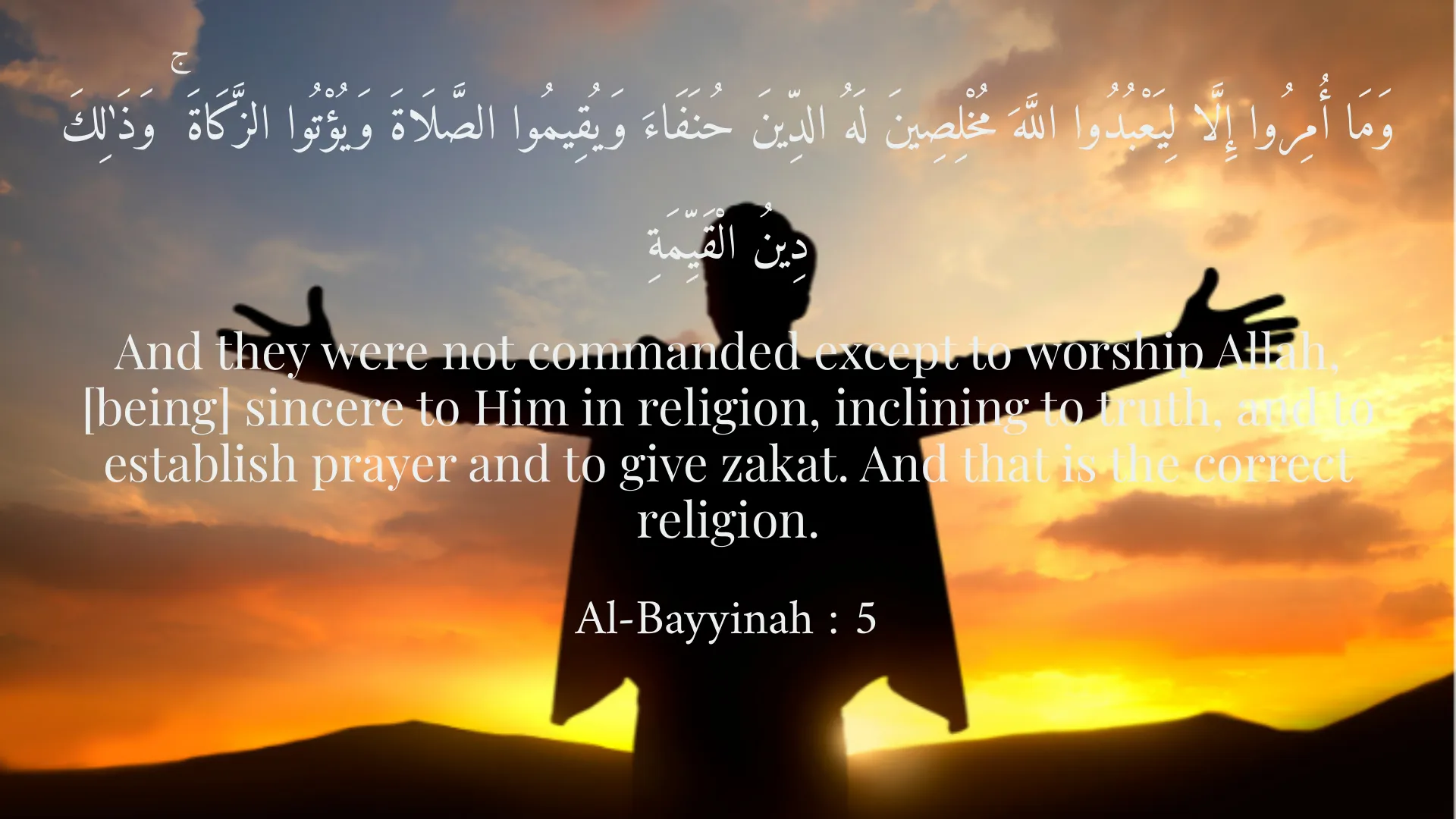
وَمَا أُمِرُوا إِلَّا لِيَعْبُدُوا اللَّهَ مُخْلِصِينَ لَهُ الدِّينَ حُنَفَاءَ وَيُقِيمُوا الصَّلَاةَ وَيُؤْتُوا الزَّكَاةَ ۚ وَذَٰلِكَ دِينُ الْقَيِّمَةِ
And they were not commanded except to worship Allah, [being] sincere to Him in religion, inclining to truth, and to establish prayer and to give zakat. And that is the correct religion.
Al-Bayyinah : 5
قَدْ أَفْلَحَ مَن زَكَّاهَا
He has succeeded who purifies it,
Ash-Shams : 9
وَقَدْ خَابَ مَن دَسَّاهَا
And he has failed who corrupts it.
Ash-Shams : 10
الَّذِينَ هُمْ يُرَاءُونَ
Those who make show [of their deeds]
Al-Ma'un : 6
Short Story
It is narrated that in Saadi's time, there was a benevolent man who always spoke grandly of his good deeds in gatherings and enjoyed people's praise. He built bridges, dug wells, and erected mosques, but his heart constantly yearned for his name to be on everyone's lips. One day, a poor dervish, passing by a remote path, removed a stone from the road so that no passerby would be harmed. He did this in solitude, with no eye witnessing it but the Eye of Truth. The benevolent man, suffering from inner turmoil, asked the dervish: 'How is it that I, with all these great deeds, find no peace, while your heart is content with such a small act?' The dervish replied with a warm smile: 'My friend, when rainwater falls purely from the sky, it reaches the ocean, but if it clings to branches and leaves along the way, it perishes. Your deeds are good, but because they are for the eyes of people, they do not lead to sincerity. My deed, though small, because it was purely for God, my heart connected with His pleasure and found peace. Pure intention is the key to peace and salvation, not the magnitude of the action.'