Quranic Answer
Purifying the heart from grudges is one of the noblest and most fundamental goals for any spiritual seeker and for every human being who desires inner peace and true felicity in this world and the Hereafter. Grudges, like a corrosive agent, gnaw at the human spirit and soul, hindering the perception of spiritual joys and the establishment of healthy relationships with others. The Holy Quran, this divine book and a complete guide for human life, provides clear directives for the purification of the self (tazkiyah an-nafs) and the cleansing of the heart from any impurities, including grudges. These teachings are not merely theoretical instructions but practical programs for inner transformation that, if correctly implemented, will transform the heart into a fount of light and mercy. The first and perhaps most crucial step in cleansing the heart from grudges is the concept of "forgiveness and pardon" (al-afw wal-safh). The Quran repeatedly admonishes believers to adopt forgiveness and overlook faults. In Surah An-Nur, verse 22, Allah says: "And let them pardon and overlook. Would you not like that Allah should forgive you? And Allah is Forgiving and Merciful." This verse poses a profound and thought-provoking question: Are we, who are constantly in need of divine forgiveness and mercy, unwilling to forgo our rights against others? Forgiveness is, in essence, liberating oneself from the prison of resentment; for a grudge primarily harms its bearer, not necessarily the one against whom the grudge is held. When you forgive, you lift a heavy burden from your shoulders and open the way for divine tranquility to enter your heart. This act of forgiveness is a sign of spiritual strength and deep faith, not weakness. The next step is "repelling evil with good" (daf' al-sayyi'ah bil-hasanah). This Quranic principle is beautifully articulated in Surah Fussilat, verses 34 and 35: "And not equal are the good deed and the bad. Repel [evil] with that which is better; thereupon the one whom between you and him is enmity [will become] as though he was a devoted friend. But none is granted it except those who are patient, and none is granted it except one having a great portion [of good]." This verse offers an extraordinary strategy for transforming enmity into friendship and cleansing the heart of grudges. By responding to evil with good, you break the cycle of revenge and resentment. This requires immense patience and perseverance, but the outcome is astonishing: turning an enemy into a devoted friend. This act represents the highest level of self-control and mastery over negative emotions, possible only through reliance on Allah and steadfast patience. "Brotherhood of faith and reconciliation" (ukhuwwah Imani wa islah dhat al-bayn) is also an effective means. The Quran states in Surah Al-Hujurat, verse 10: "The believers are but brothers, so make reconciliation between your brothers and fear Allah that you may receive mercy." Grudges often result from conflict and misunderstanding. The Quran instructs believers to actively work towards peace and reconciliation instead of fueling disputes. This means suppressing anger, setting aside pride, and prioritizing the unity of the believing community. When a person sees themselves as part of a single body, where all members are brothers, there is less room for grudges and enmity. "Patience and steadfastness" (sabr wa istiqamah) also play a crucial role in this journey. Allah, in many verses, calls upon believers to be patient. Grudges often stem from an inability to tolerate hardships, adversities, and injustices. Patience helps a person overcome these emotions and respond with wisdom and reflection instead of emotional reactions. Patience assists not only against external problems but also against internal temptations to hold onto grudges and seek revenge. "Prayer and supplication to Allah" (du'a wa tadarru' ila Allah) is also a powerful tool. Ask Allah to cleanse your heart from grudges and any impurities. Supplication to the Lord purifies the soul and empowers a person to overcome their egoistic weaknesses. The Quran invites us to the remembrance of Allah, for "unquestionably, by the remembrance of Allah hearts are assured" (Surah Ar-Ra'd: 28). This tranquility leaves no room for grudges. Finally, remembering the "ultimate purpose of life"—attaining Paradise and Allah's pleasure—is a great motivation for purifying the heart. The Quran describes the inhabitants of Paradise: "And We will remove whatever is in their breasts of resentment, [so they will be] brothers, sitting on couches, facing each other" (Surah Al-A'raf: 43). This verse indicates that a pure heart, free from grudges, is a distinguishing characteristic of the dwellers of Paradise. If we can remove grudges from our hearts in this world, we draw closer to that heavenly spiritual state and taste a preview of eternal peace. Purifying the heart from grudges is a spiritual struggle (jihad an-nafs) that requires continuous effort, self-awareness, and divine assistance. By acting upon the Quranic teachings regarding forgiveness, kindness, patience, reconciliation, and brotherhood, and by resorting to prayer and the remembrance of Allah, one can possess a heart that is a source of peace for oneself and others, not a reservoir of grudges and resentments. This path leads to true tranquility, lasting friendship, and divine contentment.
Related Verses
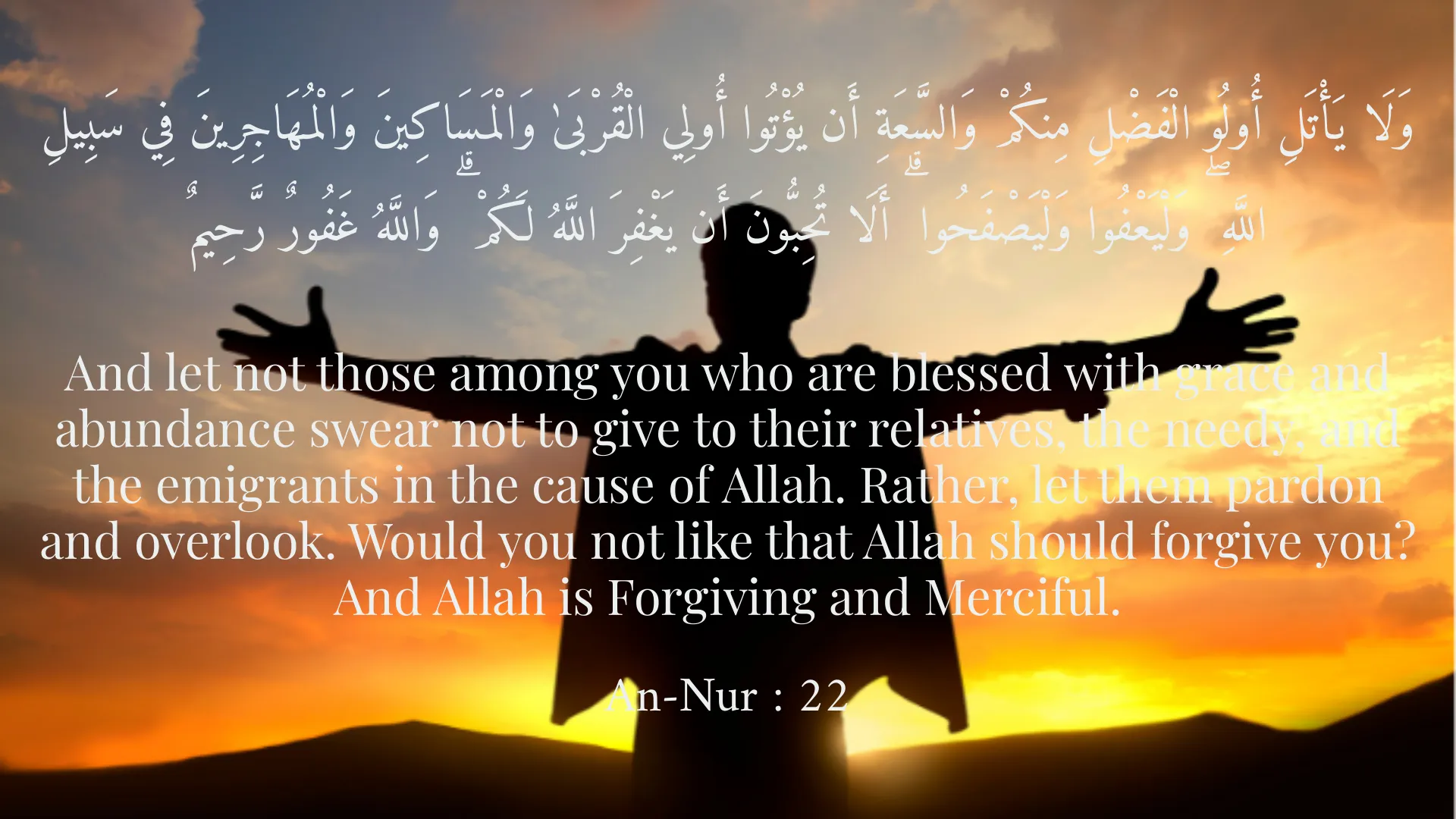
وَلَا يَأْتَلِ أُولُو الْفَضْلِ مِنكُمْ وَالسَّعَةِ أَن يُؤْتُوا أُولِي الْقُرْبَىٰ وَالْمَسَاكِينَ وَالْمُهَاجِرِينَ فِي سَبِيلِ اللَّهِ ۖ وَلْيَعْفُوا وَلْيَصْفَحُوا ۗ أَلَا تُحِبُّونَ أَن يَغْفِرَ اللَّهُ لَكُمْ ۗ وَاللَّهُ غَفُورٌ رَّحِيمٌ
And let not those among you who are blessed with grace and abundance swear not to give to their relatives, the needy, and the emigrants in the cause of Allah. Rather, let them pardon and overlook. Would you not like that Allah should forgive you? And Allah is Forgiving and Merciful.
An-Nur : 22
وَلَا تَسْتَوِي الْحَسَنَةُ وَلَا السَّيِّئَةُ ۚ ادْفَعْ بِالَّتِي هِيَ أَحْسَنُ فَإِذَا الَّذِي بَيْنَكَ وَبَيْنَهُ عَدَاوَةٌ كَأَنَّهُ وَلِيٌّ حَمِيمٌ
And not equal are the good deed and the bad. Repel [evil] with that which is better; thereupon the one whom between you and him is enmity [will become] as though he was a devoted friend.
Fussilat : 34
وَمَا يُلَقَّاهَا إِلَّا الَّذِينَ صَبَرُوا وَمَا يُلَقَّاهَا إِلَّا ذُو حَظٍّ عَظِيمٍ
But none is granted it except those who are patient, and none is granted it except one having a great portion [of good].
Fussilat : 35
إِنَّمَا الْمُؤْمِنُونَ إِخْوَةٌ فَأَصْلِحُوا بَيْنَ أَخَوَيْكُمْ وَاتَّقُوا اللَّهَ لَعَلَّكُمْ تُرْحَمُونَ
The believers are but brothers, so make reconciliation between your brothers and fear Allah that you may receive mercy.
Al-Hujurat : 10
وَنَزَعْنَا مَا فِي صُدُورِهِم مِّنْ غِلٍّ تَجْرِي مِن تَحْتِهِمُ الْأَنْهَارُ ۖ وَقَالُوا الْحَمْدُ لِلَّهِ الَّذِي هَدَانَا لِهَٰذَا وَمَا كُنَّا لِنَهْتَدِيَ لَوْلَا أَن هَدَانَا اللَّهُ ۖ لَقَدْ جَاءَتْ رُسُلُ رَبِّنَا بِالْحَقِّ ۖ وَنُودُوا أَن تِلْكُمُ الْجَنَّةُ أُورِثْتُمُوهَا بِمَا كُنتُمْ تَعْمَلُونَ
And We will remove whatever is in their breasts of resentment, [so they will be] brothers, sitting on couches, facing each other. And they will say, 'Praise to Allah, who has guided us to this; and we would not have been guided had not Allah guided us. Certainly the messengers of our Lord had come with the truth.' And they will be called, 'This is Paradise, which you have been made to inherit for what you used to do.'
Al-A'raf : 43
Short Story
One day, a king asked a wise man, "O wise sage, what is the greatest treasure for a human being?" The wise man replied, "O King, a heart free from resentment and a tongue pure from falsehood and backbiting is the greatest treasure. For a heart that harbors grudges will never taste true peace, even if its owner sits on a throne. But a heart that is free from grudges, even in a humble hut, finds a tranquility and happiness that kings yearn for." The king pondered these words and realized that true peace resides within oneself, not in external power. From that day forward, he strived to cleanse his heart of grudges and look upon others with kindness.