Quranic Answer
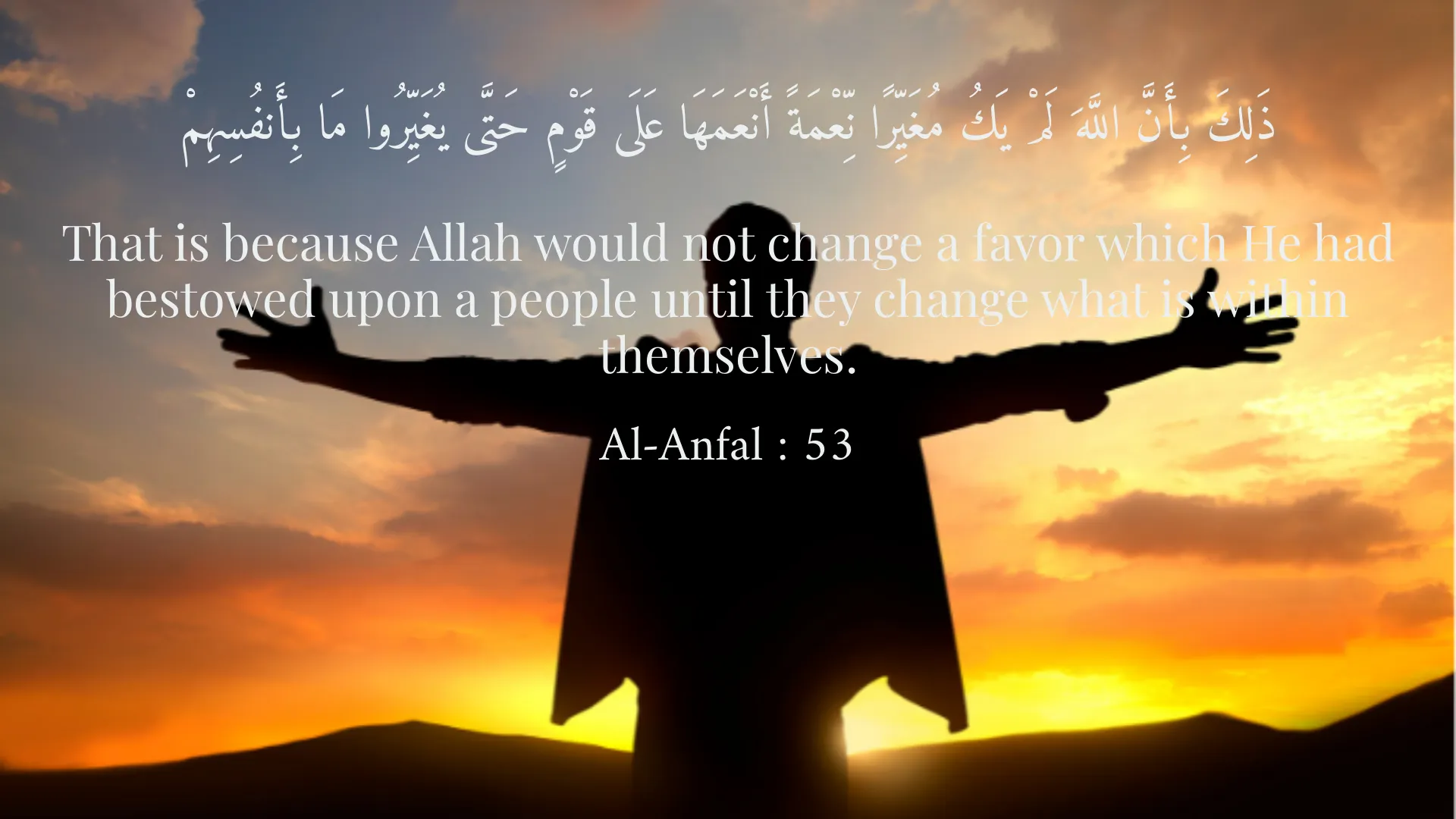
Self-reform is an essential and profound subject within Islamic teachings, calling for individuals to actively strive towards bettering themselves. The concept of self-reformation emphasizes the importance of personal responsibility and growth, which is prominently highlighted in the Holy Quran. A significant verse that elucidates this notion is found in Surah Al-Anfal, verse 53, where Allah states: 'That is because Allah would not change a favor which He had bestowed upon a people until they change what is within themselves.' This verse serves as a reminder that the divine blessings granted to individuals or communities can be retracted if there is a lack of desire for change and reform. It underscores a key principle of Islamic philosophy: that genuine transformation begins from within. The importance of self-reflection and awareness in the path of self-reformation cannot be overstated. The journey towards self-betterment requires individuals to engage in deep introspection, thereby identifying their shortcomings and flaws. As individuals acknowledge their moral and spiritual lapses, such recognition becomes the first step towards meaningful reform. It is imperative for one to not only repent for past sins but also to strive to improve behavior towards others, exhibiting compassion, kindness, and understanding in relationships. This reformative process is not just introspective but also extends outward towards the community, showing that self-reform is inherently tied to how one interacts with others. Repentance is a pivotal aspect of self-reformation in Islamic teachings. It is emphasized that true repentance, or Tawbah, involves not only seeking forgiveness from Allah but also a firm resolution to avoid falling into the same sins in the future. This duality of acknowledging one's faults while committing to change forms the bedrock of a sincere reformation process. The Quran states in Surah Al-Baqarah, verse 27: 'Those who break the covenant of Allah after its ratification and sever what Allah has commanded to be joined and spread corruption in the land—it is they who are the losers.' This highlights the gravity of turning away from the paths ordained by Allah, thereby reinforcing the dire consequences of neglecting the spiritual and ethical commitments expected of believers. Moreover, embarking on the journey of self-reform necessitates patience and persistent effort. In Surah Al-Baqarah, verse 153, Allah advises the believers: 'O you who have believed, seek help through patience and prayer. Indeed, Allah is with the patient.' This quintessential verse highlights the dual pillars required for personal development: patience and prayer, or Salah. Engaging in regular prayer not only fortifies one's connection with Allah, but it also serves as a structured outlet for reflection, gratitude, and supplication. The act of praying itself can be an act of self-reform, helping individuals cultivate mindfulness and awareness of their actions, thoughts, and intentions. Self-reform is also significantly tied to one’s relationships with others. Establishing and nurturing positive interactions with family, friends, and community members is indicative of personal growth. Serving others aligns with the fundamental Islamic principle of Ummah, or community, reinforcing the idea that individual welfare is intertwined with that of the society. Acts of kindness, charity, and community service are pivotal components of self-reformation, demonstrating the importance of not only working on oneself but also contributing positively to the lives of others. Being of service to others can keep one grounded, instilling a sense of purpose and connection that is essential for holistic self-development. To successfully navigate the journey of self-reform, it is vital to cultivate self-awareness. This includes recognizing one's strengths and weaknesses honestly, which empowers individuals to leverage their abilities while actively working on their deficiencies. Self-confidence plays a crucial role in this process. When individuals believe in themselves and their capacity to change, they are more likely to embark on the path of self-improvement with determination. The road to reform is often fraught with challenges and setbacks; however, maintaining a strong will and having realistic expectations can aid individuals in their pursuit of becoming better versions of themselves. In conclusion, self-reform is a fundamental tenet of Islamic teachings, deeply rooted in the principles of personal responsibility, humility, patience, and community. It is a continuous journey that involves repentance, prayer, serving others, and fostering self-awareness. The emphasis placed on individual character development is not only vital for personal well-being but also for the collective upliftment of society. To be blessed with Allah’s grace and guidance, one must strive continuously to change what lies within themselves, paving the way towards a more fulfilling and spiritually enriched life. As we reflect on the teachings of the Quran, let us remember that true self-reformation requires an earnest commitment to change, rooted in faith and supported by action. May we all find the courage to embark on this path of self-improvement, transforming ourselves for the better and contributing positively to the world around us.
Related Verses
ذَلِكَ بِأَنَّ اللَّهَ لَمْ يَكُ مُغَيِّرًا نِّعْمَةً أَنْعَمَهَا عَلَى قَوْمٍ حَتَّى يُغَيِّرُوا مَا بِأَنفُسِهِمْ
That is because Allah would not change a favor which He had bestowed upon a people until they change what is within themselves.
Al-Anfal : 53
الَّذِينَ يُنقِضُونَ عَهْدَ اللَّهِ مِن بَعْدِ مِيثَاقِهِ وَيَقْطَعُونَ مَا أَمَرَ اللَّهُ بِهِ أَن يُوصلَ وَيُفْسِدُونَ فِي الْأَرْضِ أُولَـئِكَ هُمُ الْخَاسِرُونَ
Those who break the covenant of Allah after its ratification and sever what Allah has commanded to be joined and spread corruption in the land—it is they who are the losers.
Al-Baqarah : 27
يَـٰٓأَيُّهَا الَّذِينَ ءَامَنُوا اسْتَعِينُوا بِالصَّبْرِ وَالصَّلَوةِ ۚ إِنَّ ٱللَّهَ مَعَ ٱلصَّـٰبِرِينَ
O you who have believed, seek help through patience and prayer. Indeed, Allah is with the patient.
Al-Baqarah : 153
Short Story
On a rainy day, a young man named Amin was sitting in a corner, contemplating his life with sadness. He had decided to change but didn't know where to start. He recalled the verses of the Quran and realized that self-reformation begins from within. He decided to dedicate specific time each day for prayer and recitation of the Quran, and to strive for better behavior with his friends. Gradually, Amin felt a greater happiness, and blessings flowed into his life. He understood that self-reform is a journey and that he must always strive in this direction.