Quranic Answer
Dealing with mental clutter and finding a way to remember God amidst the cacophony of thoughts is a common challenge in modern life. Our minds are often preoccupied with daily worries, future planning, past recollections, or the incessant influx of information from the world around us. In such a state, focusing on spiritual matters and connecting with the Creator can seem difficult. However, the Holy Quran, as divine guidance, offers profound and practical solutions to overcome this mental dispersion and achieve true tranquility through the remembrance of God (Dhikr Allah). These solutions are applicable not only during leisure but also during busy and turbulent internal moments, helping individuals find a secure anchor for their heart and mind amidst life's complexities. The fundamental principle in answering this question is the concept of "Dhikr" (remembrance). Dhikr is not merely the repetition of specific words; rather, it signifies presence of heart, continuous awareness of the Lord's existence, remembering His greatness, His countless blessings, and His presence in all aspects of life. Allah states in the Quran: "Those who have believed and whose hearts are assured by the remembrance of Allah. Unquestionably, by the remembrance of Allah hearts are assured." (Quran 13:28). This verse clearly states that true tranquility for hearts is achieved only through the remembrance of Allah. This remembrance acts like an anchor that stabilizes the ship of the mind amidst a storm of thoughts, preventing it from drowning in waves of distress. Dhikr, more than a verbal act, is a state of mind and heart that connects a person to the source of eternal peace. One of the most effective and important tools for Dhikr is "Salat" (prayer). Prayer, as the pillar of faith and the believer's ascension, provides a regular and obligatory opportunity to disconnect from the material world and fully focus on the Creator. Although the mind may initially wander even during prayer, and distracting thoughts might arise, persistence in it and a conscious effort to achieve presence of heart (khushu) gradually train the mind to focus during these sacred moments. Allah says in Surah Taha, verse 14: "And establish prayer for My remembrance." (Quran 20:14). This indicates that the primary purpose of prayer is the remembrance of God. With every bowing (ruku) and prostration (sujud), a person sees themselves before divine majesty and is freed from the shackles of worldly thoughts, achieving a form of mental purification. Even if the call to prayer (adhan) reaches one's ears in the middle of a busy day and peak mental activity, a temporary halt and performing prayer can act as a "reset" for the mind, offering an opportunity to rejuvenate and connect to the source of tranquility. This daily practice provides a spiritual structure to life that, by itself, can reduce mental disarray. In addition to obligatory prayers, "verbal Dhikr" also plays a very important role. Phrases like "Subhanallah" (Glory be to Allah), "Alhamdulillah" (Praise be to Allah), "La ilaha illallah" (There is no god but Allah), and "Allahu Akbar" (Allah is the Greatest) can be repeated at any moment and in any place, even while performing daily tasks such as walking, driving, or doing housework. These forms of Dhikr act like a quiet whisper in the background of the mind, unconsciously maintaining the connection with God and preventing useless and negative thoughts from completely overpowering the mind. The Prophet Muhammad (PBUH) said: "The example of the one who remembers his Lord and the one who does not remember his Lord is like that of the living and the dead." These short but frequent remembrances are like drops of water that quench the soul's thirst in the desert of mental clutter, gradually guiding the mind towards spiritual matters and freeing it from futile preoccupations. "Recitation of the Quran" and pondering over its divine verses are also powerful ways to remember God and purify the mind from any impurity or mental contamination. When we read God's words and reflect on their profound meanings, the mind distances itself from trivial worldly matters and turns towards greater, eternal truths. Each verse is a window to understanding the Lord, divine wisdoms, and the lofty goals of creation. Even listening to Quranic recitation, without full comprehension of the meanings, can be soothing and allow God's presence to pervade the atmosphere and the heart. This act not only helps reduce mental clutter but also bestows deeper insight and understanding of life. "Du'a" (supplication) is also a direct and intimate tool for connecting with God. In moments of mental turmoil, expressing needs, worries, and gratitude to the Divine presence removes a heavy burden from the mind, bringing a sense of lightness and freedom. When a person knows that there is an infinitely merciful, wise, and powerful Listener who is aware of all their heart's whispers and has the power to fulfill their needs, feelings of loneliness and helplessness give way to hope and tranquility. This conversation with God allows the mind to entrust its chaotic thoughts to Him and be freed from their burden, knowing that the management of affairs is in His hands. Another key Quranic concept that helps reduce mental clutter is "Tawakkul" (reliance on God). Much of mental clutter stems from the relentless effort to control every aspect of life and worrying about the unknown future. The Holy Quran repeatedly emphasizes reliance on God: "And whoever relies upon Allah – then He is sufficient for him." (Quran 65:3). This belief that Allah is the best planner and supporter and manages affairs in the best way helps a person relieve the burden of future worries and carry out their duties with greater peace. When the mind knows that important matters are in the hands of an infinite power that is free from any error, it is freed from entanglement in countless details and endless calculations, and finds peace. Furthermore, "contemplation of creation" (Tafakkur in the signs in the horizons and within oneself) can be a way to remember God and free oneself from unproductive thoughts. Observing the beauty and complexity of the universe, from the smallest particles and creatures to the largest galaxies and cosmic systems, guides humanity towards the Creator of this order and beauty. This contemplation lifts the mind beyond "self" and "one's own problems," directing it towards the boundless greatness, wisdom, and power of the Divine, which itself is considered a form of practical Dhikr. Finally, "avoiding heedlessness" (Ghaflah), which is repeatedly mentioned in the Quran, is a crucial point. "And remember your Lord within yourself in humility and fear without being apparent in speech—in the mornings and the evenings. And do not be among the heedless." (Quran 7:205). Heedlessness is the distance from the remembrance of God that leads to hardness of heart and mental clutter, trapping a person in the closed circle of their own thoughts. To overcome mental clutter, one must consciously avoid the trap of heedlessness and move towards continuous remembrance of God. This movement requires practice and persistence. Every time the mind tends to scatter, bringing it back to God with a short Dhikr, an istighfar (seeking forgiveness), or a heartfelt attention, gradually leads to the mind being less drawn to chaotic thoughts and more inclined to a state of tranquility and divine presence. This path is a continuous journey towards inner peace and a deeper connection with the Creator, which can be traversed at every moment of life, even in the midst of its clamor, bringing reassurance and serenity.
Related Verses
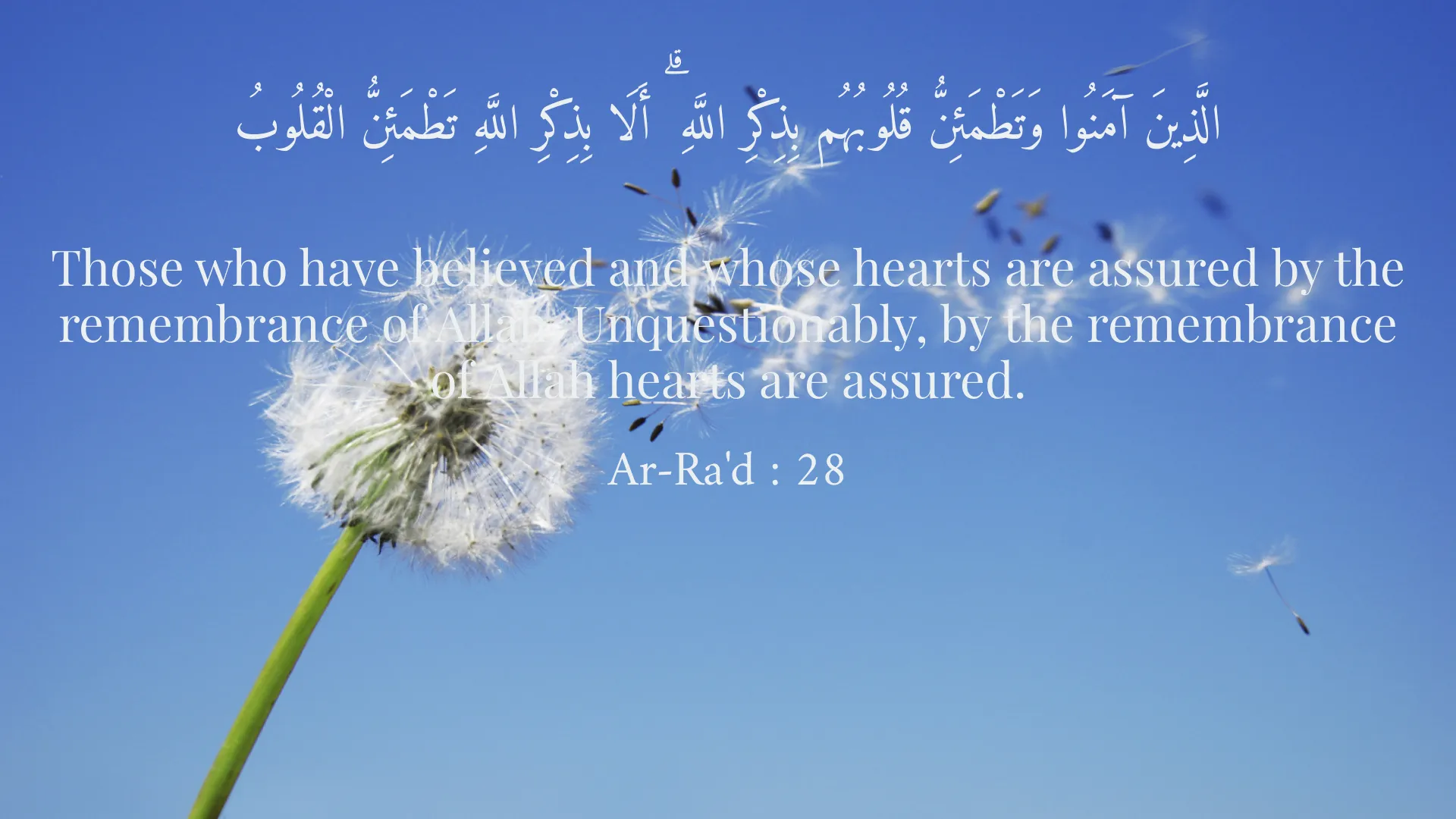
الَّذِينَ آمَنُوا وَتَطْمَئِنُّ قُلُوبُهُم بِذِكْرِ اللَّهِ ۗ أَلَا بِذِكْرِ اللَّهِ تَطْمَئِنُّ الْقُلُوبُ
Those who have believed and whose hearts are assured by the remembrance of Allah. Unquestionably, by the remembrance of Allah hearts are assured.
Ar-Ra'd : 28
إِنَّنِي أَنَا اللَّهُ لَا إِلَهَ إِلَّا أَنَا فَاعْبُدْنِي وَأَقِمِ الصَّلَاةَ لِذِكْرِي
Indeed, I am Allah. There is no deity except Me, so worship Me and establish prayer for My remembrance.
Taha : 14
وَاذْكُر رَّبَّكَ فِي نَفْسِكَ تَضَرُّعًا وَخِيفَةً وَدُونَ الْجَهْرِ مِنَ الْقَوْلِ بِالْغُدُوِّ وَالْآصَالِ وَلَا تَكُن مِّنَ الْغَافِلِينَ
And remember your Lord within yourself in humility and fear without being apparent in speech—in the mornings and the evenings. And do not be among the heedless.
Al-A'raf : 205
Short Story
One day, a wealthy merchant, whose mind was cluttered with the anxieties of trade and worldly gains, approached a wise ascetic and said, 'O Sage, with all this constant worry and distress that never leaves me, how can I find peace and remember God? My heart feels lost amidst this commotion.' The ascetic smiled and replied, 'O brother, cultivate reliance upon God, and know that He is the Provider. Do not imagine that your efforts alone bring success, for all that is, comes from Him. Now that your heart is captivated by the world, how can there be room for the remembrance of truth within it?' The merchant asked, 'Then what shall I do?' The ascetic advised, 'Instead of constantly focusing on your troubles and what you lack, reflect upon His blessings, and in every task you undertake, utter His Name and entrust your heart to Him. Even in your buying and selling, remember that whatever you gain is from His grace.' The merchant followed the sage's counsel. It was difficult at first, but gradually, his mind found tranquility. Whenever a chaotic thought came to him, he would release it with a brief remembrance or a heartfelt trust. Before long, not only did his trade prosper, but a deep peace settled in his heart. He realized that the remembrance of God is a treasure that illuminates the heart and frees it from distress, even in the midst of the greatest clamor.