Quranic Answer
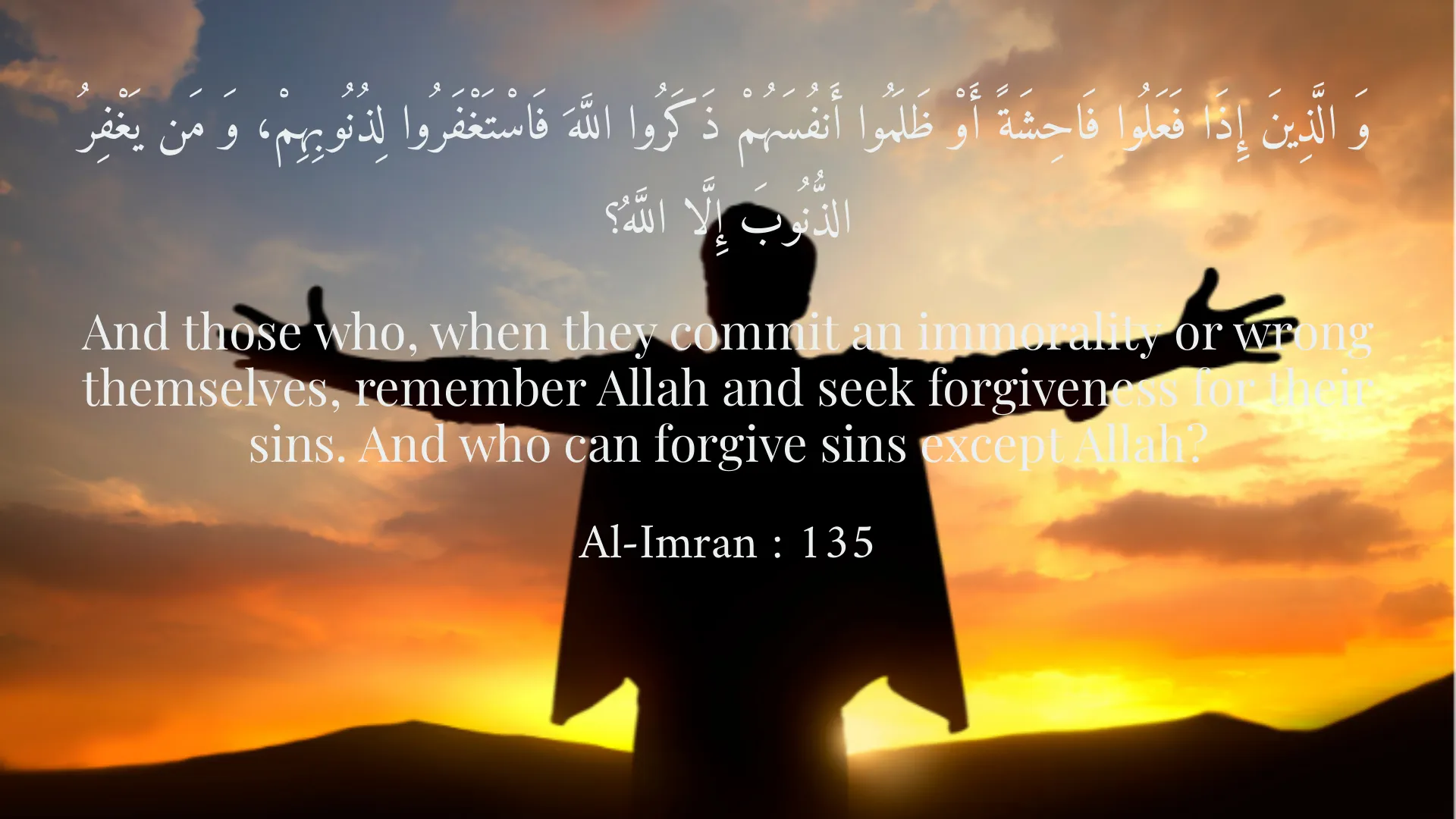
In the Holy Quran, Allah demonstrates a profound understanding of human nature and the mistakes that individuals often make. It is an intrinsic part of our existence to err and falter; thus, it is essential to recognize that these missteps do not define us. Instead, they serve as opportunities for growth, reflection, and self-improvement. Through various verses in the Quran, Allah emphasizes the importance of turning to Him for forgiveness and encourages us not to succumb to self-blame. This exploration seeks to delve deeper into the concept of forgiveness in Islam, the message of the aforementioned verses, and the broader implications for our lives. One of the most poignant verses that encapsulates the essence of self-forgiveness is found in Surah Al-Imran, verse 135. The verse states, 'And those who, when they commit an immorality or wrong themselves, remember Allah and seek forgiveness for their sins. And who can forgive sins except Allah?' This profound statement serves as a reminder that everyone makes mistakes; it is an integral aspect of being human. But what distinguishes individuals is how they respond to these errors. By remembering Allah and seeking His forgiveness, one can transcend their mistakes and take steps toward personal growth. When we read this verse, we are compelled to reflect on the nature of self-blame. Many individuals struggle with feelings of guilt and shame when they make mistakes, often leading to a harsh internal dialogue that can be damaging. Instead of fostering a spirit of growth, self-blame can lead to a cycle of despair and negativity. However, Allah's message urges us to seek His guidance and mercy instead of being trapped in this cycle. It highlights that forgiveness is readily available for those who sincerely seek it, and this can be a source of immense comfort and motivation. Moreover, the subsequent verse from Surah At-Tawbah, verse 118, furthers this narrative of mercy and forgiveness. It reads, 'And [He also forgave] the three who were left behind ... and their souls were confined to them and they thought that there is no refuge from Allah except in Him. Then He turned to them that they might repent.' In this context, the three excluded individuals recognized their mistakes and their reliance on Allah for mercy. Here, the concept of repentance is central. It signifies not only seeking forgiveness but also taking tangible steps to rectify one’s wrongs. This illustrates that no matter how far one has strayed, there remains an opportunity for redemption, provided one acknowledges their fault and resolves to improve. What can we infer from these teachings? The encouragement to move away from self-blame and toward corrective action underlines a fundamental aspect of Islamic teachings. There exists an inherent understanding within the Quran that humans will err, which is why the process of repentance and seeking forgiveness is emphasized so strongly. The act of turning to Allah fosters a supportive framework for growth. It cultivates a mindset that sees errors as lessons, rather than ultimate failures. In turn, this understanding can significantly enhance our emotional and psychological well-being, providing a conducive environment for self-improvement. In our daily lives, it becomes increasingly important to adopt a perspective of self-encouragement rather than self-criticism. Instead of punishing ourselves for our mistakes, we can focus our energy on acknowledging our strengths and capabilities. Cultivating a positive mindset allows us to approach challenges with resilience and optimism. When faced with failures, we can ask ourselves, 'What can I learn from this experience?' This question shall not only help mitigate feelings of despair but also guide us toward productive actions moving forward. Additionally, this framework can help foster a thriving community as well. One of the pillars of Islamic teachings is the importance of communal support and upliftment. When individuals practice forgiveness and positivity towards themselves, they are more likely to extend this attitude to others. This creates an environment of compassion, mutual support, and growth where everyone benefits from the strengths of one another while learning from collective mistakes. Through this lens, it is clear that self-forgiveness is not merely a personal journey; it has the potential to ripple out into the community, fostering a more forgiving and supportive society. To summarize, the Holy Quran offers invaluable lessons on forgiveness, self-acceptance, and personal growth. In Surah Al-Imran and Surah At-Tawbah, Allah emphasizes the importance of seeking forgiveness after making mistakes and reminds us that self-blame should not hinder our progress. Instead, He urges us to strive towards improvement, repentance, and self-encouragement. By embodying these teachings, we not only uplift ourselves but also contribute to a more harmonious and supportive community. Let us remember that our errors do not define us; it is our response to those errors that shapes who we are. With the grace of Allah, may we all find peace in acknowledging our mistakes, learn from them, and grow into better versions of ourselves.
Related Verses
وَ الَّذِينَ إِذَا فَعَلُوا فَاحِشَةً أَوْ ظَلَمُوا أَنفُسَهُمْ ذَكَرُوا اللَّهَ فَاسْتَغْفَرُوا لِذُنُوبِهِمْ، وَ مَن يَغْفِرُ الذُّنُوبَ إِلَّا اللَّهُ؟
And those who, when they commit an immorality or wrong themselves, remember Allah and seek forgiveness for their sins. And who can forgive sins except Allah?
Al-Imran : 135
وَ عَلَى الثَّلَاثَةِ الَّذِينَ خُلِّفُوا حَتَّى إِذَا ضَاقَتْ عَلَيْهِمُ الْأَرْضُ بِمَا رَحُبَتْ وَ ضَاقَتْ عَلَيْهِمْ أَنفُسُهُمْ وَ ظَنُّوا أَن لا مَلْجَأَ مِنَ اللَّهِ إِلَّا إِلَيْهِ، ثُمَّ تَابَ عَلَيْهِمْ لِيَتُوبُوا...
And [He also forgave] the three who were left behind ... and their souls were confined to them and they thought that there is no refuge from Allah except in Him. Then He turned to them that they might repent.
At-Tawbah : 118
Short Story
One day, Adel was deep in thought, contemplating the mistakes he had made. He started to blame himself but suddenly recalled the verses of the Quran and decided instead to seek forgiveness from Allah. He said to himself, 'I must learn from this mistake to become better.' After some time, he felt much better and noticed a greater peace in his life.