Quranic Answer
Treating oneself with honesty is one of the deepest and most fundamental teachings in the Quran and Islam, often overlooked. This concept extends beyond merely not lying to others; it signifies a complete harmony between one's inner intentions (batin) and outward actions (zahir). The Holy Quran repeatedly emphasizes the importance of Sidq (truthfulness), Ikhlas (sincerity), and avoiding Nifaq (hypocrisy), all of which relate to inner honesty with oneself. It is a continuous journey of self-knowledge, self-evaluation, and striving to align with divine values. One of the core pillars of self-honesty is the concept of Sidq and Ikhlas. In Islam, Sidq is not limited to speaking the truth; it encompasses truthfulness in intention, commitment, action, and faith. When a person is honest with themselves, it means their intentions are pure, solely for the pleasure of Allah, and their actions stem from the depths of their heart, free from ostentation or showing off. Ikhlas means purifying one's intention from any impure motive and performing deeds solely for Allah. This level of self-honesty prevents self-deception and gives true weight and meaning to one's actions. The Quran repeatedly calls believers to Sidq and praises the truthful. For instance, in Surah At-Tawbah, verse 119, Allah says: "O you who have believed, fear Allah and be with the truthful." This verse instructs us to fear Allah and be among the truthful, which inherently requires us to first be truthful ourselves. This inner truthfulness is the foundation for Taqwa (God-consciousness). Furthermore, in Surah Al-Hajj, verse 37, Allah states: "It is not their flesh nor their blood that reaches Allah, but rather your piety (taqwa) reaches Him." This verse clearly indicates that the value of deeds in the sight of Allah is not based on their outward appearance, but on the individual's inner intention and taqwa. Therefore, self-honesty means ensuring that our actions are rooted in taqwa and Ikhlas, not mere habit or hypocrisy. Conversely, the Holy Quran strongly warns against Nifaq (hypocrisy and pretense) and considers it one of the greatest diseases of the heart. Hypocrisy is precisely the opposite of self-honesty: what a person displays outwardly differs from what they conceal inwardly. The hypocrite primarily deceives themselves, thinking they can deceive Allah and people, whereas in reality, they only deceive themselves and are hindered from spiritual growth and perfection. In Surah Al-Baqarah, verses 8-10, Allah describes the characteristics of hypocrites: "And among the people are some who say, 'We believe in Allah and the Last Day,' but they are not believers. (8) They [think to] deceive Allah and those who believe, but they deceive not except themselves and perceive [it] not. (9) In their hearts is a disease, so Allah has increased their disease; and for them is a painful punishment because they [habitually] used to lie." These verses clearly state that hypocrites are essentially deceiving themselves, as they do not realize that the disease has taken root in their hearts and only harms them. Therefore, to be honest with ourselves, we must avoid any form of pretense, showing off, or denial of our inner weaknesses. This includes honestly admitting our mistakes, shortcomings, and sins, rather than rationalizing them. Another crucial way to cultivate self-honesty is through the practice of Muhasabah al-Nafs (self-accountability or self-reckoning). Although this term is not explicitly mentioned in the Quran, its concept is derived from verses like Surah Al-Hashr, verse 18, which states: "O you who have believed, fear Allah. And let every soul look to what it has put forth for tomorrow (the Hereafter); and fear Allah. Indeed, Allah is Acquainted with what you do." This verse explicitly calls believers to examine what they have sent forth for their future, meaning to review their actions and intentions. Muhasabah al-Nafs is a regular and honest evaluation of one's deeds, thoughts, and intentions. This practice helps individuals recognize their strengths and weaknesses, correct their path, and avoid deviations. A self-honest person constantly holds themselves accountable, asking: Was my intention pure? Was what I did in accordance with Allah's pleasure? Did I use my time wisely? Did I infringe upon anyone's rights? This process of constructive self-criticism is key to spiritual growth and achieving inner peace. To practically implement self-honesty, we can take specific steps. First, "purifying intentions (Niyyah)": Before any action, reflect on your intention and ensure that your deed is solely for Allah's pleasure, not for gaining attention from others or worldly benefits. Second, "admitting mistakes and seeking forgiveness": The courage to admit our faults and seek Allah's forgiveness is a sign of deep self-honesty. This opens the door for sincere repentance (Tawbah Nasuh) and rectification. Third, "avoiding justification and excuses": A self-honest person takes responsibility for their actions and seeks improvement instead of making excuses. Fourth, "seeking knowledge and insight": The more we learn from the Quran and Sunnah, the clearer criteria we will have for assessing our inner honesty. Fifth, "associating with the truthful": As verse 119 of Surah At-Tawbah indicates, being in the company of truthful and sincere people helps us cultivate this virtue and keeps us on the right path. Finally, constant remembrance of the Day of Judgment (Ma'ad) and accountability is the strongest motivator for maintaining self-honesty, as we know that on that day, nothing will remain hidden, and all our deeds and intentions will be revealed. In conclusion, treating oneself with honesty in Islam is the cornerstone of true faith and human perfection. It involves cultivating sincerity in intentions, avoiding all forms of hypocrisy and pretense, and consistently practicing self-evaluation and self-accountability. This journey, though challenging, leads to inner peace, a strong connection with Allah, and a life lived with integrity and purpose. It is the only way a person can succeed in both this world and the Hereafter, for a sound heart and a pure inner self are the most valuable assets of a believer.
Related Verses
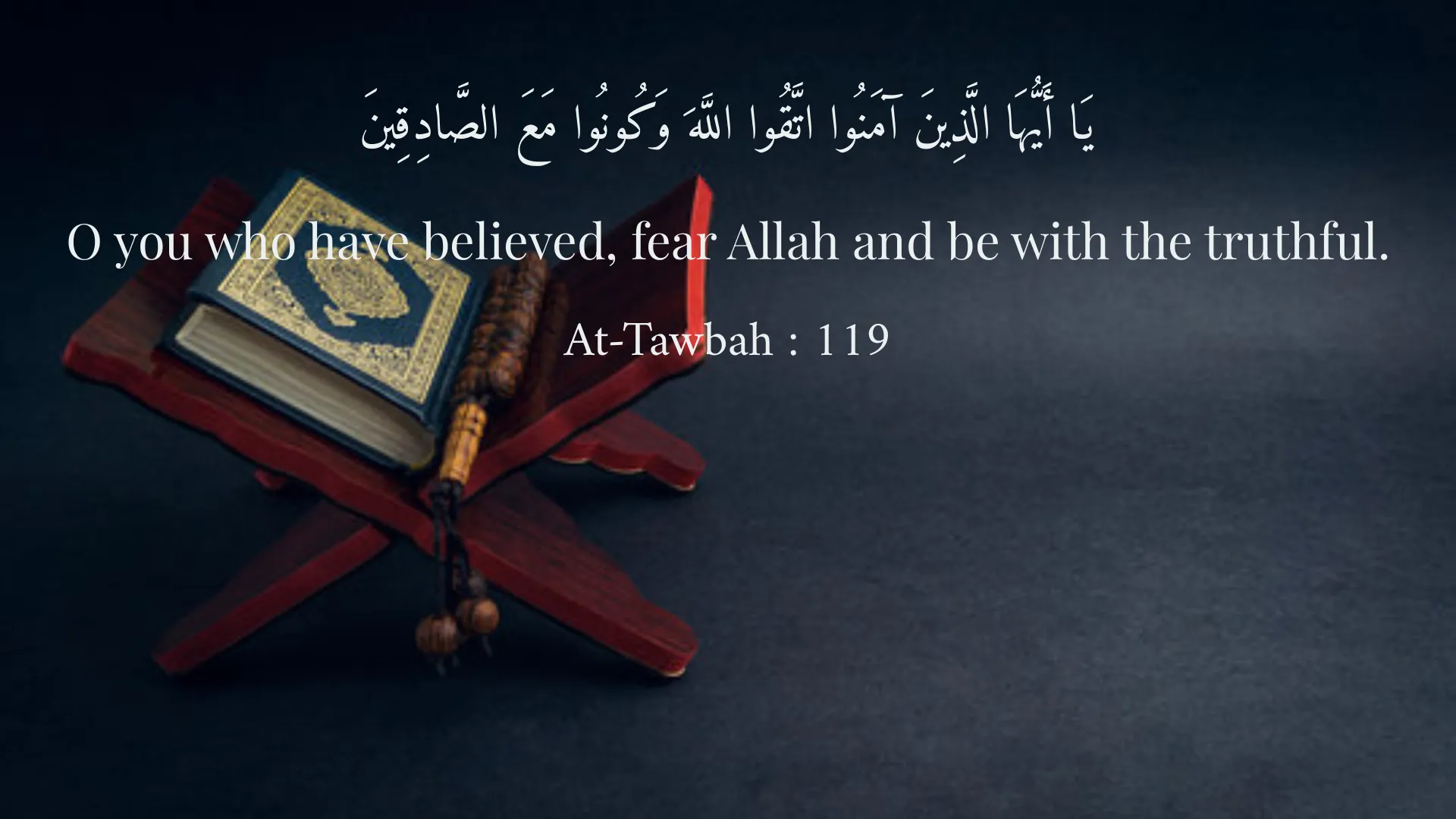
يَا أَيُّهَا الَّذِينَ آمَنُوا اتَّقُوا اللَّهَ وَكُونُوا مَعَ الصَّادِقِينَ
O you who have believed, fear Allah and be with the truthful.
At-Tawbah : 119
وَمِنَ النَّاسِ مَن يَقُولُ آمَنَّا بِاللَّهِ وَبِالْيَوْمِ الْآخِرِ وَمَا هُم بِمُؤْمِنِينَ
And among the people are some who say, 'We believe in Allah and the Last Day,' but they are not believers.
Al-Baqarah : 8
يُخَادِعُونَ اللَّهَ وَالَّذِينَ آمَنُوا وَمَا يَخْدَعُونَ إِلَّا أَنفُسَهُم وَمَا يَشْعُرُونَ
They [think to] deceive Allah and those who believe, but they deceive not except themselves and perceive [it] not.
Al-Baqarah : 9
يَا أَيُّهَا الَّذِينَ آمَنُوا اتَّقُوا اللَّهَ وَلْتَنظُرْ نَفْسٌ مَّا قَدَّمَتْ لِغَدٍ ۖ وَاتَّقُوا اللَّهَ ۚ إِنَّ اللَّهَ خَبِيرٌ بِمَا تَعْمَلُونَ
O you who have believed, fear Allah. And let every soul look to what it has put forth for tomorrow; and fear Allah. Indeed, Allah is Acquainted with what you do.
Al-Hashr : 18
Short Story
In Sa'di's Gulistan, it is narrated that a Dervish adorned his appearance with piety; he wore old clothes and spoke of asceticism and devotion, but in his solitude, his heart was attached to worldly possessions, and he accumulated wealth. One day, a wise man saw him and asked: "O Dervish, I see you speak of detachment on your tongue, yet in your heart, you are a slave to dirhams and dinars. Did you not know that true honesty is within, not merely in appearance? Whoever deceives himself will never find peace or truth, for Allah sees the inner being, not just the outer form." The Dervish was disturbed by these words and pondered how he had deceived himself for years. From then on, he began to purify his inner self, striving to align what was in his heart with what he expressed through words and actions, and thus tasted the sweet fruit of honesty with himself.