Quranic Answer
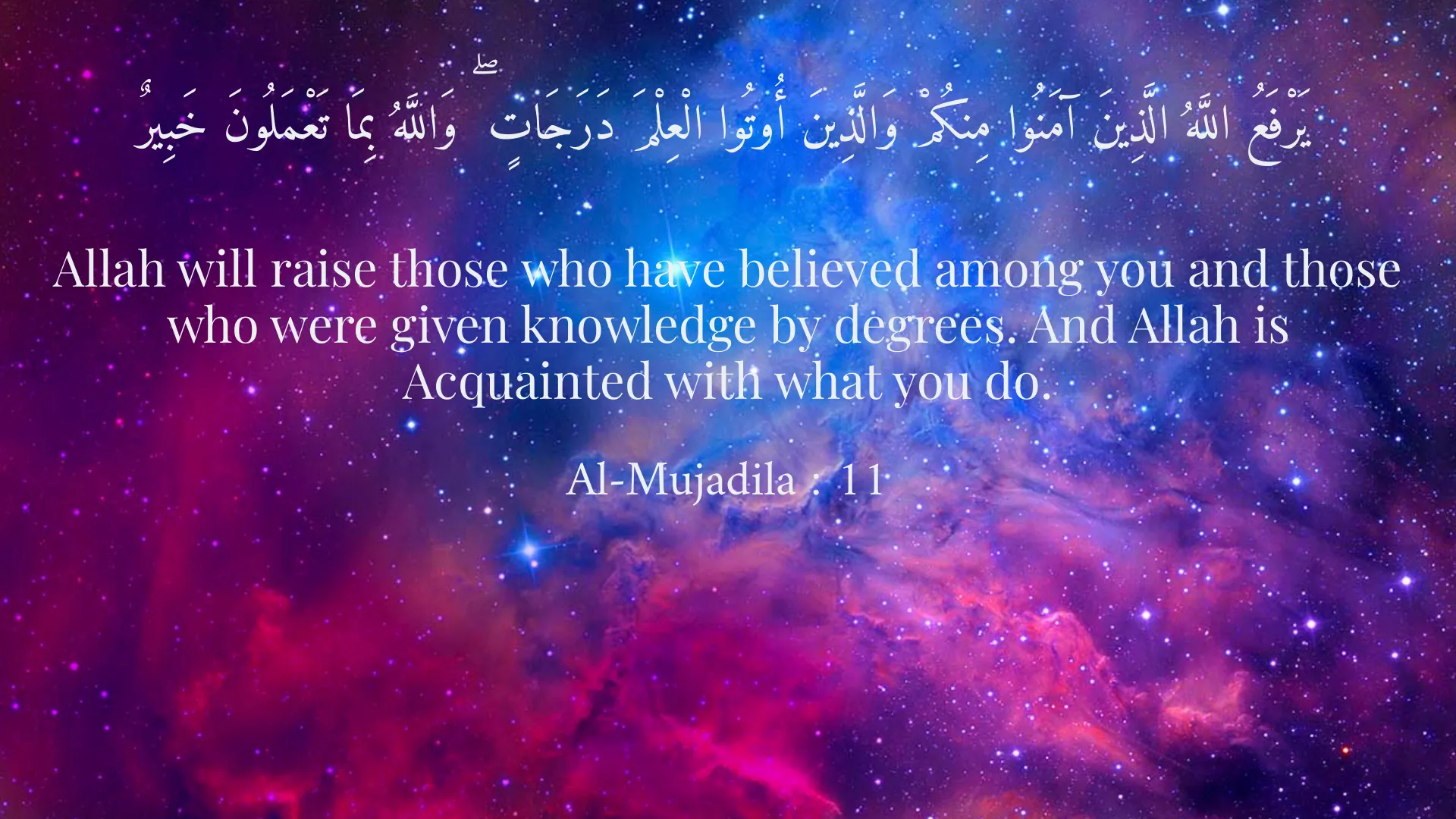
Knowledge in Islam, particularly as articulated in the Holy Quran, is heralded as a profound gift and an essential pathway to drawing nearer to Allah. The venerable text, which serves as the cornerstone of Islamic belief and practice, places immense emphasis on the acquisition and application of knowledge. This underscores the importance of knowledge not only as an intellectual pursuit but also as a spiritual obligation. One of the pivotal verses that encapsulates this sentiment is located in Surah Al-Mujadila, verse 11, which states: 'Allah will raise those who have believed among you and those who were given knowledge by degrees.' This powerful affirmation not only highlights the high esteem in which those endowed with knowledge are held in the sight of Allah but also signals a hierarchical elevation that knowledge can confer upon believers. The verse essentially elevates both faith and knowledge, suggesting that there exists an intrinsic link between the two. Believers are encouraged to pursue knowledge as a means not only of personal growth but as a framework through which their faith can flourish. This relationship between knowledge and faith is also emphasized in various Islamic teachings, which advocate for the pursuit of knowledge from the cradle to the grave. In this light, knowledge becomes not just an end in itself but also a means of receiving Allah's favor and ascending to higher spiritual and moral heights. Thus, the significance attributed to knowledge is multifaceted, as it intersects with one's faith as well as one's role and responsibilities within the community. Furthermore, the Quran illustrates that knowledge, when employed for the sake of God and in service to humanity, brings immense joy and proximity to Allah. Surah Az-Zumar, verse 9 conveys this idea beautifully, stating that those who engage not merely in the accumulation of knowledge but also in its practical application attain remarkable rewards and advantages. The essence of this verse lies in the understanding that knowledge should not be a mere repository of information, but rather a tool for positive action. When knowledge is harnessed effectively for the welfare of the community, it transforms individuals into assets who contribute to societal betterment. The application of knowledge involves its correct utilization — channeling it to benefit others while simultaneously fortifying one's own faith in Allah. A pertinent example can be gleaned from professions critical to human survival and well-being, such as medicine and academia. Medical professionals, scholars, and educators are endowed with specific knowledge that bears the potential to influence lives profoundly. When they employ their expertise to serve humanity — be it by saving lives, imparting wisdom, or fostering critical thinking — they are not only fulfilling a personal obligation but also honoring the divine trust placed upon them. Their roles become vessels for divine mercy and grace within society, reinforcing the notion that knowledge acts as both a resource and a responsibility. In this context, the act of practicing knowledge and expanding one’s understanding becomes imperative. Striving for knowledge in a manner that enhances both individual faith and societal benefit nurtures a flourishing relationship with Allah and cultivates strong communities. It is essential to recognize that knowledge is endowed with purpose, and the weight of that purpose necessitates conscientious intent and action. An individual engaged in lifelong learning not only enhances their wisdom but also contributes to the collective intellect of their community. Through continuous learning, they embody the Islamic principle of seeking knowledge, illuminated by the understanding that learning is a noble pursuit that someone carries in their heart throughout life. Moreover, to dedicate knowledge to the service of God, one must possess pure intentions. Intentions act as the lens through which knowledge is perceived and acted upon; they dictate the manner in which knowledge shapes one's actions and interactions with others. This highlights the necessity for believers to cultivate sincerity and commitment in their quest for wisdom. A sound intention coupled with acquired knowledge leads to actions that resonate with altruism, humility, and compassion. In Islam, the pursuit of knowledge is not only an intellectual endeavor but also a moral fabric woven into the pursuit of a righteous life. The responsibility of being bearers of knowledge cannot be overlooked. Those who have been favored with knowledge are accountable for its use, not only in a personal context but within their broader communities. The divine trust that knowledge embodies expands beyond the self; it proliferates into the lives of others, accentuating the value of community engagement and improvement. When individuals approach knowledge as a responsibility, they become proactive agents for change, striving to utilize their insights to uplift their surroundings, challenge social injustices, and foster a harmonious environment. In conclusion, knowledge in Islam serves a dual purpose: it is a means of personal elevation and a means to uplift society. The verses in the Quran highlight the elevated status granted to those who seek and embody knowledge within their lives. By channeling knowledge toward acts of service and commitment to the faith, individuals make strides toward becoming better Muslims, neighbors, and global citizens. Thus, knowledge must not be regarded solely as a tool for academic success but embraced as a profound and sacred trust guiding one to a more authentic life of devotion to God and service to humanity. This perspective necessitates a commitment to continuously learn, engage with the community, and apply knowledge for constructive purposes, leading ultimately to both personal fulfillment and societal improvement.
Related Verses
يَرْفَعُ اللَّهُ الَّذِينَ آمَنُوا مِنكُمْ وَالَّذِينَ أُوتُوا الْعِلْمَ دَرَجَاتٍ ۖ وَاللَّهُ بِمَا تَعْمَلُونَ خَبِيرٌ
Allah will raise those who have believed among you and those who were given knowledge by degrees. And Allah is Acquainted with what you do.
Al-Mujadila : 11
أَمَّنْ هُوَ قَانِتٌ آنَاءَ اللَّيْلِ سَاجِدًا وَقَائِمًا يَحْذَرُ الْآخِرَةَ وَيَرْجُو رَحْمَةَ رَبِّهِ قُلْ هَلْ يَسْتَوِي الَّذِينَ يَعْلَمُونَ وَالَّذِينَ لَا يَعْلَمُونَ ۚ إِنَّمَا يَتَذَكَّرُ أُولُو الْأَلْبَابِ
Is one who is devoutly obedient during the hours of the night, prostrating and standing [in prayer], fearing the Hereafter and hoping for the mercy of his Lord, [to be compared to one who does not]? Say, 'Are those who know equal to those who do not know?' Only they will remember [who are people of understanding].
Az-Zumar : 9
Short Story
On a beautiful day, Adel, a passionate and knowledge-seeking youth, went to a library to find a new book about science and knowledge. While searching, he stumbled upon a verse in the Quran: 'Allah will raise those who have believed among you and those who were given knowledge by degrees.' This verse inspired him so much that he decided to dedicate his knowledge to the service of humanity. Following this, he began teaching at a school and helping others in their learning. Adel felt that with every piece of knowledge he shared, he was getting closer to God.