Quranic Answer
In the Holy Quran, humanity's duty towards nature is presented not merely as an ethical responsibility but as an intrinsic part of faith and submission to God. The Quranic perspective on nature is not solely materialistic or instrumental; rather, it views nature as a creation of God and as signs (Ayat) reflecting His power, wisdom, and mercy. Humanity is designated as "Khalifa Allah" or God's vicegerent on Earth (Surah Al-Baqarah, verse 30). This exalted status bestows upon humanity not only authority and dominion over the world but also places a heavy responsibility on its shoulders. Vicegerency does not imply absolute ownership but rather stewardship, meaning the proper management and preservation of divine resources. In this role, humans are obliged to utilize nature's bounties justly and benevolently, ensuring that their needs are met without compromising the ability of future generations to meet theirs. The Quran repeatedly emphasizes that God has created everything with meticulous order and balance. This balance (Mizan) in creation is a fundamental principle that humanity is commanded to uphold. In Surah Ar-Rahman, verses 7-9, Allah states: "And the heaven He raised and set the balance, that you may not transgress [due measure] in the balance. And establish weight in justice and do not make the balance deficient." These verses symbolically invite humans to maintain equilibrium in all matters, including their interaction with nature. Any destruction or misuse of natural resources constitutes a disruption of this divine balance and an act of transgression (ghuluw) against the "Mizan," leading to severe consequences. One of the central concepts concerning humanity's duty towards nature is the prohibition of "Fasad fil-Ard" (corruption or mischief on Earth). Numerous verses explicitly forbid causing disorder and destruction on Earth. In Surah Al-A'raf, verse 56, it is stated: "And do not cause corruption upon the earth after its reformation. And invoke Him in fear and hope. Indeed, the mercy of Allah is near to the doers of good." This verse clearly indicates that the Earth was created in an ordered and reformed state, and any destructive human action is considered an act of corruption and disruption of the natural order. Fasad on Earth can encompass polluting water and air, deforestation, eradicating plant and animal species, and any form of misuse that leads to ecosystem imbalance and environmental damage. The Quran not only condemns these actions morally but also considers them sins against divine will. Furthermore, the Quran extensively speaks of God's blessings in nature and invites humanity to reflect upon them. From the rain that brings forth vegetation to the ships that sail the seas and the animals subdued for human benefit (e.g., Surah An-Nahl, verses 10-14). These verses serve not only as a reminder of God's power and mercy but also to instill a sense of gratitude and responsibility for these bounties. Gratitude is not merely expressed verbally but is materialized through the proper use and preservation of these blessings. Whoever destroys or harms God's bounties is, in essence, ungrateful and deserving of the ensuing consequences. Another Quranic principle in interacting with nature is the avoidance of "Israf" (extravagance) and "Tabdhir" (wastefulness). In Surah Al-A'raf, verse 31, we read: "O children of Adam, take your adornment at every masjid, and eat and drink and do not commit extravagance; indeed, He does not like extravagants." This principle applies not only to eating and drinking but also to the utilization of all natural resources. Excessive consumption of water, energy, and other resources, as well as the production of unnecessary and polluting waste, all fall under the category of Israf, which the Quran strongly prohibits. The Quran explicitly states that the corruption and despoliation witnessed on land and sea are a direct result of human actions. In Surah Ar-Rum, verse 41, it is mentioned: "Corruption has appeared on land and sea by [reason of] what the hands of people have earned so He may let them taste part of [the consequence of] what they have done, that perhaps they will return [to righteousness]." This verse serves as a stern warning, indicating that current environmental crises are a direct consequence of irresponsible human behavior. The purpose of these sufferings and problems is to lead humanity back to the righteous path and rectify its conduct. In conclusion, humanity's duty towards nature, from the Quranic perspective, is a comprehensive and multifaceted responsibility. Humans must regard themselves not as owners but as trustees and stewards. Respect for nature, maintaining ecological balance, abstaining from all forms of corruption and destruction, showing gratitude for divine blessings through proper and moderate use, and contemplating God's signs in creation are all fundamental principles of this duty. The Quran guides humanity towards a sustainable and responsible life, where harmony with nature is an integral part of harmony with divine will. This perspective provides the foundations for a strong and deeply rooted environmental ethic that can pave the way for resolving many of today's environmental challenges. From the Quranic viewpoint, preserving the environment is not an option but a religious and human obligation upon which humanity's well-being in this world and the hereafter depends. A true believer is not only diligent in their individual acts of worship but also demonstrates the utmost responsibility in their interaction with their surroundings, striving to preserve the beauty and bounties of God on Earth. This perspective transcends short-term self-interest, prioritizing the long-term sustainability and health of the entire creation.
Related Verses
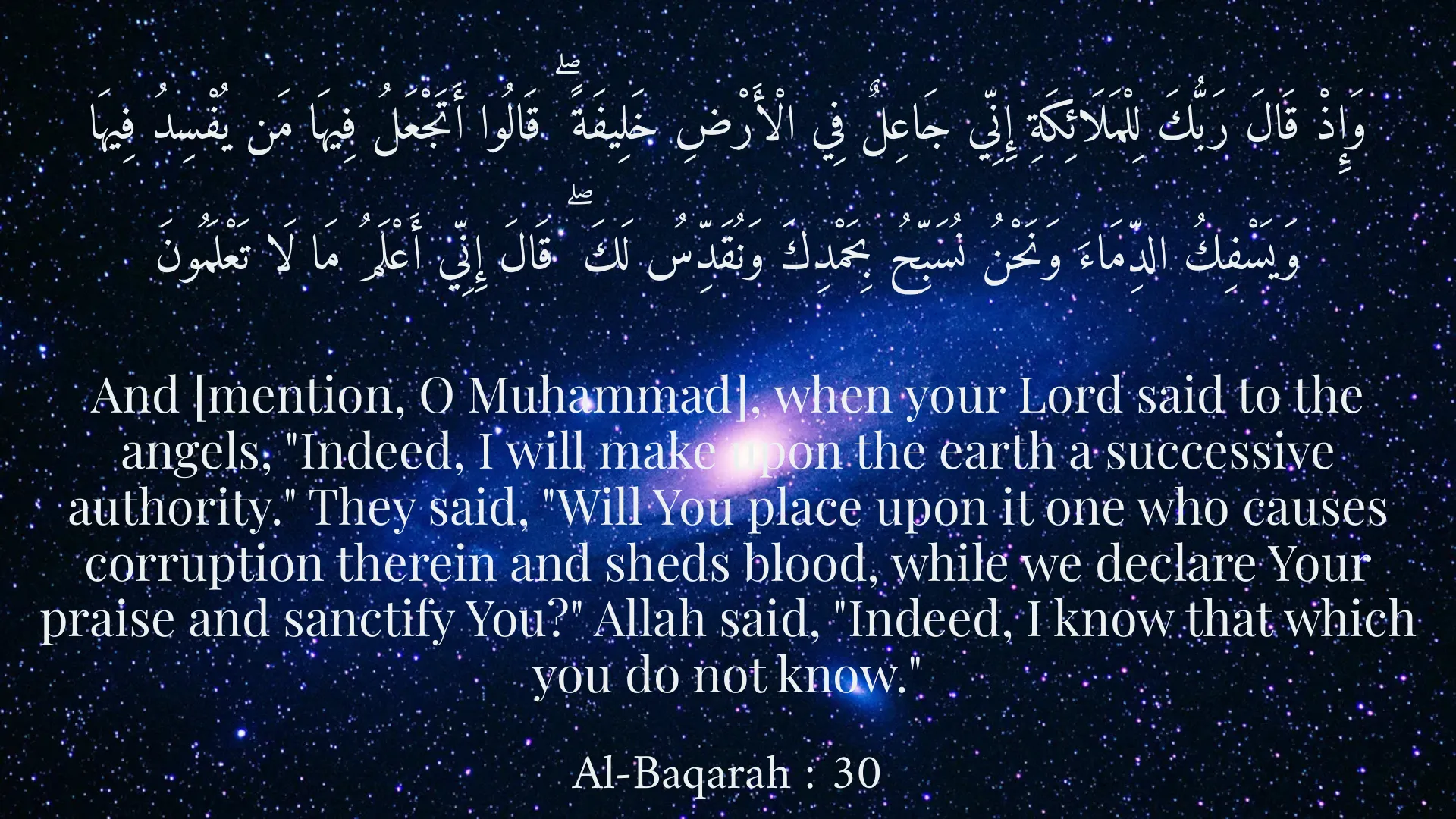
وَإِذْ قَالَ رَبُّكَ لِلْمَلَائِكَةِ إِنِّي جَاعِلٌ فِي الْأَرْضِ خَلِيفَةً ۖ قَالُوا أَتَجْعَلُ فِيهَا مَن يُفْسِدُ فِيهَا وَيَسْفِكُ الدِّمَاءَ وَنَحْنُ نُسَبِّحُ بِحَمْدِكَ وَنُقَدِّسُ لَكَ ۖ قَالَ إِنِّي أَعْلَمُ مَا لَا تَعْلَمُونَ
And [mention, O Muhammad], when your Lord said to the angels, "Indeed, I will make upon the earth a successive authority." They said, "Will You place upon it one who causes corruption therein and sheds blood, while we declare Your praise and sanctify You?" Allah said, "Indeed, I know that which you do not know."
Al-Baqarah : 30
وَلَا تُفْسِدُوا فِي الْأَرْضِ بَعْدَ إِصْلَاحِهَا وَادْعُوهُ خَوْفًا وَطَمَعًا ۚ إِنَّ رَحْمَتَ اللَّهِ قَرِيبٌ مِّنَ الْمُحْسِنِينَ
And do not cause corruption upon the earth after its reformation. And invoke Him in fear and hope. Indeed, the mercy of Allah is near to the doers of good.
Al-A'raf : 56
ظَهَرَ الْفَسَادُ فِي الْبَرِّ وَالْبَحْرِ بِمَا كَسَبَتْ أَيْدِي النَّاسِ لِيُذِيقَهُم بَعْضَ الَّذِي عَمِلُوا لَعَلَّهُمْ يَرْجِعُونَ
Corruption has appeared on land and sea by [reason of] what the hands of people have earned so He may let them taste part of [the consequence of] what they have done, that perhaps they will return [to righteousness].
Ar-Rum : 41
Short Story
It is recounted that Nushirvan the Just, a wise and equitable king, was once on a journey. He arrived at a village whose people drank from a clear spring, surrounded by ancient trees casting their shade. A village elder told him: "O King, in the past, there was a bountiful fruit orchard here, but a greedy man cut down all the trees to sell their wood, drying up the land. Now we only benefit from this spring." Nushirvan was saddened by this and said: "Such a person who destroys a lasting bounty for a fleeting profit wrongs not only himself but also future generations. Nature is a trust in our hands, and the wise are those who benefit from it but do not spoil it." This anecdote reminds us that true value lies in preserving and maintaining what God has bestowed upon us, not in destroying it for transient gain.