Quranic Answer
In today's world, where social media has become an inseparable part of our lives, the phenomenon of 'social comparison' has become extremely prevalent. We are constantly exposed to images of seemingly perfect lives, impressive achievements, and luxurious possessions of others. These comparisons, consciously or unconsciously, can trigger feelings of envy, dissatisfaction, anxiety, and even depression. In such an environment, how can we maintain our inner peace and free ourselves from the traps of comparison? The Holy Quran, as a book of divine guidance, offers profound and fundamental solutions to these challenges that transcend time and place, addressing all dimensions of human existence. These solutions not only protect us from the harms of comparison but also guide us towards a meaningful, satisfying, and deeply peaceful life. One of the most important principles the Quran provides to combat comparison is the principle of gratitude and contentment (Qana'ah). The Quran repeatedly emphasizes the importance of being grateful for Allah's blessings. When a person looks at what they possess, even the smallest things, with an attitude of gratitude and thankfulness, doors of satisfaction and tranquility open up to them. In contrast, looking at what others have and wishing for it causes us to overlook our own blessings and never achieve true contentment. Allah says in the Quran: “And do not wish for that by which Allah has made some of you exceed others. For men is a share of what they have earned, and for women is a share of what they have earned. And ask Allah of His bounty. Indeed, Allah is ever, of all things, Knowing.” (An-Nisa: 32). This verse clearly prohibits us from longing for the advantages of others and instead advises us to ask Allah for His bounty. This means that every individual has a share from their efforts and work, and Allah, with His wisdom, has distributed provisions and talents among His servants. Understanding this truth is the foundation of contentment and acceptance of divine destiny. Contentment does not mean giving up effort; rather, it means having inner satisfaction with what you possess and not coveting what others have. Secondly, a fundamental principle is focusing on the Hereafter and recognizing the triviality of worldly glitter. Social media primarily showcases the material and superficial aspects of life: large homes, extravagant travels, expensive clothes, and luxurious lifestyles. The Quran repeatedly warns that this worldly glamour is deceptive and transient, and true value lies in the permanence and eternity of the Hereafter. Allah says in Surah Al-Hadid: “Know that the life of this world is but amusement and diversion and adornment and boasting among yourselves and competition in increase of wealth and children - like the example of a rain whose [resulting] plant growth pleases the tillers; then it dries and you see it [become] yellow; then it becomes [scattered] debris. And in the Hereafter is severe punishment and forgiveness from Allah and approval. And what is the worldly life except the enjoyment of delusion.” (Al-Hadid: 20). This verse beautifully likens the transient and deceptive nature of worldly life to a rain that produces lush, pleasing vegetation, but quickly turns yellow, dries up, and perishes. This perspective helps a person redefine their values and, instead of comparing themselves with others' material possessions, seek more lasting and spiritual values. When a person remembers that true success is with Allah and in the eternal life, worldly comparisons become meaningless. Thirdly, a Quranic strategy is the emphasis on piety (Taqwa) and inner values instead of outward appearances. In modern societies, individuals are often valued based on wealth, beauty, social status, or the number of followers on social media. However, the Quran rejects these criteria and considers piety and closeness to Allah as the only measure of superiority. In Surah Al-Hujurat, we read: “O mankind, indeed We have created you from male and female and made you peoples and tribes that you may know one another. Indeed, the most noble of you in the sight of Allah is the most righteous of you. Indeed, Allah is Knowing and Acquainted.” (Al-Hujurat: 13). This verse clearly states that a person's dignity and honor are not in their race, wealth, beauty, or fame, but in their piety and God-consciousness. Focusing on one's own spiritual and moral growth, instead of competing with others in worldly appearances, is a sure path to achieving inner peace and contentment. Furthermore, the Quran emphasizes attention to one's individual journey and personal accountability. Every human being has their unique path in life, and Allah has set a specific destiny and test for each. Focusing on the truth that “And that there is not for man except that [good] for which he strives” (An-Najm: 39) helps us not to expend our energy comparing ourselves to others. Instead, it encourages us to focus on our self-improvement and development. We are only responsible for our own deeds and efforts, not for comparing and envying the possessions of others. This perspective on life not only prevents feelings of inferiority or false superiority but also provides the necessary motivation for growth and progress on one's individual path. Ultimately, the Quran teaches us that the purpose of life is to achieve peace and tranquility of heart through the remembrance of Allah (Ar-Ra'd: 28: “Unquestionably, by the remembrance of Allah hearts are assured.”). Social comparison is precisely the opposite of this tranquility; it constantly leads to restlessness, anxiety, and regret. By seeking refuge in the remembrance of Allah, by focusing on gratitude, by understanding the transient nature of this world, and by prioritizing piety, we can free ourselves from the endless comparisons of social media and attain true and lasting peace. The Quran shows us a path where inner and spiritual values replace external and material ones, and a person comes closer to their true self, which is the divine spirit breathed into them. This path is the way to freedom from the chains of comparison and a flight towards eternal liberty and peace.
Related Verses
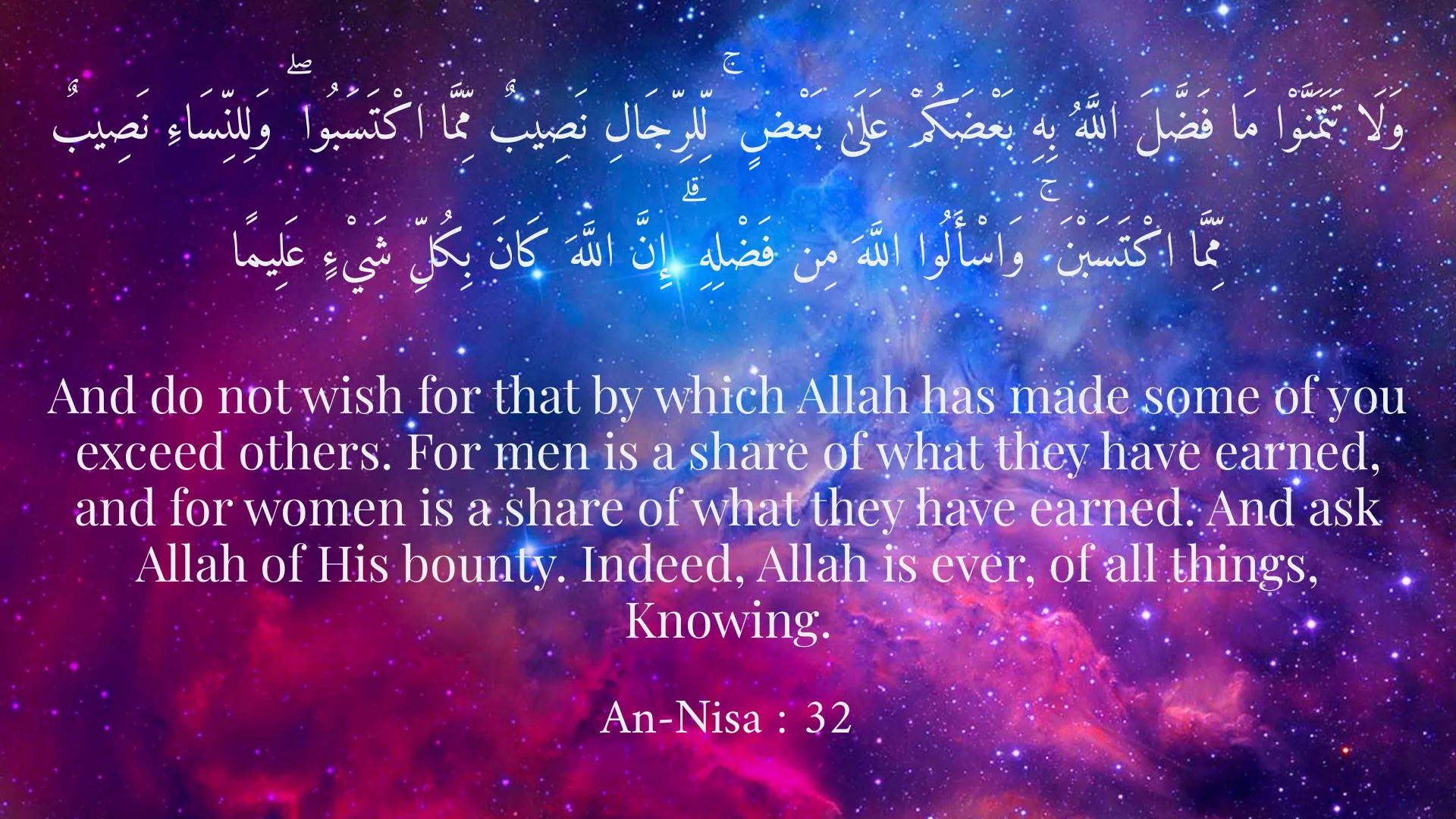
وَلَا تَتَمَنَّوْا مَا فَضَّلَ اللَّهُ بِهِ بَعْضَكُمْ عَلَىٰ بَعْضٍ ۚ لِّلرِّجَالِ نَصِيبٌ مِّمَّا اكْتَسَبُوا ۖ وَلِلنِّسَاءِ نَصِيبٌ مِّمَّا اكْتَسَبْنَ ۚ وَاسْأَلُوا اللَّهَ مِن فَضْلِهِ ۗ إِنَّ اللَّهَ كَانَ بِكُلِّ شَيْءٍ عَلِيمًا
And do not wish for that by which Allah has made some of you exceed others. For men is a share of what they have earned, and for women is a share of what they have earned. And ask Allah of His bounty. Indeed, Allah is ever, of all things, Knowing.
An-Nisa : 32
اعْلَمُوا أَنَّمَا الْحَيَاةُ الدُّنْيَا لَعِبٌ وَلَهْوٌ وَزِينَةٌ وَتَفَاخُرٌ بَيْنَكُمْ وَتَكَاثُرٌ فِي الْأَمْوَالِ وَالْأَوْلَادِ ۖ كَمَثَلِ غَيْثٍ أَعْجَبَ الْكُفَّارَ نَبَاتُهُ ثُمَّ يَهِيجُ فَتَرَاهُ مُصْفَرًّا ثُمَّ يَكُونُ حُطَامًا ۚ وَفِي الْآخِرَةِ عَذَابٌ شَدِيدٌ وَمَغْفِرَةٌ مِّنَ اللَّهِ وَرِضْوَانٌ ۚ وَمَا الْحَيَاةُ الدُّنْيَا إِلَّا مَتَاعُ الْغُرُورِ
Know that the life of this world is but amusement and diversion and adornment and boasting among yourselves and competition in increase of wealth and children - like the example of a rain whose [resulting] plant growth pleases the tillers; then it dries and you see it [become] yellow; then it becomes [scattered] debris. And in the Hereafter is severe punishment and forgiveness from Allah and approval. And what is the worldly life except the enjoyment of delusion.
Al-Hadid : 20
يَا أَيُّهَا النَّاسُ إِنَّا خَلَقْنَاكُم مِّن ذَكَرٍ وَأُنثَىٰ وَجَعَلْنَاكُمْ شُعُوبًا وَقَبَائِلَ لِتَعَارَفُوا ۚ إِنَّ أَكْرَمَكُمْ عِندَ اللَّهِ أَتْقَاكُمْ ۚ إِنَّ اللَّهَ عَلِيمٌ خَبِيرٌ
O mankind, indeed We have created you from male and female and made you peoples and tribes that you may know one another. Indeed, the most noble of you in the sight of Allah is the most righteous of you. Indeed, Allah is Knowing and Acquainted.
Al-Hujurat : 13
Short Story
In a time long past, there lived a wealthy and boastful man who, every morning, paraded his riches and possessions before the people of the marketplace, speaking with arrogance about those who had less than him. In the same city, in a quiet corner, lived a simple and devout man, known for his contentment and peace of heart. He had neither great wealth nor a desire for fame; his heart was warmed only by the remembrance of God and gratitude for daily blessings. One day, the wealthy man, with a sneer, said to the devout man: 'O dervish, what has become of you that you are unaware of all the pleasures and beauties of this world? See what I have and what you have!' The devout man replied with a calm smile: 'My friend, what good is all that you possess if your heart constantly yearns for more? I am neither unaware of what you have nor attached to it; for the eye of my heart is fixed upon an infinity you have yet to see. Contentment is a treasure that elevates poverty to kingship and frees the heart from the shackles of comparison. Worldly wealth is a fleeting shadow, but peace of heart is an eternal light that is not sold in any market.' These words resonated with the wealthy man, making him ponder that perhaps true happiness lies not in external possessions, but in inner richness and contentment with divine decree.