Quranic Answer
The Holy Quran, as a divine guide, delves into profound human and spiritual matters with unparalleled precision and subtlety. Within this framework, it draws a clear distinction between genuine, sincere religiosity and the reprehensible phenomenon of 'selling religion.' This differentiation is not merely conceptual but is explicitly elucidated in numerous verses, detailing the characteristics of both groups and the consequences of their actions. Genuine religiosity, as expounded by the Quran, has deep roots in the human heart and soul, stemming from sincerity, pure intention, and absolute obedience to God. A true believer is one whose faith arises not from self-interest or hypocrisy, but from a heartfelt conviction in the oneness of God, the prophethood of His messengers, and the truth of the Hereafter. Such religiosity impels an individual towards righteous deeds, abstaining from sins, upholding the rights of others, and striving for justice in society. The Quran emphasizes that acts of worship and good deeds must be performed solely for the pleasure of the Lord, not for seeking human attention or worldly gains. The ultimate goal of a believer is divine satisfaction and achieving eternal bliss in the Hereafter; worldly life is merely a means to this end, not the ultimate destination. For instance, numerous verses underscore the importance of sincerity in worship. In Surah Al-Bayyinah, verse 5, we read: "And they were not commanded except to worship Allah, [being] sincerely obedient to Him in religion, inclining to truth; and to establish prayer and to give zakah. And that is the correct religion." This verse clearly indicates that sincerity and monotheism are the core of religiosity, and any religious act performed with an intention other than God's pleasure deviates from the true path. In contrast, 'selling religion' is a phenomenon that the Quran strongly condemns and repeatedly addresses. A person who 'sells religion' adopts an outward appearance of piety but, in reality, their intention is to gain worldly benefits, power, wealth, or fame. These individuals might exploit their religious position or distort and misinterpret divine verses and rulings to deceive people and achieve their material objectives. The Quran refers to this act as 'selling Allah's verses for a small price' (buying Allah's signs for a small price). This 'small price' can be any worldly benefit that, compared to divine rewards and eternal bliss, holds negligible value. For example, in Surah Al-Baqarah, verse 41, we read: "And do not exchange My verses for a small price." And in verse 79 of the same Surah, it states: "So woe to those who write the Scripture with their own hands, then say, 'This is from Allah,' in order to exchange it for a small price. So woe to them for what their hands have written and woe to them for what they earn." These verses explicitly show that distorting divine words or exploiting them for material gains is a reprehensible act deserving of punishment. One of the most prominent examples of 'selling religion' in the Quran is exemplified by the characteristics of hypocrites (munafiqun). Hypocrites are those who outwardly present themselves as Muslims and believers but are inwardly disbelievers and enemies of Islam and Muslims. Their motivation for this hypocrisy and pretense is usually to preserve their lives and property or to gain status and influence within the Muslim community. The Quran elaborates on the traits and actions of hypocrites, revealing that they seek to deceive God and people, while in reality, they only deceive themselves. In Surah An-Nisa, verse 142, we read: "Indeed, the hypocrites [think to] deceive Allah, but He is deceiving them. And when they stand for prayer, they stand lazily, showing [themselves to] the people and not remembering Allah except a little." This verse provides a precise depiction of 'selling religion': an act that has the outward appearance of faith but is inwardly devoid of sincerity and full of hypocrisy. The fundamental and central difference between religiosity and selling religion lies in 'intention' and 'purpose.' A true religious person aims for proximity to God and His pleasure, and every action begins with this intention. However, one who 'sells religion' aims for worldly gain and seeking the attention of creation, turning religion into a tool to achieve these ends. The Holy Quran repeatedly emphasizes this distinction to guide believers towards honesty in faith and action and to free them from the traps of hypocrisy and worldliness. Ultimately, the Quran clearly warns that the consequences of selling religion are dire in this world and the Hereafter, and these individuals will not only find no true peace in this world but will also suffer painful torment in the Hereafter. Conversely, genuine religious people are blessed with divine mercy and favor, attaining eternal blissful lives. This fundamental distinction forms the heart of the Quranic messages, guiding humanity in discerning truth from falsehood, and sincerity from deceit.
Related Verses
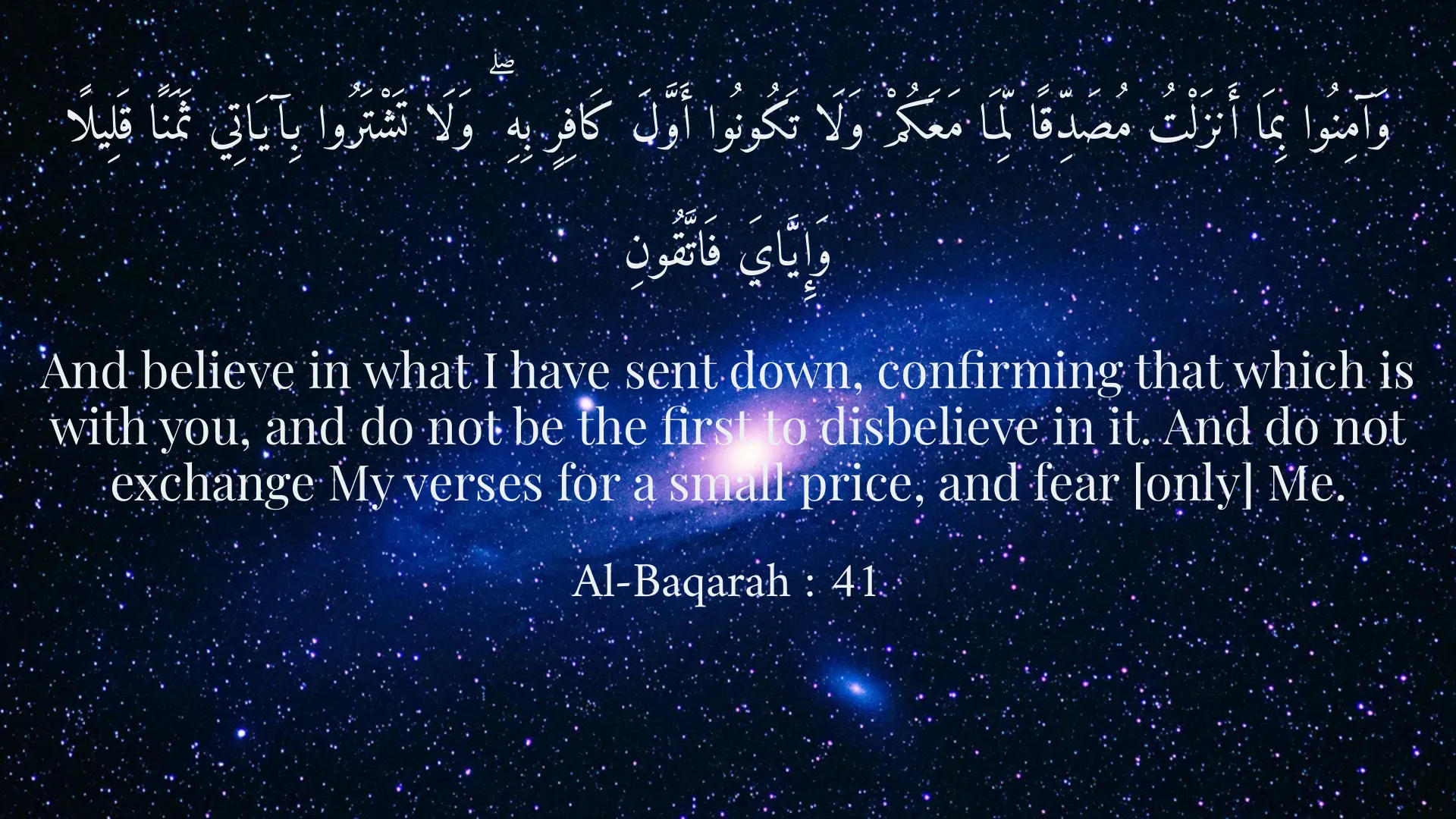
وَآمِنُوا بِمَا أَنزَلْتُ مُصَدِّقًا لِّمَا مَعَكُمْ وَلَا تَكُونُوا أَوَّلَ كَافِرٍ بِهِ ۖ وَلَا تَشْتَرُوا بِآيَاتِي ثَمَنًا قَلِيلًا وَإِيَّايَ فَاتَّقُونِ
And believe in what I have sent down, confirming that which is with you, and do not be the first to disbelieve in it. And do not exchange My verses for a small price, and fear [only] Me.
Al-Baqarah : 41
فَوَيْلٌ لِّلَّذِينَ يَكْتُبُونَ الْكِتَابَ بِأَيْدِيهِمْ ثُمَّ يَقُولُونَ هَٰذَا مِنْ عِندِ اللَّهِ لِيَشْتَرُوا بِهِ ثَمَنًا قَلِيلًا ۖ فَوَيْلٌ لَّهُم مِّمَّا كَتَبَتْ أَيْدِيهِمْ وَوَيْلٌ لَّهُم مِّمَّا يَكْسِبُونَ
So woe to those who write the Scripture with their own hands, then say, 'This is from Allah,' in order to exchange it for a small price. So woe to them for what their hands have written and woe to them for what they earn.
Al-Baqarah : 79
إِنَّ الْمُنَافِقِينَ يُخَادِعُونَ اللَّهَ وَهُوَ خَادِعُهُمْ وَإِذَا قَامُوا إِلَى الصَّلَاةِ قَامُوا كُسَالَىٰ يُرَاءُونَ النَّاسَ وَلَا يَذْكُرُونَ اللَّهَ إِلَّا قَلِيلًا
Indeed, the hypocrites [think to] deceive Allah, but He is deceiving them. And when they stand for prayer, they stand lazily, showing [themselves to] the people and not remembering Allah except a little.
An-Nisa : 142
وَمَا أُمِرُوا إِلَّا لِيَعْبُدُوا اللَّهَ مُخْلِصِينَ لَهُ الدِّينَ حُنَفَاءَ وَيُقِيمُوا الصَّلَاةَ وَيُؤْتُوا الزَّكَاةَ ۚ وَذَٰلِكَ دِينُ الْقَيِّمَةِ
And they were not commanded except to worship Allah, [being] sincerely obedient to Him in religion, inclining to truth; and to establish prayer and to give zakah. And that is the correct religion.
Al-Bayyinah : 5
Short Story
In Saadi's Golestan, it is narrated that a friend saw a Sheikh performing prayer with great fervor and humility. His friend asked him, 'O Sheikh, whence comes all this presence of heart and humility?' The Sheikh chuckled and replied, 'My friend, to tell you the truth, there is a house nearby, and a girl was looking at me from the window; I wanted to impress her with my piety, hoping she might be moved to pity and accept me as her husband!' With this gentle story, Saadi beautifully illustrates the difference between true religiosity and hypocrisy; where a good deed is done not for God but for the eyes of people and personal gain, it is no longer piety, but the very act of selling religion.