Quranic Answer
The question of whether a simple life is synonymous with God's contentment is a profound one within the Quranic and Islamic worldview. To answer this comprehensively, we must delve into various facets of Quranic teachings regarding worldly life, wealth, contentment, and the ultimate purpose of human existence. It must be stated at the outset that the Holy Quran does not explicitly declare that a simple or impoverished life, in itself, guarantees complete divine contentment. Rather, God's satisfaction is contingent upon a multitude of continuous factors, for which a simple life can serve as a conducive environment, but it is neither a necessary nor a sufficient condition. Divine contentment, at its core, is the outcome of piety (Taqwa), sincerity (Ikhlas), righteous deeds (Amal Salih), gratitude (Shukr), patience (Sabr), justice (Adl), and moderation (I'tidal) in all aspects of life. The Quran emphatically forbids extravagance (Israaf) and wastefulness (Tabdheer). In numerous verses, Allah prohibits humans from excessive consumption and profligacy. For instance, in Surah Al-An'am (6:141), it states: "...And eat of its fruit when it yields, and give its due [zakah] on the day of its harvest. And do not be extravagant. Indeed, He does not like those who commit extravagance." This verse indicates that utilizing blessings is permissible, but not in an extravagant manner. Extravagance, in essence, is exceeding moderation, disregarding the rights of others, and ingratitude for divine blessings. Therefore, a life that avoids excessive luxuries and uncontrolled consumerism is inherently more compatible with this divine command and can be a precursor to God's pleasure. Such a life frees an individual from vain preoccupations and material competitions that often lead to forgetting the primary purpose of creation. Furthermore, the Quran emphasizes avoiding excessive attachment to this world and its allurements. The worldly life (Dunya) is described in the Quran as "Mata' al-Ghuroor" (a deceiving enjoyment) or "Lahw wa La'ib" (diversion and amusement). These descriptions do not imply that the world is valueless or should be completely abandoned. Instead, they signify that it should not be man's ultimate goal or primary source of delight. In Surah Al-Kahf (18:46), we read: "Wealth and children are the adornment of worldly life. But the enduring good deeds are better to your Lord in reward and better in [the hope of] attainment." This verse clearly illustrates that true value lies in righteous deeds that endure, not in wealth and children, which are merely fleeting adornments of this world. A simpler life generally helps a person become less attached to materialism and focus more on spiritual and eternal values. This detachment is itself a significant factor in gaining God's contentment, as it liberates a person from the servitude of wealth and directs them towards sincere servitude to Him. The concept of "Qana'ah" (contentment with what is sufficient) is also highly valued in Islamic teachings. Qana'ah does not mean being satisfied with minimal needs and having no ambition for worldly progress, but rather being content with what Allah has provided and not striving greedily for what is beyond one's true capacity or need. The Prophet Muhammad (peace be upon him) said: "Qana'ah is a treasure that never perishes." One who chooses a simple life and is content with it remains free from anxieties stemming from greed, envy, and material competition. This inner peace and contentment are themselves manifestations of divine pleasure in the servant's heart. A content person is always grateful for God's blessings, even if they are few, and gratitude is one of the primary ways to earn God's contentment. However, it is crucial to emphasize that Islam does not endorse monasticism (Rahbaniyyah), which involves completely abandoning the world and living in isolation. In Surah Al-Hadid (57:27), it states: "...And monasticism, which they innovated; We did not prescribe it for them except [that they seek thereby] God's approval; but they did not observe it with due observance..." This verse indicates that Islam does not recommend a complete abandonment of the world and excessive asceticism that leads to a lack of active participation in society and neglect of social responsibilities. The goal is a balance between this world and the Hereafter. In Surah Al-Qasas (28:77), it says: "But seek, through that which Allah has given you, the home of the Hereafter; and [yet], do not forget your share of the world. And do good as Allah has done good to you..." This verse expresses a fundamental principle: legitimate and moderate use of worldly provisions to achieve ultimate happiness in the Hereafter is not only permissible but desirable. Thus, simplicity of life should not mean abandoning work, effort, and earning lawful wealth, but rather not being enslaved by wealth and using it appropriately and moderately in the path of divine pleasure. Ultimately, God's contentment is not tied to the simplicity or luxury of one's life, but rather to the state of one's heart, intentions, and deeds. A wealthy person who spends their wealth in the way of Allah, avoids extravagance, cares for the poor, and never becomes arrogant, can attain God's contentment. Similarly, an individual with a simple life who is content with what they have, is grateful, and uses their contentment to focus on worship and serving creation, can also achieve divine pleasure. The most important point is that a simple life creates a conducive environment for spiritual growth, avoiding sins related to greed and avarice, and focusing on the primary purpose of creation. This favorable environment increases the likelihood of attaining God's contentment, but it does not absolutely guarantee it. God's contentment is achieved through piety, righteous deeds, and sincerity in servitude, and simplicity of life can be one of the effective paths to these virtues, provided it is accompanied by pure intentions and guided by the correct path of servitude. Consequently, a simple life is not synonymous with God's contentment, but it can be a powerful and effective means to achieve it, provided this simplicity is accompanied by other principles of faith and ethics, and the ultimate goal of the individual is divine contentment, not merely the absence of wealth. It is a conscious choice to free oneself from worldly attachments and focus on what is enduring, which is the relationship with God.
Related Verses
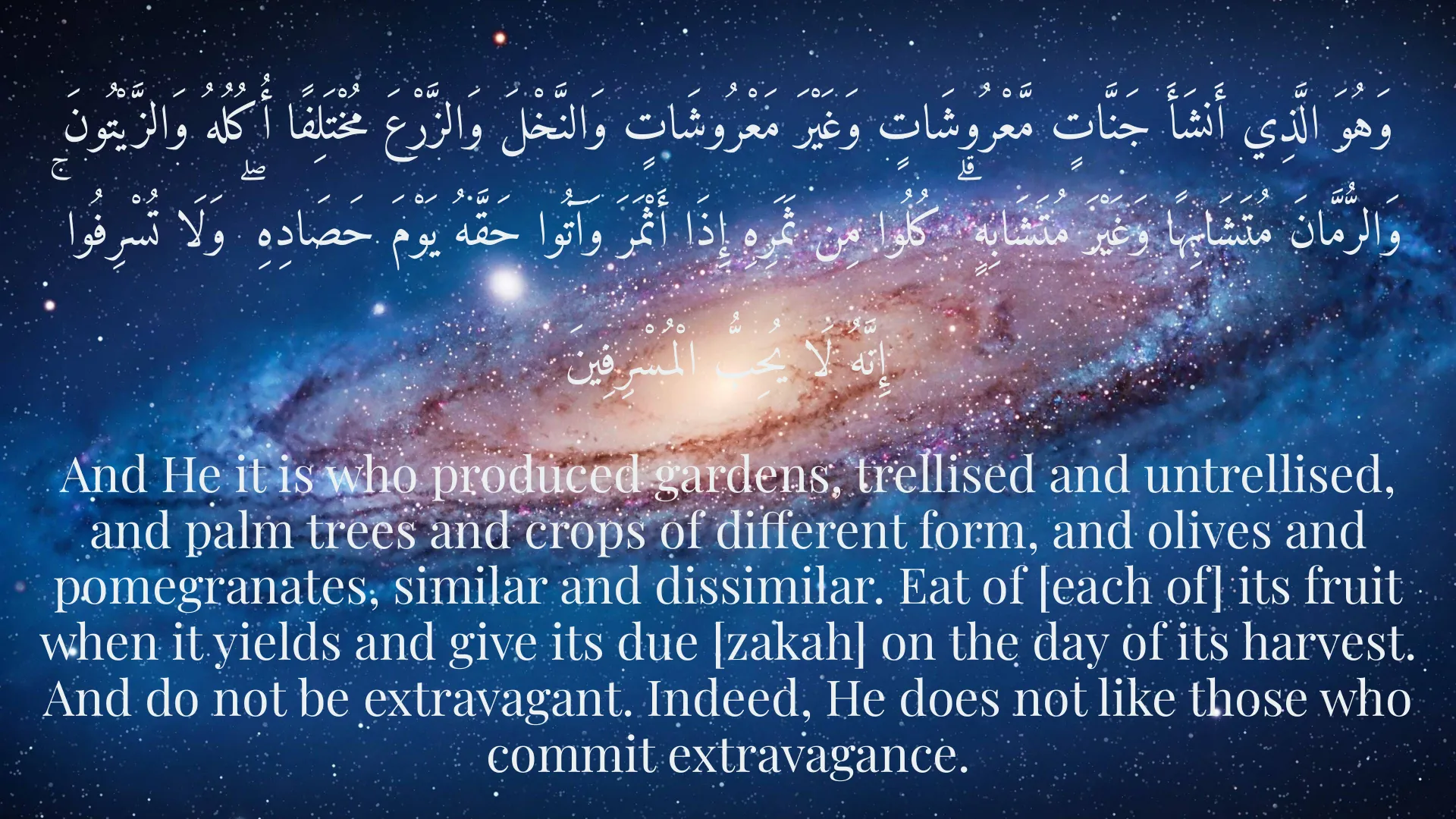
وَهُوَ الَّذِي أَنشَأَ جَنَّاتٍ مَّعْرُوشَاتٍ وَغَيْرَ مَعْرُوشَاتٍ وَالنَّخْلَ وَالزَّرْعَ مُخْتَلِفًا أُكُلُهُ وَالزَّيْتُونَ وَالرُّمَّانَ مُتَشَابِهًا وَغَيْرَ مُتَشَابِهٍ ۗ كُلُوا مِن ثَمَرِهِ إِذَا أَثْمَرَ وَآتُوا حَقَّهُ يَوْمَ حَصَادِهِ ۖ وَلَا تُسْرِفُوا ۚ إِنَّهُ لَا يُحِبُّ الْمُسْرِفِينَ
And He it is who produced gardens, trellised and untrellised, and palm trees and crops of different form, and olives and pomegranates, similar and dissimilar. Eat of [each of] its fruit when it yields and give its due [zakah] on the day of its harvest. And do not be extravagant. Indeed, He does not like those who commit extravagance.
Al-An'am : 141
الْمَالُ وَالْبَنُونَ زِينَةُ الْحَيَاةِ الدُّنْيَا ۖ وَالْبَاقِيَاتُ الصَّالِحَاتُ خَيْرٌ عِندَ رَبِّكَ ثَوَابًا وَخَيْرٌ أَمَلًا
Wealth and children are the adornment of worldly life. But the enduring good deeds are better to your Lord in reward and better in [the hope of] attainment.
Al-Kahf : 46
وَابْتَغِ فِيمَا آتَاكَ اللَّهُ الدَّارَ الْآخِرَةَ ۖ وَلَا تَنسَ نَصِيبَكَ مِنَ الدُّنْيَا ۖ وَأَحْسِن كَمَا أَحْسَنَ اللَّهُ إِلَيْكَ ۖ وَلَا تَبْغِ الْفَسَادَ فِي الْأَرْضِ ۖ إِنَّ اللَّهَ لَا يُحِبُّ الْمُفْسِدِينَ
But seek, through that which Allah has given you, the home of the Hereafter; and [yet], do not forget your share of the world. And do good as Allah has done good to you. And desire not corruption in the land. Indeed, Allah does not like corrupters.
Al-Qasas : 77
Short Story
It is narrated that one day Anushirvan the Just asked one of his close associates: "Whose life is more pleasant, that of a king or a dervish?" The man replied: "Kingship is accompanied by hardship and anxiety, while dervishhood is accompanied by ease and contentment." The king was touched and fell into thought. After a while, he saw a dervish sitting in a corner, dressed simply, with a cheerful face, complaining about nothing. Anushirvan approached him and asked: "What do you possess in this world that makes you so carefree and joyful?" The dervish smiled and said: "O King, I possess what you do not: a contentment that has made me free from every desire, and a light burden that has liberated me from every sorrow. Worldly possessions are chains for you, but for me, they are wings. I am pleased with a little lawful sustenance, while you, with an abundance of wealth, are still worried and restless." Anushirvan took heed of this speech and realized that true peace lies in simplicity of heart and contentment, not in the abundance of gold and silver.