Quranic Answer
Is anger always condemned? This is a question many of us grapple with in our daily lives. At first glance, it might seem that anger is a negative and destructive emotion that should always be avoided. But does the Holy Quran, the guiding scripture for Muslims, endorse such an absolute view? By reflecting upon the divine verses and the teachings of Prophet Muhammad (peace be upon him), we come to understand that the answer to this question requires a deeper and more nuanced understanding. Anger, in itself, is a natural human emotion, just like joy, sadness, fear, and love. What truly matters is how this emotion is managed and expressed. The Quran primarily emphasizes the control and suppression of destructive anger, rather than its absolute negation. One of the most prominent verses that addresses the topic of anger is Surah Ali 'Imran (3:134). In this verse, Allah describes the characteristics of the righteous and the doers of good, stating: "Those who spend [in the way of Allah] during ease and hardship and who restrain their rage and who pardon the people - and Allah loves the doers of good." (الْكَاظِمِينَ الْغَيْظَ وَالْعَافِينَ عَنِ النَّاسِ وَاللَّهُ يُحِبُّ الْمُحْسِنِينَ). Here, the phrase "Al-Kaazimeena al-Ghaydh" (those who restrain their rage) is mentioned as one of the prominent qualities of the pious. This indicates that suppressing anger and preventing its expression in a way that leads to harm and regret is highly valued in the sight of Allah. This verse clearly states that overcoming the desire for revenge and controlling negative emotions is a sign of piety and righteousness. This type of anger refers to personal, impulsive anger that can damage relationships and disturb individual and societal peace. The Quran reminds us that true strength lies in self-control, not in succumbing to fleeting emotions. When a person suppresses their anger, they are essentially mastering their ego, and this mastery has a great reward from Allah. Another verse in Surah Ash-Shura (42:37) refers to the qualities of true believers: "And those who avoid the major sins and immoralities, and when they are angered, they forgive." (وَإِذَا مَا غَضِبُوا هُمْ يَغْفِرُونَ). This verse suggests that even if an individual becomes angry, the correct and Islamic response is forgiveness and overlooking. This does not mean an absolute negation of anger, but rather an emphasis on not allowing anger to control one's actions and decisions. Anger may arise, but what matters is how one responds to it: with forgiveness instead of revenge, and patience instead of haste. This verse teaches us that the capacity for forgiveness, even at the height of anger, is a sign of spiritual and emotional maturity. Such individuals not only avoid major sins but also maintain the virtue of forgiveness when faced with intense emotions. From these verses, it can be concluded that the condemned anger is that which gets out of control, leads to oppression and injustice, or infringes upon the rights of others. This type of anger, rooted in arrogance, egoism, or envy, is certainly censured in Islam, as it has destructive consequences for the individual (including mental and physical ailments like high blood pressure and heart disease) and for society (such as conflict, violence, severed ties, and long-standing enmities). Prophet Muhammad (PBUH) also advised against undue anger and encouraged forbearance and patience in numerous narrations. He said, "The strong man is not the one who can wrestle (defeat others); the strong man is the one who controls himself when he is in a fit of rage." This prophetic saying perfectly illustrates that real strength lies in self-mastery, not in the ability to overcome others. However, is anger always condemned under all circumstances? The answer is no. In some cases, anger can not only be permissible but also a sign of religious zeal, a sense of justice, and a defense of truth. This type of anger is often referred to as "divine anger" or "righteous indignation." When divine sanctities are violated, an injustice is committed against the oppressed, or a right is usurped, feeling anger and abhorrence towards such an act is completely natural and even necessary. Prophet Muhammad (PBUH) himself would become angry when divine limits were transgressed, or a great injustice occurred. However, this anger never spiraled out of control and never led to oppression or injustice. The purpose of this anger was to defend the truth, rectify matters, and establish justice. This type of anger is sacred, stemming from rationality, faith, and social responsibility. For instance, when Pharaoh acted arrogantly and spread corruption against Prophet Musa (Moses), Musa (peace be upon him) felt anger and protest, which was anger for the sake of truth and was affirmed by Allah. Or, in confronting idolatry and polytheism, prophets felt divine wrath. This anger did not stem from personal whims, but from the depth of faith and zeal for religion and justice. Such anger serves as a catalyst for standing against falsehood and combating corruption and can be used as a constructive force for good and reform. This anger is not only harmless but sometimes necessary for upholding truth and combating falsehood, provided it does not exceed the bounds of justice and, instead of burning within, transforms into a tool for positive change. Therefore, distinguishing between types of anger is essential: 1. Personal and Ego-driven Anger: This type of anger, often arising from pride, arrogance, self-centeredness, or harm to personal interests, is strongly condemned in Islam, and its control is a prominent characteristic of believers. This anger leads to aggression, ill-treatment, and regret, and can jeopardize one's mental and physical health while damaging social relationships. 2. Righteous and Justice-seeking Anger: This type of anger manifests in response to oppression, injustice, violation of divine and human rights, and corruption. This anger serves as a motivation for reform and establishing truth, and it must be accompanied by wisdom and complete control so that it does not turn into another form of injustice. This anger is an aspect of divine zeal that motivates a person to not remain silent in the face of wrong and to strive for the establishment of good. Ultimately, the teachings of the Holy Quran and the Prophetic tradition are based on the principle that humans must be masters of their souls, not slaves to their emotions. Anger, like any other powerful force, can be destructive if left unchecked; but if channeled correctly and for a noble divine purpose, it can be a tool for achieving justice and defending truth. The key to understanding this issue is "anger management." Suppressing anger where it causes harm and expressing it where it benefits truth and justice, with complete control and without transgressing legal and ethical limits, is the Quranic approach. A true believer is one who can practice forgiveness and pardon even when most angered, and conversely, stand firm against disbelief and oppression, not out of malice or personal desire, but out of zeal for justice and truth. This teaching points towards achieving inner peace and a just and compassionate society, and teaches a person how to use every emotion, even seemingly negative ones, for their own perfection and the betterment of society.
Related Verses
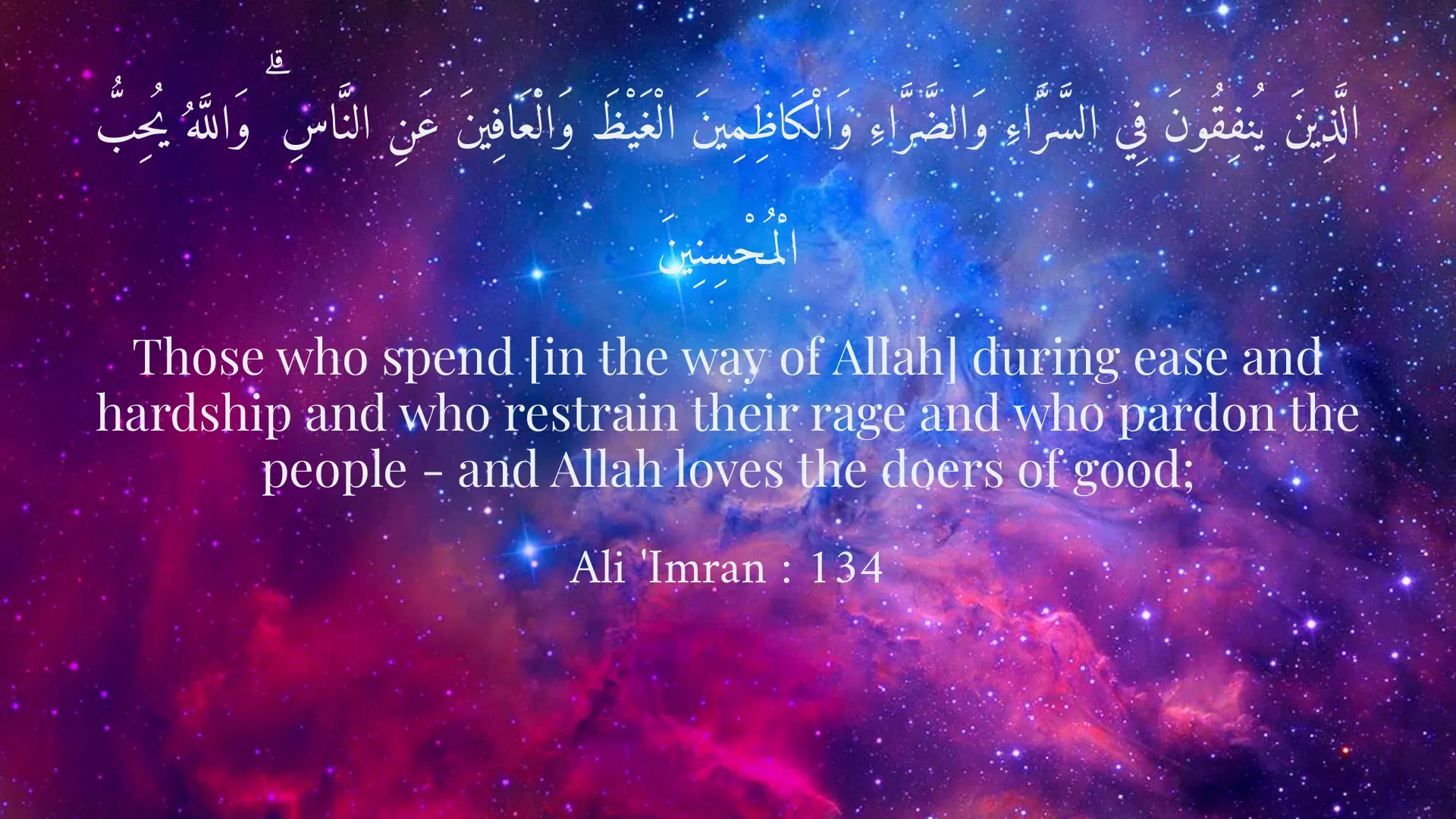
الَّذِينَ يُنفِقُونَ فِي السَّرَّاءِ وَالضَّرَّاءِ وَالْكَاظِمِينَ الْغَيْظَ وَالْعَافِينَ عَنِ النَّاسِ ۗ وَاللَّهُ يُحِبُّ الْمُحْسِنِينَ
Those who spend [in the way of Allah] during ease and hardship and who restrain their rage and who pardon the people - and Allah loves the doers of good;
Ali 'Imran : 134
وَالَّذِينَ يَجْتَنِبُونَ كَبَائِرَ الْإِثْمِ وَالْفَوَاحِشَ وَإِذَا مَا غَضِبُوا هُمْ يَغْفِرُونَ
And those who avoid the major sins and immoralities, and when they are angered, they forgive;
Ash-Shura : 37
وَلَا تَسْتَوِي الْحَسَنَةُ وَلَا السَّيِّئَةُ ۚ ادْفَعْ بِالَّتِي هِيَ أَحْسَنُ فَإِذَا الَّذِي بَيْنَكَ وَبَيْنَهُ عَدَاوَةٌ كَأَنَّهُ وَلِيٌّ حَمِيمٌ
And not equal are the good deed and the bad deed. Repel [evil] by that which is better; then abruptly the one whom between you and him is enmity will become as though he was a devoted friend.
Fussilat : 34
Short Story
In Saadi's Golestan, it is narrated that a king had a servant whom he dearly loved. One day, the servant dropped and broke a valuable vessel. The king was inflamed with anger and intended to punish him. The shrewd servant cleverly said, "O King, know that anger is like fire; it first consumes its owner. If your anger consumes me, it is as if you have set fire to your own garden." Upon hearing this, the king pondered for a moment and suppressed his anger. He thought to himself, "It is true, undue anger disturbs my peace more than it harms another and keeps me away from wisdom." So, he forgave the servant and learned a great lesson from this experience: that controlling anger is a sign of greatness and wisdom, and it is a treasure that brings peace.