Quranic Answer
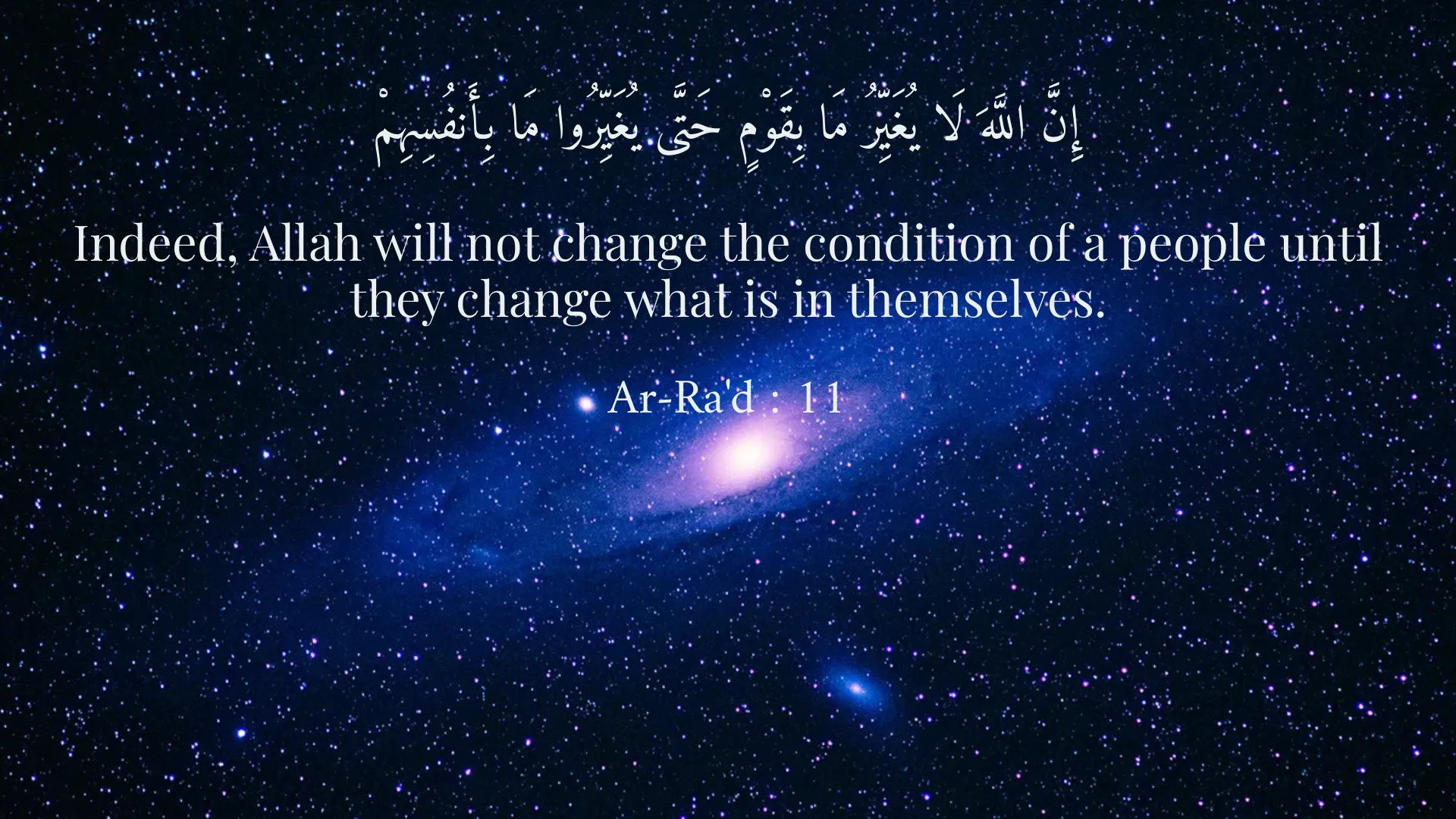
Changing the course of one's life is a profound subject that transcends mere personal experience; it engages with the core of our beliefs, values, and aspirations. Many social, psychological, and spiritual dimensions revolve around the concept of change. Contrary to the belief that altering one's life path might be viewed negatively or as a sign of weakness, the truth is that initiating change can be an act of profound virtue and courage. This is especially true in the light of various religious teachings that promote growth, improvement, and redemption. The Holy Quran, in particular, is rich with verses that admonish believers to strive for betterment, thus framing change as a vital process of spiritual and personal development. To begin, the essence of why and how change can be virtuous is beautifully encapsulated in Surah Ar-Ra'd (The Thunder), verse 11, where Allah states, 'Indeed, Allah will not change the condition of a people until they change what is in themselves.' This profound statement serves as a reminder that external changes in circumstances, communities, or nations often stem from internal transformations. It underscores a fundamental truth: real change must begin within. This serves as a powerful motivational force for individuals facing struggles, suggesting that empowerment lies in personal responsibility and the pursuit of righteousness. The notion of self-improvement is inherently linked to the concept of repentance. In Islam, the act of turning away from sin and seeking forgiveness is central to personal growth. Acknowledging one's mistakes is not merely a confession but a crucial step toward fostering a renewed spirit and purpose. In Surah Al-Fajr (The Dawn), verses 27 to 31, Allah provides vivid illustrations of how individuals can access a more fulfilling life through sincere repentance. These verses act as a call to action, demonstrating that the capacity for change is available to everyone, regardless of their past decisions. Moreover, they emphasize that such a journey toward righteousness is commendable. The Quran does not merely affirm change; it celebrates it, encouraging believers to discard harmful behaviors and to seek out actions which foster both personal and communal improvement. Therefore, when one is inherently inclined to change toward goodness—engaging in acts of service to others, seeking knowledge, and striving for moral integrity—these actions are celebrated as virtuous. In this context, change becomes not a sin or an error, but a noble pursuit. The implications of these teachings extend beyond just individual relationships to encompass broader social change. When individuals strive for self-improvement, their transformations can ripple outward, influencing families, communities, and societies at large. Through self-reflection and prayer, believers can become agents of change who uplift those around them, thus creating a cycle of positivity and improvement that echoes within the society. This societal ripple effect is essential, as communities thrive when their members work collaboratively toward shared goals of virtue and integrity. Additionally, embarking on a journey of change requires steadfast determination and consistent effort. The Quran reminds us that intention is pivotal. The power of sincere intention cannot be overstated; when individuals determine to make a change, they must pair their intentions with action. Change is not passive— it demands active participation and engagement. Anyone who has endeavored to alter habits or alter their course of life understands that this is often fraught with challenges and setbacks. However, acknowledging these difficulties does not render the effort futile; rather, it highlights the necessity for resilience and perseverance. People often experience fear of judgment from others when seeking to change their lives. This is a natural human fear, but it should not deter one from pursuing growth. The Quran assures us that personal growth is a journey meant for every believer. Rather than yielding to societal pressures or doubts, individuals should embrace their path and recognize that the pursuit of goodness, even if it is unconventional or met with criticism, is ultimately a noble endeavor. Obliteration of former selves, formed by poor choices, is possible and often accompanied by the blossoming of new virtues, aspirations, and potentials. Furthermore, in our contemporary world, where the past weighs heavily on individuals, and the temptations of modern life often lead to moral disarray, it is essential to understand that everyone, regardless of their background, has the opportunity to rewrite their narrative. The Quran's guidance reinforces that regardless of one's past mistakes, they can still aim for improvement through repentance, sincere intention, and righteous action. By fostering a culture of forgiveness—not only for others, but also for oneself—we take the most significant steps toward growth. Learning to forgive ourselves for past missteps liberates individuals from the shackles of guilt and allows them to engage fully with the present and the future. In conclusion, the transformative power of change is not only a potential reality; it is an imperative that resonates deeply within the teachings of the Holy Quran. Shifting the course of one’s life should not be viewed through a lens of sin or disgrace. Instead, if such changes evoke goodness, serve others, and reflect a departure from sin, then they are, indeed, commendable acts of virtue. Ultimately, change is a dynamic process filled with challenges and rewards, and through determination, prayer, and sincere effort, anyone can embark on a journey toward self-improvement that not only honors their spirit but also contributes to the collective betterment of society. Just as the Quran teaches, we must heed the call for change, remembering that each dawn brings new opportunities for redemption and growth.
Related Verses
إِنَّ اللَّهَ لَا يُغَيِّرُ مَا بِقَوْمٍ حَتَّى يُغَيِّرُوا مَا بِأَنفُسِهِمْ
Indeed, Allah will not change the condition of a people until they change what is in themselves.
Ar-Ra'd : 11
يَا أَيَّتُهَا النَّفْسُ الْمُطْمَئِنَّةُ
O tranquil soul,
Al-Fajr : 27
إِرْجِعِي إِلَى رَبِّكِ رَاضِيَةً مَّرْضِيَّةً
Return to your Lord, well-pleased and pleasing to Him.
Al-Fajr : 28
Short Story
One day, Adel came across a beautiful tree on his way home. He thought that he had never paid attention to this tree before. The tree reminded him that it’s never too late to change. He decided to change the course of his life and focus more on his education. He spent days working and helping people with their needs. This new feeling brought him deep satisfaction and happiness.