Quranic Answer
The question of whether depression is a sign of weak faith is a nuanced one that requires careful consideration of both Islamic teachings and modern understanding of mental health. The Holy Quran, while not using the specific medical term "depression," addresses various human emotions, including profound sorrow, grief, anxiety, and distress. It acknowledges that human beings will inevitably face trials, losses, and hardships throughout their lives. Therefore, experiencing sadness, grief, or even prolonged periods of distress is recognized as a natural part of the human condition and is not, in itself, presented as an indicator of deficient faith. The Quran recounts numerous instances where prophets, who are exemplars of profound faith, experienced deep sorrow and anguish. A prominent example is Prophet Yaqub (Jacob), who grieved so intensely over the presumed loss of his beloved son Yusuf (Joseph) that he lost his eyesight (Surah Yusuf, 12:84). Yet, throughout his suffering, he maintained his trust in Allah's plan, saying, "I only complain of my suffering and my grief to Allah, and I know from Allah that which you do not know" (Surah Yusuf, 12:86). His immense grief was a natural human response to an unimaginable loss, not a sign of weak faith, but rather a demonstration of profound patience and reliance on divine wisdom even in the darkest of times. Similarly, Prophet Muhammad (peace be upon him) faced immense personal tragedies, including the loss of his beloved wife Khadijah and his uncle Abu Talib in the "Year of Sorrow," as well as severe persecution and personal attacks. He undoubtedly experienced deep sadness, yet his faith remained unwavering, serving as a beacon of resilience for all believers. These examples clearly illustrate that feeling sorrow or distress is part of the human experience, even for those with the strongest faith. It is crucial to distinguish between natural human emotions of sadness, grief, or temporary despondency, and what the Quran strongly discourages: despair (qanūṭ) from Allah's mercy. Despair implies a complete loss of hope in Allah's ability or willingness to relieve one's suffering, or a denial of His infinite mercy. This state, if unchecked, could indicate a fundamental misunderstanding or weakness in one's perception of Allah's attributes. However, clinical depression, as understood today, is a complex medical condition often involving chemical imbalances in the brain, genetic predispositions, environmental stressors, and trauma. It is not simply a matter of choosing to be sad or happy. A person suffering from clinical depression may experience profound hopelessness despite genuinely wanting to feel better and actively trying to connect with their faith. The Quran offers profound guidance for navigating hardship and emotional distress. It repeatedly calls upon believers to seek help through patience (صبر) and prayer (صلاة). In Surah Al-Baqarah, Allah says, "O you who have believed, seek help through patience and prayer. Indeed, Allah is with the patient" (2:153). Patience is not passive resignation but an active perseverance, a steadfastness in faith even when faced with adversity. Prayer provides solace, a direct connection to the Almighty, and a means to unburden one's heart. Remembrance of Allah (ذكر الله) is also emphasized as a source of tranquility: "Unquestionably, by the remembrance of Allah hearts are assured" (Surah Ar-Ra'd, 13:28). These practices are vital tools for spiritual resilience, helping to anchor the soul during turbulent times. They empower the individual to endure, to seek solace, and to maintain hope. Furthermore, the Quran teaches that life is a test, and trials are inevitable. "And We will surely test you with something of fear and hunger and a loss of wealth and lives and fruits, but give good tidings to the patient, Who, when disaster strikes them, say, 'Indeed we belong to Allah, and indeed to Him we will return.' Those are the ones upon whom are blessings from their Lord and mercy. And it is those who are the [rightly] guided" (Surah Al-Baqarah, 2:155-157). Experiencing these tests, including emotional distress, is part of Allah's divine plan to purify, strengthen, and elevate the believer. The response to these tests—maintaining patience, reliance on Allah, and seeking His help—is what truly reflects the strength of one's faith, not the mere presence of the trial itself. Therefore, it is inaccurate and potentially harmful to label depression as solely a sign of weak faith. Such a perspective can lead to stigma, shame, and prevent individuals from seeking necessary help, both spiritual and professional. Instead, a strong faith can be an invaluable asset in managing depression. It provides a framework of meaning, purpose, and hope. It encourages reliance on Allah, seeking His mercy and guidance, and believing that even in suffering, there is wisdom and potential for spiritual growth. A believer facing depression should utilize all permissible means of healing: prayer, supplication (dua), seeking spiritual guidance, engaging in acts of worship, and simultaneously seeking professional medical and psychological support. Just as one would seek a doctor for a physical ailment, one should seek professional help for a mental health condition. Islam encourages seeking knowledge and using the resources available to us for well-being. The Prophet Muhammad (PBUH) himself encouraged seeking treatment, stating, "For every disease there is a cure, and if the cure is applied to the disease, it is cured by the permission of Allah Almighty." This applies to both physical and mental ailments. In conclusion, depression is a complex human condition that affects individuals regardless of their level of faith. While faith can serve as an immense source of strength, resilience, and hope during difficult times, the presence of depressive symptoms does not automatically signify a deficiency in one's belief. Rather, a true test of faith often lies in how one navigates these challenges – with patience, perseverance, reliance on Allah, and active engagement in seeking appropriate remedies, both spiritual and worldly. The Quran teaches us to turn to Allah in all states, and to never despair of His mercy, while also acknowledging the realities of human suffering and encouraging us to strive for well-being.
Related Verses
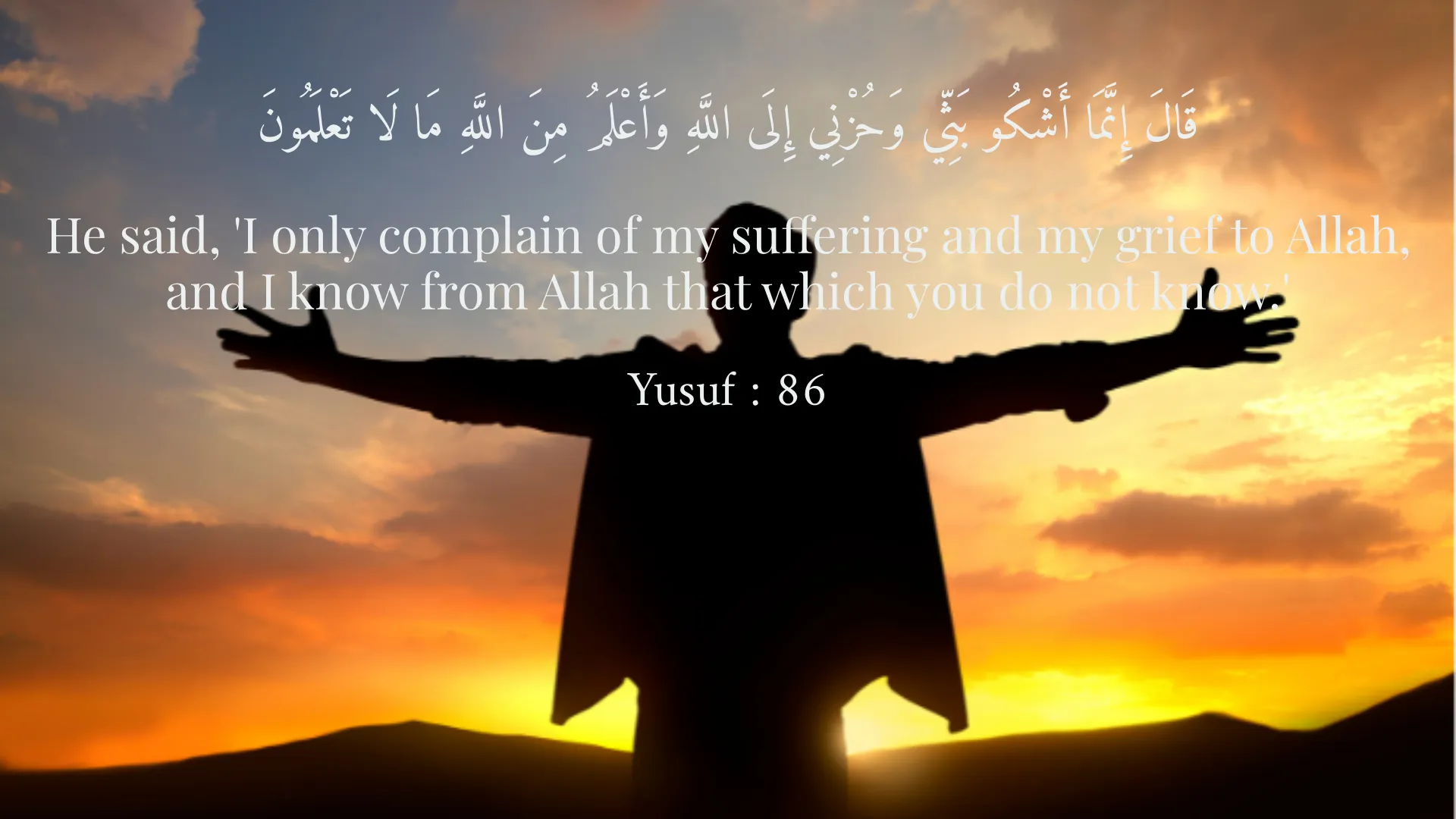
قَالَ إِنَّمَا أَشْكُو بَثِّي وَحُزْنِي إِلَى اللَّهِ وَأَعْلَمُ مِنَ اللَّهِ مَا لَا تَعْلَمُونَ
He said, 'I only complain of my suffering and my grief to Allah, and I know from Allah that which you do not know.'
Yusuf : 86
يَا أَيُّهَا الَّذِينَ آمَنُوا اسْتَعِينُوا بِالصَّبْرِ وَالصَّلَاةِ ۚ إِنَّ اللَّهَ مَعَ الصَّابِرِينَ
O you who have believed, seek help through patience and prayer. Indeed, Allah is with the patient.
Al-Baqarah : 153
وَلَنَبْلُوَنَّكُم بِشَيْءٍ مِّنَ الْخَوْفِ وَالْجُوعِ وَنَقْصٍ مِّنَ الْأَمْوَالِ وَالْأَنفُسِ وَالثَّمَرَاتِ ۗ وَبَشِّرِ الصَّابِرِينَ
And We will surely test you with something of fear and hunger and a loss of wealth and lives and fruits, but give good tidings to the patient.
Al-Baqarah : 155
الَّذِينَ آمَنُوا وَتَطْمَئِنُّ قُلُوبُهُم بِذِكْرِ اللَّهِ ۗ أَلَا بِذِكْرِ اللَّهِ تَطْمَئِنُّ الْقُلُوبُ
Those who have believed and whose hearts are assured by the remembrance of Allah. Unquestionably, by the remembrance of Allah hearts are assured.
Ar-Ra'd : 28
قُلْ يَا عِبَادِيَ الَّذِينَ أَسْرَفُوا عَلَى أَنفُسِهِمْ لَا تَقْنَطُوا مِن رَّحْمَةِ اللَّهِ ۚ إِنَّ اللَّهَ يَغْفِرُ الذُّنُوبَ جَمِيعًا ۚ إِنَّهُ هُوَ الْغَفُورُ الرَّحِيمُ
Say, 'O My servants who have transgressed against themselves [by sinning], do not despair of the mercy of Allah. Indeed, Allah forgives all sins. Indeed, it is He who is the Forgiving, the Merciful.'
Az-Zumar : 53
Short Story
It is recounted that a certain dervish, renowned for his profound piety and contentment, once fell gravely ill and lost all his worldly possessions. His friends, seeing him in such a dire state, came to visit, expressing their sorrow. One friend, pitying him deeply, said, 'Alas, my dear brother, how has fate dealt you such a cruel hand? You who were so vibrant, now lie weak and deprived.' The dervish, though frail, smiled faintly and replied, 'Do not lament for me, for indeed, my spirit has never been stronger. When I possessed riches, my heart was often distracted by their management. Now, being stripped bare, my heart is utterly free, conversing solely with my Creator. This body, though it suffers, is but a temporary vessel. My soul, however, soars towards its beloved. My trust in the Divine decree has deepened, and in this newfound emptiness, I have discovered a fullness of peace that no worldly possession could ever bestow. For true contentment lies not in what one gathers, but in how one’s heart is bound to the Giver of all blessings.' Thus, the dervish, even in his utmost suffering, exemplified that inner peace and connection with the Divine are independent of external circumstances, and indeed, hardship can refine one's faith and bring about a deeper understanding of true spiritual wealth.