Quranic Answer
Yes, the Holy Quran extensively and profoundly addresses the subject of economic justice, considering it an integral part of a healthy and faith-driven society. Quranic teachings are not merely limited to individual worship and ethics; they provide robust frameworks for social and economic relations, with a special emphasis on the equitable distribution of wealth and preventing its concentration in the hands of a few. The primary goal of the Quran in outlining these principles is to establish a society where poverty is minimized, the basic needs of all individuals are met, and equal opportunities for growth and progress are provided. One of the most central principles of economic justice in the Quran is the concept of 'Adl' (justice) and 'Qist' (equity). Allah commands the establishment of justice and equity in numerous verses. This justice must prevail not only in judgments and transactions but also in all dimensions of economic life. The Quran considers wealth and possessions as a trust from Allah, and humans as its trustees. Therefore, wealth should not be used solely for personal pleasure or further accumulation but must be circulated in the way of Allah and to meet the needs of society. Verse 7 of Surah Al-Hashr clearly states that war spoils (and by extension, all wealth) should be distributed in a way that it “does not become a perpetual [distribution] among the rich among you.” This verse establishes a general principle for preventing wealth concentration and encouraging its equitable distribution in society. To realize this economic justice, the Quran also introduces practical and institutional mechanisms. 'Zakat' and 'Sadaqat' (charity) are among the most important of these mechanisms. Zakat is not only a financial act of worship but also a fundamental pillar in the Islamic economic system for wealth redistribution. Through Zakat, a portion of the rich's assets is annually paid to the poor, needy, the destitute, debtors, travelers, and others. This ensures that wealth circulates within the community and reduces class disparities. The Quran repeatedly mentions the importance of Zakat alongside prayer, highlighting its central role in the religion. Verse 19 of Surah Adh-Dhariyat states: “And in their properties was a share for the beggar and the deprived.” This verse clearly emphasizes the right of the poor and needy to a share in the wealth of the affluent, considering this right a religious and moral obligation, not merely an optional act of charity. In addition to Zakat, the Quran strongly condemns and prohibits 'Riba' (interest/usury). The prohibition of Riba, explicitly mentioned in verses such as 2:275 of Surah Al-Baqarah, is another cornerstone of economic justice in Islam. Riba leads to an unchecked increase in the wealth of the rich and greater poverty for the poor, disrupting the natural flow of the economy. The Quran considers Riba as a war against Allah and His Messenger and, instead, encourages lawful trade and 'Qardh al-Hasan' (interest-free loans). This approach aims to create an economy based on partnership, genuine risk-sharing, and mutual assistance, rather than exploitation and mere profiteering. Furthermore, the Quran emphasizes the importance of 'Infaq' (spending in the way of Allah) and forbids 'Ihtikar' (hoarding goods to inflate prices) and 'Tabdhir' (extravagance/wastefulness). Infaq includes any voluntary financial assistance to those in need, and individuals are encouraged to give from what Allah has provided them, regardless of their financial capacity. Conversely, hoarding and extravagance are severely condemned because they disrupt markets, waste resources, and create inequality. Inheritance laws are also detailed in the Quran to prevent the accumulation of wealth within one generation and to facilitate its distribution among heirs. In summary, the Quran's perspective on economic justice is comprehensive and pragmatic, aiming to create a balanced, stable, and cohesive society. These teachings not only emphasize individual responsibilities but also provide a framework for economic policies that can lead to poverty reduction, more equitable wealth distribution, and equal opportunities for all. This economic justice in the Quran is rooted in the belief that all humans are equal before Allah, and no one should be deprived of their basic rights due to their economic status. Therefore, the Islamic economic system is built upon cooperation, solidarity, and social responsibility so that every individual can live with dignity and contribute to the development of their community. These principles are not only relevant for the time of the Quran's revelation but are also guiding and illuminating for every era and every society, capable of inspiring just economic systems in the contemporary world.
Related Verses
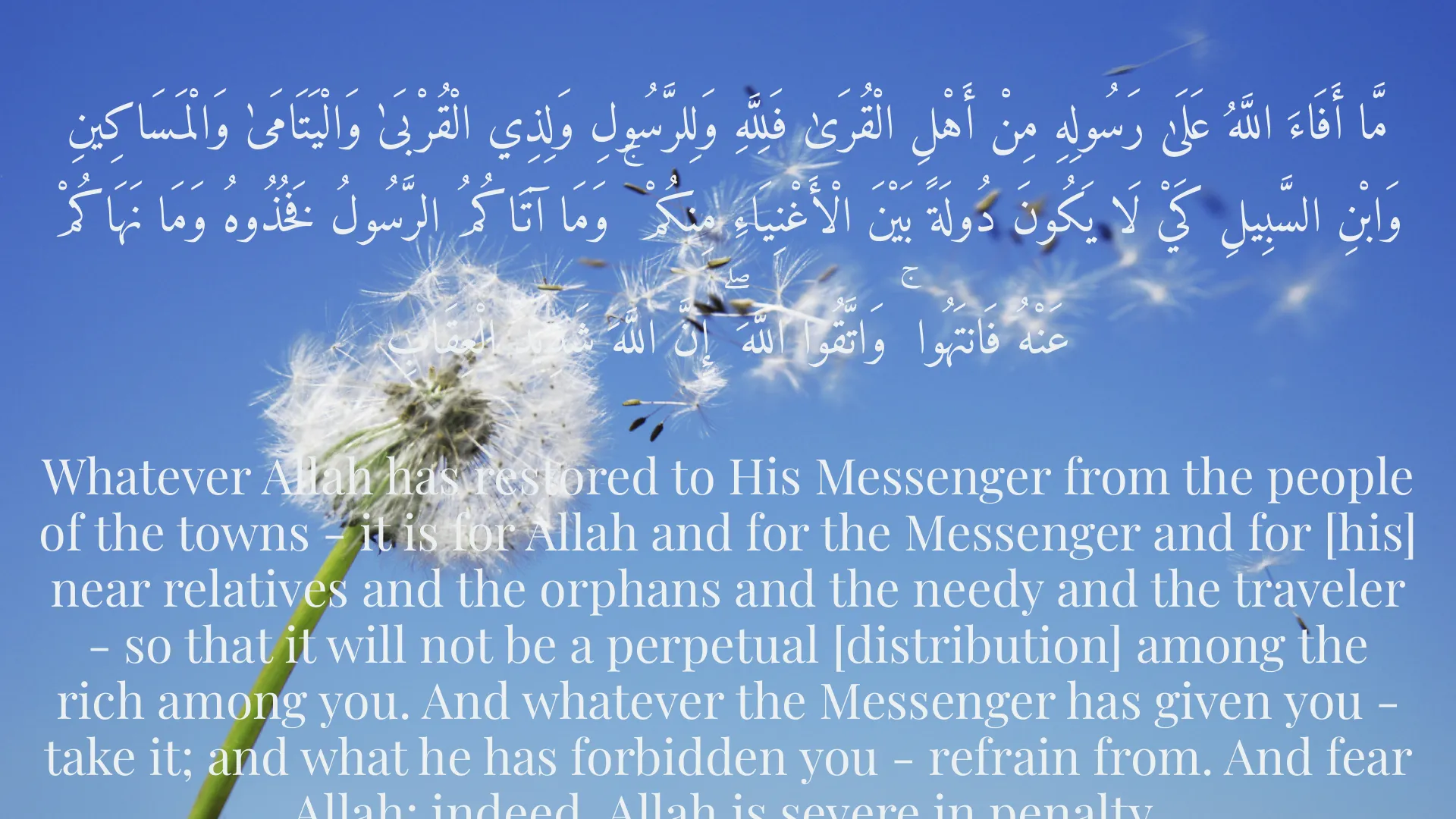
مَّا أَفَاءَ اللَّهُ عَلَىٰ رَسُولِهِ مِنْ أَهْلِ الْقُرَىٰ فَلِلَّهِ وَلِلرَّسُولِ وَلِذِي الْقُرْبَىٰ وَالْيَتَامَىٰ وَالْمَسَاكِينِ وَابْنِ السَّبِيلِ كَيْ لَا يَكُونَ دُولَةً بَيْنَ الْأَغْنِيَاءِ مِنكُمْ ۚ وَمَا آتَاكُمُ الرَّسُولُ فَخُذُوهُ وَمَا نَهَاكُمْ عَنْهُ فَانتَهُوا ۚ وَاتَّقُوا اللَّهَ ۖ إِنَّ اللَّهَ شَدِيدُ الْعِقَابِ
Whatever Allah has restored to His Messenger from the people of the towns - it is for Allah and for the Messenger and for [his] near relatives and the orphans and the needy and the traveler - so that it will not be a perpetual [distribution] among the rich among you. And whatever the Messenger has given you - take it; and what he has forbidden you - refrain from. And fear Allah; indeed, Allah is severe in penalty.
Al-Hashr : 7
إِنَّ اللَّهَ يَأْمُرُ بِالْعَدْلِ وَالْإِحْسَانِ وَإِيتَاءِ ذِي الْقُرْبَىٰ وَيَنْهَىٰ عَنِ الْفَحْشَاءِ وَالْمُنكَرِ وَالْبَغْيِ ۚ يَعِظُكُمْ لَعَلَّكُمْ تَذَكَّرُونَ
Indeed, Allah orders justice and good conduct and giving to relatives and forbids immorality and bad conduct and oppression. He admonishes you that perhaps you will be reminded.
An-Nahl : 90
وَفِي أَمْوَالِهِمْ حَقٌّ لِلسَّائِلِ وَالْمَحْرُومِ
And in their properties was a share for the beggar and the deprived.
Adh-Dhariyat : 19
Short Story
It is narrated that in a certain city, there lived a merchant who possessed great wealth, yet he turned away from giving to the poor, believing that riches were accumulated solely for oneself. He had a neighbor, a simple farmer who sought lawful sustenance, and whenever his hand reached for good, he would unhesitatingly give a portion of it to those in need. One day, the merchant complained of poverty and said, "My wealth is gone, and blessing has departed from it." The farmer, with a sweet smile, said, "My friend, when you let water flow in a stream, it goes everywhere and irrigates the crops; but if you keep it in a reservoir, it becomes stagnant and salty. Wealth is likewise; when it flows in the way of God and His servants, it gains blessing and grows, but if it is held back in the chest, it not only lacks blessing but also perishes." The merchant took heed of this advice and, by acting upon it, found ease in his affairs and peace in his heart.